
Quick answer: Safety comes first, so make sure your care team has given you written instructions for treating lows, checking ketones, handling sick days, and knowing who to call. After that, treat your early glucose curves as observations, not results you are being marked on. The most useful thing you can do in your first weeks is log meals with enough context that you and your care team can look back at them together.
A Type 1 diabetes diagnosis often arrives fast. There may have been weeks of exhaustion, thirst and unexplained weight loss beforehand, but the diagnosis itself tends to land in a single afternoon, through a blood test or an emergency visit. Your immune system has damaged the cells in your pancreas that make insulin, and what your body still produces has stopped being enough.
What follows is a great deal of information at once, most of it in the same week: new devices, new vocabulary, new appointments, and a screen full of glucose data that nobody has yet taught you to read.
The ADA and the CDC already explain what Type 1 diabetes is, and they do it well, so this guide covers something narrower that most overviews skip. What do you actually do with the first meals you eat and the first curves you see?
Start with the safety plan your care team gives you
Before any of the meal learning, you need a plan for when something goes wrong, and this is the one part of your first month to work out with a clinician.
Your care team should give you clear written instructions for each of the following. If any are missing, raise it at your next appointment, or call sooner if it feels urgent.
- How to recognise and treat low blood sugar, including what to keep with you at all times
- When and how glucagon is used, and who around you knows where it is
- How and when to check for ketones, and the warning signs of diabetic ketoacidosis
- What to do on sick days, or when you cannot eat or keep food down
- What to do if your CGM, pump, or insulin supply fails
- Which situations mean call now, and which can wait
The ADA's 2026 Standards of Care put structured hypoglycemia education and glucagon access at the centre of care for anyone taking insulin, alongside education on recognising and preventing hyperglycemic crises. Asking for all of this is simply asking for standard care.
Who is on your care team
Most people do better with support spread across a few different people, so that one doctor is not carrying everything.
- An endocrinologist who manages your treatment plan and adjusts it over time
- A registered dietitian who works with carbohydrate estimation and meal planning
- A diabetes care and education specialist, often called a diabetes educator, for practical day to day skills
- A mental health professional with experience in chronic illness, if you want that support
Full teams take time to assemble, and yours may come together over months. Even one or two of these connections early on changes how quickly you find your feet.
One boundary, stated plainly
Follow the insulin plan your care team gives you. Nothing in this article, and nothing in SNAQ, should be used to calculate or change insulin doses. That belongs to your clinician, and it stays there.
Your glucose curve is information, not a grade
This is worth building early, because it becomes much harder to install once you have spent a few months reading your data the other way.
When you eat and then watch the line climb, the obvious interpretation is that you are being marked on something: good meal or bad meal, did well or messed up. Almost everyone lands there first, and it is a reasonable place to land when the numbers arrive with that much apparent precision.
The trouble is that the same plate of food will produce a different curve on a different day, and the reason usually sits somewhere other than the food.
A post-meal curve is shaped by all of this at once:
- Where your glucose started before you ate
- How much insulin was already active
- How close your carbohydrate estimate was
- Fat and protein content, which can slow things down or push a rise later
- Whether you moved, sat still, or exercised afterwards
- Stress, illness, sleep, and hormones
- The timing of everything relative to the meal
- A honeymoon phase that may still be shifting week to week
- CGM lag, the short delay between a change in your blood glucose and the reading appearing on your phone
Take just one of those and follow it through. Stress leaves the plate exactly as it was, and still changes what the plate does.
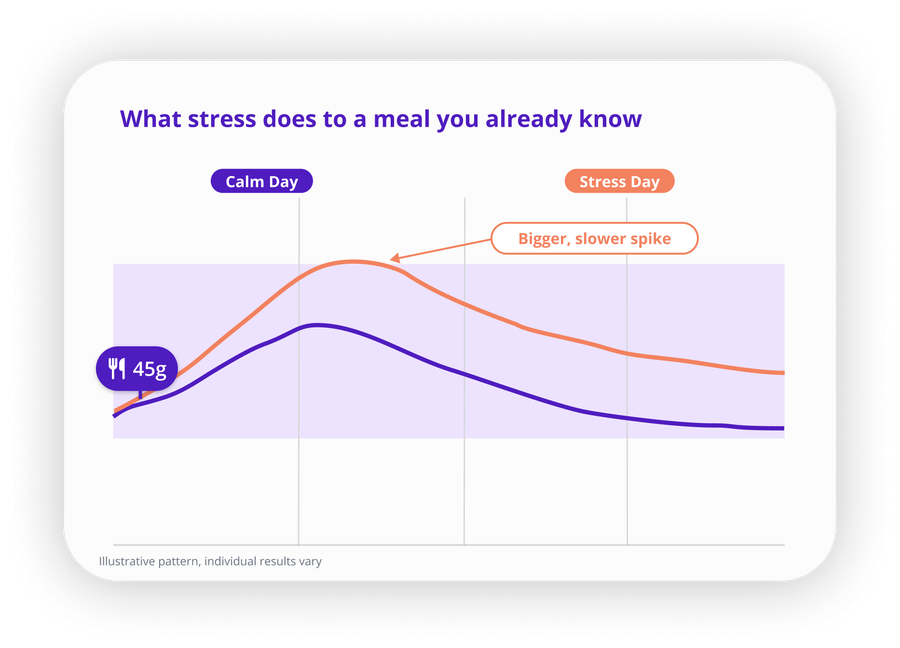
The same 45g meal on two different days. The food stayed the same.
Now stack the other eight variables on top of that one, and you can see why a single curve tells you so little in isolation. It is a lot of weight for one line on a screen to carry.
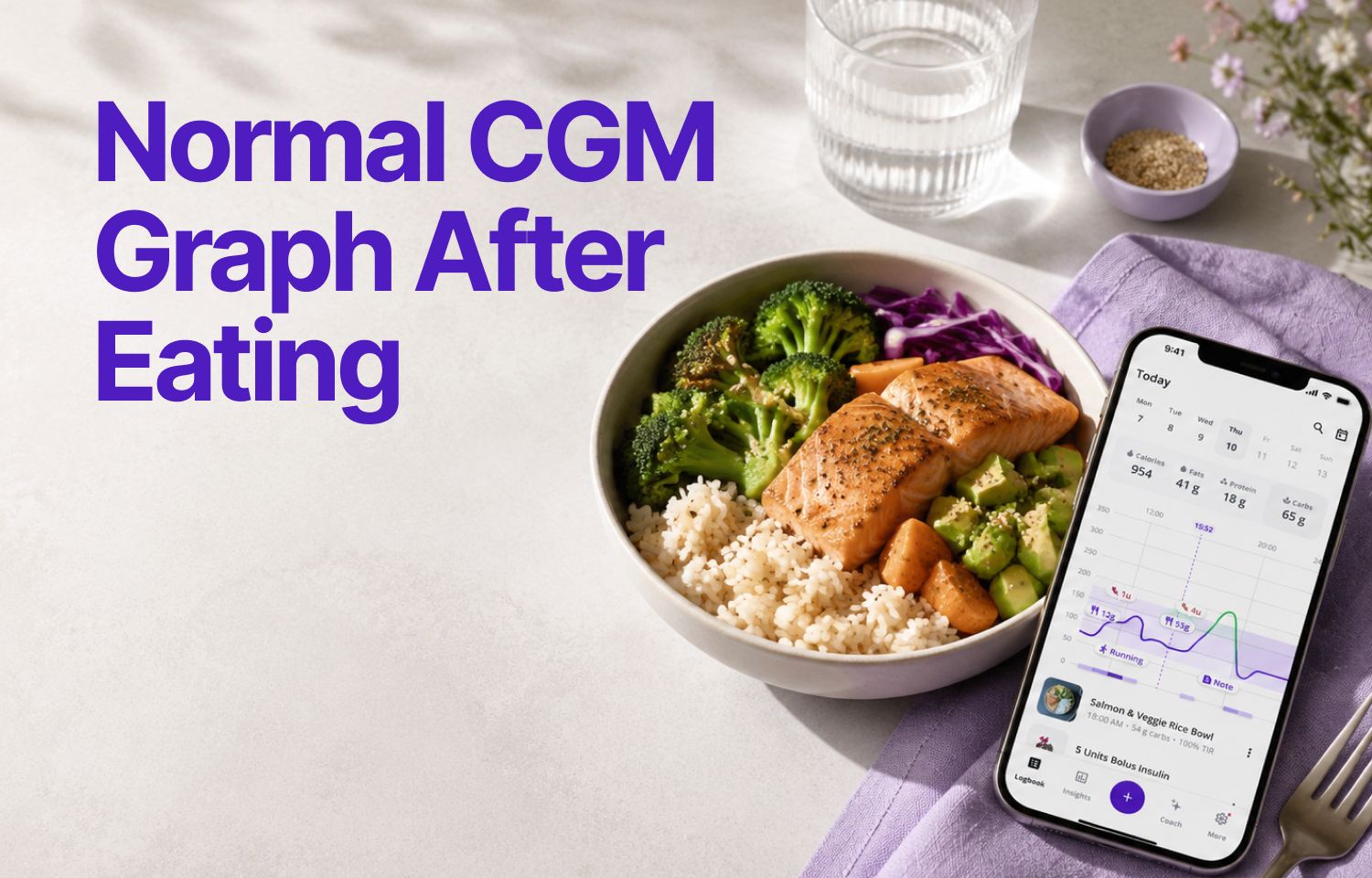
If you have never looked at a post-meal curve before, it helps to know what a common one usually looks like and which shapes turn up most often, less as a standard to hit than as a way of getting familiar with the terrain.
Which leads to a few working rules for your first few weeks:
- One rise tells you almost nothing about whether a food works for you.
- One flat curve guarantees nothing about next week.
- Repeated observations of the same meal beat a strong reaction to a single one.
- Decisions about treatment belong in a conversation with your care team.
There is research behind this, and it matters more than it might sound. In a study of 379 adults with diabetes wearing CGM, how in control people felt predicted their day to day diabetes distress, while their measured glucose variability did not. That finding is worth sitting with, particularly if you have already spent a week feeling like the screen is marking your homework.
You did not cause this, either. Type 1 diabetes is an autoimmune condition, and nothing you ate or failed to do brought it on. People react to that news very differently, and relief is as common as anything else, particularly after weeks of being unwell with no explanation. So are grief, anger, and a long stretch of feeling nothing much at all.
The first 30 meals: a way to learn without drowning
Thirty meals here means the first thirty you deliberately log, not the first thirty you eat. Almost nobody logs everything and you should not try, so in practice this tends to cover three or four weeks.
Splitting it into phases exists for one reason, which is that trying to learn everything from meal one is how people burn out by week two.
| Phase | What you do | What you are not doing yet |
|---|---|---|
| Meals 1 to 5 | Log what you ate, roughly how much, and when. Add a note for anything unusual, like a workout, poor sleep, or a low beforehand. | Drawing conclusions. Five meals is not a pattern. You are getting the habit working. |
| Meals 6 to 15 | Find meals you have eaten more than once. Put two occasions side by side and ask what was similar and what was different. | Sorting meals into good and bad. You are looking for repetition, not verdicts. |
| Meals 16 to 30 | Pick the two or three patterns that keep showing up. Summarise them and bring specific questions to your next appointment. | Changing anything on your own. Your clinician decides what happens with your treatment plan. |
Meals 1 to 5: capture, do not optimise
Follow the plan your care team gave you and change nothing based on what you see.
Your only job at this stage is getting the habit working: what you ate, roughly how much, and when, plus a note for anything out of the ordinary such as a workout, a bad night's sleep, a low beforehand, or a morning that went sideways.
Five meals will not show you a pattern, and they are not meant to. You are collecting raw material.
If logging already feels like too much, track the minimum that still tells you something, because a short log you keep will always beat a detailed one you abandon in week two.
Meals 6 to 15: repeat and compare
Now start looking for meals you have eaten more than once, and put two occasions of the same meal side by side.
What was similar, and what was different? Did you eat at a different time of day, move afterwards, or start from a different place? These are the questions that build the comparison habit, and the habit matters more here than any individual answer.
The urge to sort meals into wins and losses will show up in this phase too. Try to let it pass, because what you are actually hunting for is repetition.
Meals 16 to 30: turn patterns into questions
By now two or three things will keep surfacing, and those are the ones to take to your appointment.
Summarise or export them, and frame them as specific questions instead of a general sense that something is off. "This meal has produced a delayed rise three times now, what should we look at?" gives your clinician something to work with, in a way that "I think my numbers are bad" cannot.
Your clinician decides what changes. Your job is arriving with a clear picture.
Three meals worth learning from
The packaged breakfast with a label
Start here, because the carbohydrate number is printed on the box, which takes one large variable off the table.
Log the product, the portion you actually ate, and the time. With the estimate mostly settled, any differences between days point somewhere else: sleep, morning hormones, or whatever you did in the hour afterwards. Mornings often behave differently from the rest of the day, and breakfast is the usual culprit.
There is one thing the box will not tell you, which is that a label describes the food and not what the food does in you.
The restaurant plate you cannot weigh
Mixed dishes, hidden oils, and a portion size somebody else decided on. This is where estimation gets genuinely hard, and research on carbohydrate counting has found that larger meals get underestimated far more often than small ones, frequently by a wide margin. Before you blame yourself for a surprising result, it is worth knowing that this is a measured, well-documented problem that experienced people run into too.
Log a photo, what you think was in it, and how confident you feel about that guess. The confidence note is more useful than people expect, because it tells you later whether to trust the entry.
Results from restaurant meals will scatter more than results from your own kitchen, and that scatter describes the situation more than it describes eating out as a habit. Worth asking your team how to approach meals where the carbohydrate content stays genuinely unknowable, since the reasons restaurant estimates go wrong turn out to be surprisingly predictable once you know them.
The high-fat dinner that shows up late
Pizza, a curry with cream in it, a cheese-heavy pasta. This is the category that catches people out, and it does so in a very particular way.
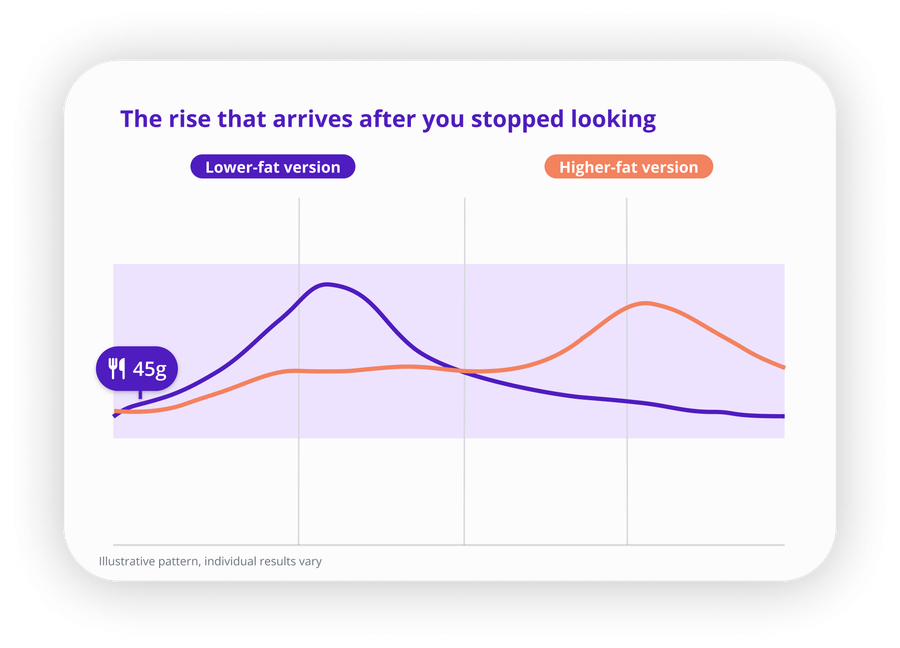
Same 45g of carbs, two versions of the same dish. The fat moved the rise later.
Fat and protein can slow the early rise and then push glucose up hours later, long after you have stopped watching. The ADA and EASD consensus on managing Type 1 diabetes in adults flags exactly this, noting that post-meal readings may be needed for three hours or more, and it is the main reason some meals peak in an hour while others take three or four.
So log the meal, the time, and a reminder to look again later that evening. If you check at two hours and see a calm number, a rich dinner can look as though nothing happened at all, which is exactly the moment people stop paying attention.
How to handle that pattern is a real question with real answers, and it belongs in a conversation with your care team rather than in a blog post.
Why the same meal can change on you
A few weeks in, a meal you thought you had pinned down may start behaving like a stranger, and the honeymoon phase is often what is behind it.
After diagnosis, some of the insulin-producing cells in your pancreas keep working, and that leftover production can make glucose easier to manage for a while. It also means your insulin needs at week three may look quite different from your insulin needs at month six. The ADA describes a honeymoon period as lasting anywhere from about a week up to a year, usually beginning after you start taking insulin, while Breakthrough T1D puts the typical range at several months, sometimes stretching to one or two years. Plenty of people never have one at all, and for those who do, it always ends.
You will see "three to six months" repeated online, which is tidier than the evidence supports.
What this means for your logging is fairly simple: familiar meals producing unfamiliar results is a thing to flag with your care team, and it is also the best argument for keeping your early logs, since they give your clinician a before and after to compare.
What to bring to your next appointment
A shoebox of raw data helps nobody, whereas five specific things can change what comes out of a fifteen-minute appointment.
Bring these five things to your next appointment
More useful than a month of raw data. Print this or keep it on your phone.
- Two meals that produced a repeated pattern The same meal eaten more than once, with what you noticed each time.
- One meal you find genuinely hard to estimate Usually a restaurant plate or a mixed dish. Bring the photo if you have one.
- Any lows, and any highs that keep coming back Note roughly when they happened and what was going on around them.
- A list of moments you felt unsure what to do These are often more useful than the data. Write them down as they happen.
- Your open questions about kit and emergencies CGM, glucagon, ketone testing, sick days, and what to do if a device fails.
Where SNAQ fits
A meal log earns its keep by capturing enough context to be worth revisiting, and by staying light enough that you actually keep doing it.
That is what SNAQ is built for. You photograph or describe a meal, check the nutrition estimate and adjust it, then save it, and if you connect a compatible glucose source the meal sits alongside your glucose data, so Thursday's question about Tuesday's dinner has an answer. Meals you eat regularly can be saved and reused, which is usually the difference between a log that survives to week four and one that quietly dies.
That is the whole role it plays in the method above: capture, compare, and arrive at your appointment with something concrete.
We have run peer-reviewed accuracy research and a randomised controlled trial published in eClinicalMedicine, and you can read the studies yourself. One caveat is worth stating up front, which is that those studies looked at adults who had been living with Type 1 for a while, so read them as evidence about the tool and not a forecast for your own numbers.
There is more on how SNAQ handles Type 1 specifically, including which CGMs and meters it connects with.
SNAQ provides nutrition and pattern context for your own review. It is not an insulin dose calculator, and treatment changes are decisions for your healthcare team.
Availability note: SNAQ's diabetes application is currently limited to people living in the United States.
Related reading
Reading your curves
- Return to baseline vs peak: which part of your curve matters more?
- Blood sugar drops after eating: why your CGM may show a post-meal dip
- A comprehensive guide to glucose metrics: understanding GMI, TIR and A1c
Estimating carbs
- Why carb estimates fail: 7 real-world scenarios
- Rice, oats, potatoes, bread: why common carbs don't always behave the same
- The best carb counting apps for diabetes (2026)
When the numbers surprise you