Quick answer: The dawn phenomenon is an early morning rise in blood glucose caused by a surge of hormones, not food. It happens between roughly 4 and 8 a.m. and affects more than half of people with type 1 or type 2 diabetes. A CGM can help you confirm the pattern and separate it from other causes of high morning glucose.
You went to bed at 120 mg/dL. You didn't eat anything. You slept fine. But when you wake up, your CGM reads 160 mg/dL.
This is the dawn phenomenon, and it happens to a lot of people with diabetes. It's one of the most common overnight glucose patterns, and it's driven by hormones, not food.
Here's what's happening, why it matters, and what you can do about it.
What the Dawn Phenomenon Actually Is
The dawn phenomenon is a natural rise in blood glucose that happens in the early morning, usually between 4 and 8 a.m. It's caused by a surge of hormones that tell your liver to release glucose into your bloodstream.
This process is normal. Your body is preparing to wake up. But in people with diabetes, insulin production or insulin sensitivity may not keep up with that glucose release, so blood sugar climbs.
Studies estimate it affects more than half of people with either type 1 or type 2 diabetes. The result: you wake up higher than you went to bed, even if you did everything right.
Why Your Liver Releases Glucose While You Sleep
Two hormones play the biggest role: cortisol and growth hormone, along with other counter-regulatory hormones like epinephrine.
Cortisol is released by your adrenal glands in the early morning. It signals your liver to make glucose, which gives your body energy to wake up. Growth hormone also increases overnight and reduces how well your cells respond to insulin.
Together, these hormones create a temporary state of insulin resistance in the early morning. For people without diabetes, the pancreas releases extra insulin to match the glucose release. For people with diabetes, that compensatory insulin response may not happen, or may not be strong enough.
The liver keeps releasing glucose. Blood sugar rises.
How CGM Helps You Spot the Pattern
One of the clearest ways to identify the dawn phenomenon is with continuous glucose monitoring. A CGM shows you what's happening while you sleep, so you can see whether your glucose is steady, rising, or dropping overnight.
The pattern has a recognizable shape on a CGM graph: a flat line through the early part of the night that begins sloping upward around 3 to 4 a.m., without any food or activity to explain it. The rise is usually gradual rather than sharp.
If your glucose is stable until around 4 a.m., then starts climbing without food or activity, that's the dawn phenomenon.
If your glucose rises earlier in the night, or spikes after a late snack, that's a different pattern. Understanding what different CGM curves mean can help you separate overnight food responses from hormone-driven glucose changes.
CGM data also makes it easier to talk with your care team. Instead of describing what you think is happening, you can show them the curve.
Other Factors That Can Look Like the Dawn Phenomenon
Not every morning glucose rise is the dawn phenomenon. A few other patterns can look similar.
Late dinner or evening snack. If you eat close to bedtime, especially a meal with fat or protein, glucose may peak hours later. That rise might show up in the early morning, but it's driven by digestion, not hormones.
Overnight lows triggering a rebound. If your glucose drops too low during the night, your body may release hormones like glucagon or adrenaline to bring it back up. This is sometimes called the Somogyi effect (pronounced so-MOH-gyee). The result can be high morning glucose, but the cause is different. The key distinction: if your CGM shows a dip before the rise, it's likely a rebound. If glucose was flat before it started climbing, it's more likely the dawn phenomenon.
Waning insulin. If you use basal insulin and your dose wears off before morning, glucose may rise as coverage drops. That's not the same as the dawn phenomenon, but the timing can overlap.
A CGM can help you tell these apart. Look at the full overnight curve, not just the morning number.
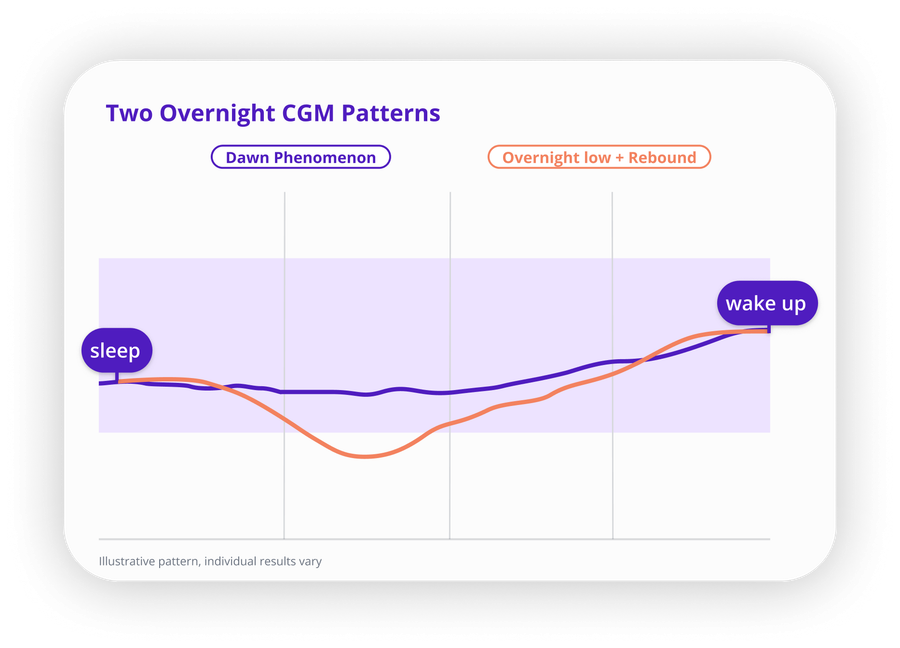
On a CGM graph, the dawn phenomenon shows as a gradual upward slope in the early morning. The overnight low and rebound pattern dips first, then rises sharply. Both can look similar at wake-up.
What You Can Do to Manage Morning Glucose
The dawn phenomenon is harder to control than post-meal glucose because it's not driven by food. But a few strategies may help reduce the morning rise.
Review your basal insulin timing or settings. If you use a pump or automated insulin delivery system, small adjustments to overnight basal rates may be worth discussing with your care team. If you use long-acting basal insulin, the timing of your injection can sometimes affect early morning coverage. This is something to work through with your doctor rather than adjust on your own.
Try eating dinner earlier. Late meals can add to the morning glucose rise, especially if they include slow-digesting carbs, fat, or protein. Moving dinner to an earlier window may reduce overlap between digestion and the dawn phenomenon.
Keep evening carbs moderate. Large carb loads at dinner or before bed can extend glucose elevation into the morning. Lower-carb evening meals may give you a flatter overnight curve. Some people find that choosing low glycemic index foods helps, but individual response varies.
Check for overnight lows. If your CGM shows a dip during the night followed by a morning spike, you may need to adjust your basal insulin or bedtime routine to avoid the low in the first place.
Track the pattern over several days. The dawn phenomenon is consistent. If your morning glucose is high one day but not the next, something else may be contributing. Logging meals, sleep quality, stress, and activity alongside your CGM data can help you spot what's actually driving the pattern.
How SNAQ Can Help You Track Overnight Context
SNAQ makes it easier to connect what you ate in the evening with what your CGM shows the next morning.
Log your dinner with a photo or voice note, then look back at your overnight curve. Over time, patterns start to emerge: whether certain meals, portion sizes, or eating times tend to leave your morning glucose higher or flatter.
SNAQ also supports weight logging, which can be useful if you're making changes to evening habits or working with your care team on insulin timing. Having meal context and glucose patterns in one place makes pattern reviews more straightforward.