
Quick answer: Poor sleep reduces how efficiently your body uses insulin and raises cortisol, a hormone that signals the liver to release more glucose. The result can be higher fasting glucose and bigger post-meal spikes the next day, even when your food choices stay exactly the same.
A bad night often shows up in your glucose data before you've had a chance to explain it. You didn't eat differently. You didn't skip your walk. The only thing that changed was how you slept, and by morning, your fasting number reflects it.
This article explains the mechanisms behind that shift and what you can do about it.
How Sleep Influences Insulin Sensitivity
When you sleep well, your cells respond to insulin efficiently. When you don't, that efficiency drops.
Research suggests that even partial sleep deprivation (sleeping 4 to 5 hours instead of 7 to 8) can reduce insulin sensitivity by roughly 20 to 30% the following day. [2] Insulin sensitivity means how effectively your cells take up glucose in response to insulin. When it drops, glucose stays elevated longer after meals.
One night of disrupted sleep can push a meal that usually keeps you in range into a bigger spike. Chronic poor sleep compounds this: over weeks and months, reduced insulin sensitivity can make glucose harder to manage and contribute to higher average levels.
Cortisol, Stress Hormones, and Morning Highs
Sleep loss triggers a stress response. Cortisol levels rise.
Cortisol is a hormone produced by the adrenal glands that signals the liver to release stored glucose into the bloodstream. It is part of your body's natural wake-up system, but when sleep is fragmented or cut short, cortisol can stay elevated through the night and into the morning hours.
This is why fasting glucose can be noticeably higher after a rough night, even when you haven't eaten anything since dinner. The liver has been releasing glucose in response to cortisol while you slept.
If you use a CGM, look at the stretch between roughly 3 a.m. and 7 a.m. on nights when your sleep was disrupted. A gradual upward drift during those hours, rather than a flat or gently declining curve, is often cortisol at work. On a good-sleep night, that same window tends to look much calmer.
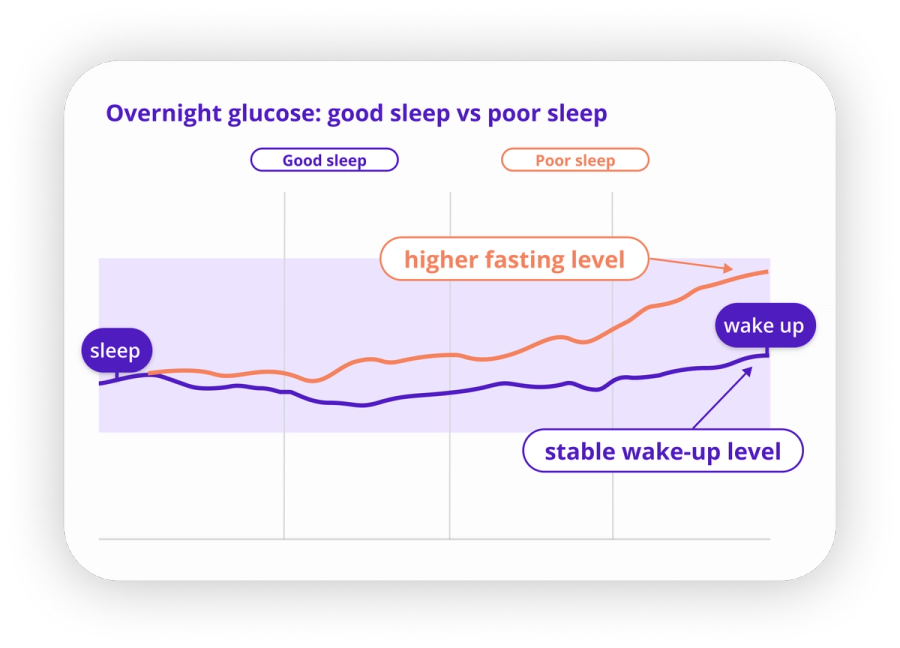
Illustrative pattern. Individual results vary.
The Role of Your Circadian Rhythm
Your body runs on an internal 24-hour clock called the circadian rhythm. This clock governs hormone release, metabolism, and how sensitive your cells are to insulin at different times of day.
Sleep timing and circadian rhythm are closely linked. When sleep timing shifts around due to late nights, irregular wake times, or heavy screen exposure before bed, the clock gets out of sync. Studies link this kind of circadian misalignment to worse glucose tolerance and higher day-to-day variability. Shift workers are an obvious example, but the same effect shows up at a smaller scale in people who stay up significantly later on weekends than they do during the week.
The practical implication: a consistent sleep schedule helps your body anticipate when to be more insulin-sensitive and when to conserve energy. If your CGM shows that your Saturday glucose looks different from your Wednesday glucose without any obvious food difference, sleep timing is worth looking at.
For more on what drives glucose variability day to day, see Factors Impacting Your Glucose Levels and What You Can Do About It.
Sleep Apnea and Glucose Control
Sleep apnea is a condition where breathing repeatedly stops and starts during sleep. Each interruption triggers a brief stress response: oxygen drops, cortisol and adrenaline spike, and the liver releases more glucose.
People with untreated sleep apnea often see higher fasting glucose, more overnight variability, and harder-to-manage blood sugar overall. These interruptions can happen many times a night without the person being aware of them.
If you snore loudly, wake feeling exhausted after a full night in bed, or notice unexplained overnight glucose rises on your CGM, it is worth talking to your doctor about a sleep study. Treating sleep apnea, often with a CPAP machine, can improve glucose patterns alongside other health outcomes.
Sleep Deprivation and Next-Day Eating Patterns
Poor sleep changes how hungry you feel the next day, and what you reach for.
Sleep loss increases ghrelin, the hormone that drives hunger, and decreases leptin, the hormone that signals fullness. The result is that sleep-deprived people tend to feel hungrier, eat more, and gravitate toward higher-carb foods. This is not a willpower problem. It is a hormonal shift.
The effect compounds: your insulin sensitivity is already lower from the sleep loss, and now you are also eating more carbs than usual. A meal that normally sits in a predictable range can look noticeably different the morning after a bad night.
Recognizing this pattern can be more useful than fighting it. If you know you slept poorly, you might choose meals that are lower in fast-acting carbs or easier to portion accurately. Not as a correction, just as a practical buffer.
For ideas on carb-conscious meal planning, see How to Improve Your Time-in-Range After Meals.
Practical Sleep Habits That Can Help
Small changes tend to add up here more than any single fix.
Keeping a consistent sleep and wake time, even on weekends, helps stabilize your circadian rhythm. This is one of the more well-supported habits for improving sleep quality over time.
Dimming lights an hour or two before bed matters more than most people expect. Bright light, especially from screens, suppresses melatonin, the hormone that initiates sleep. A cool bedroom (around 65 to 68°F or 18 to 20°C) supports deeper sleep for most people.
Caffeine has a half-life of 5 to 6 hours, so an afternoon coffee can still be active at bedtime. And eating a large meal close to bedtime can raise overnight glucose and fragment sleep.
None of these are magic. But they interact, and a few nights of better sleep quality often shows up in a noticeably calmer CGM graph.
Using SNAQ to Connect Sleep and Glucose
After a poor night, a meal that usually sits comfortably in range can spike noticeably higher. The food looks the same. The portion looks the same. But the context changed.
SNAQ places your meal markers directly on your CGM curve, so you can see the same meal on a good-sleep night and on a poor-sleep night side by side, and see how the curves actually differ. That kind of direct comparison makes the sleep-glucose connection easier to see in your own data.
You can also add a short note on mornings when you slept badly, then check your weekly review to see whether those mornings consistently show higher fasting levels or bigger post-breakfast spikes.
Closing Thoughts
If you have been focusing mainly on food and activity, sleep is the third variable that often explains the gaps.
Start somewhere concrete: check your CGM graph on the morning after your next rough night. Look at the 3 a.m. to 7 a.m. window. See if the curve drifted upward while you slept. That one comparison can make the mechanism visible in a way that is hard to unsee.
If you want to connect those overnight patterns to your meals and see what changes when sleep improves, try SNAQ to bring your CGM data and meal context into one place.