Quick answer: You don't need to log everything to learn something useful. For most people with diabetes, tracking three things (a carb estimate, meal timing, and a short description or photo) is enough to spot patterns over time. Consistency matters more than completeness.
You open your meal tracking app after dinner and stare at the empty log.
Carbs? Protein? Fiber? Glycemic index? Exact portion size? Time down to the minute? A photo? A note about whether you walked afterward?
By the time you've thought through all of it, the moment has passed. You close the app and tell yourself you'll do better tomorrow.
But what if the problem isn't your effort? What if you're trying to track too much?
This article is about the opposite of perfect meal logging. It's about tracking just enough to learn something useful, without turning every meal into a data entry job.
The Problem With Perfect Meal Logs
Most meal tracking advice assumes you have unlimited time, motivation, and energy.
It assumes you want to weigh your food, count every macronutrient, log every snack, and review your data daily. For some people, that works. For most people with diabetes, especially those juggling work, family, fatigue, or glucose swings, it doesn't.
What follows is an all-or-nothing pattern. You track perfectly for three days, burn out, stop completely, feel guilty, and restart a month later.
The alternative isn't zero tracking. It's minimum viable tracking: the smallest set of details that still gives you useful glucose context over time.
What Actually Matters in a Meal Log
If you can only track three things per meal, these are the ones that matter most.
1. A carb estimate
Carbs have the biggest, fastest effect on glucose. A rough estimate, even a rounded number, gives you a baseline to compare meals against.
You don't need to count every gram. A range works: 30 to 40 grams, 50 to 60 grams, 70 or more. If you're using carb counting for glucose management, start with total carbs. You can always refine for fiber or sugar alcohols later, once you've logged enough meals to know they're actually affecting your response.
2. Meal timing
When you ate matters almost as much as what you ate.
Morning insulin resistance can make breakfast carbs hit harder than the same carbs at lunch. Late-night meals often sit differently than early dinners. Meal spacing affects your starting glucose and how much insulin is still active from a previous dose.
Rounding to the nearest 15 minutes is precise enough. You're not looking for the exact minute. You're looking for whether timing patterns show up again and again.
3. A description or photo
You need something to remind you what the meal actually was when you look back three days later.
A photo works. So does a short voice note: "chicken burrito, no rice, extra beans." Or a typed line: "oatmeal, banana, peanut butter." The goal isn't a nutrition label. It's recognising the meal again so you can compare it to something similar.
Minimum viable logging
What to track. What to skip.
What You Can Skip (For Now)
Protein and fat grams are worth adding only if you start noticing delayed spikes or glucose curves that stay elevated longer than expected. That's a fat and protein story, and it's not where most people need to start.
Fiber grams come into play if you want to experiment with net carbs vs total carbs. Skip it until you have a reason to go there.
Exact portion sizes. A visual estimate ("small plate," "large bowl") is enough. Obsessing over grams before you've even spotted a pattern is working backwards.
Activity, stress, sleep, hormones. These all move glucose. But trying to log all of them every day turns a simple habit into homework. Note them only when something felt unusually off.
The rule: track the minimum that lets you compare one meal to the next. Add detail only when a pattern needs troubleshooting.
How to Log Meals Without Burning Out
Reduce friction first
Manual carb counting from a database works, but it's slow, and slow means skipped.
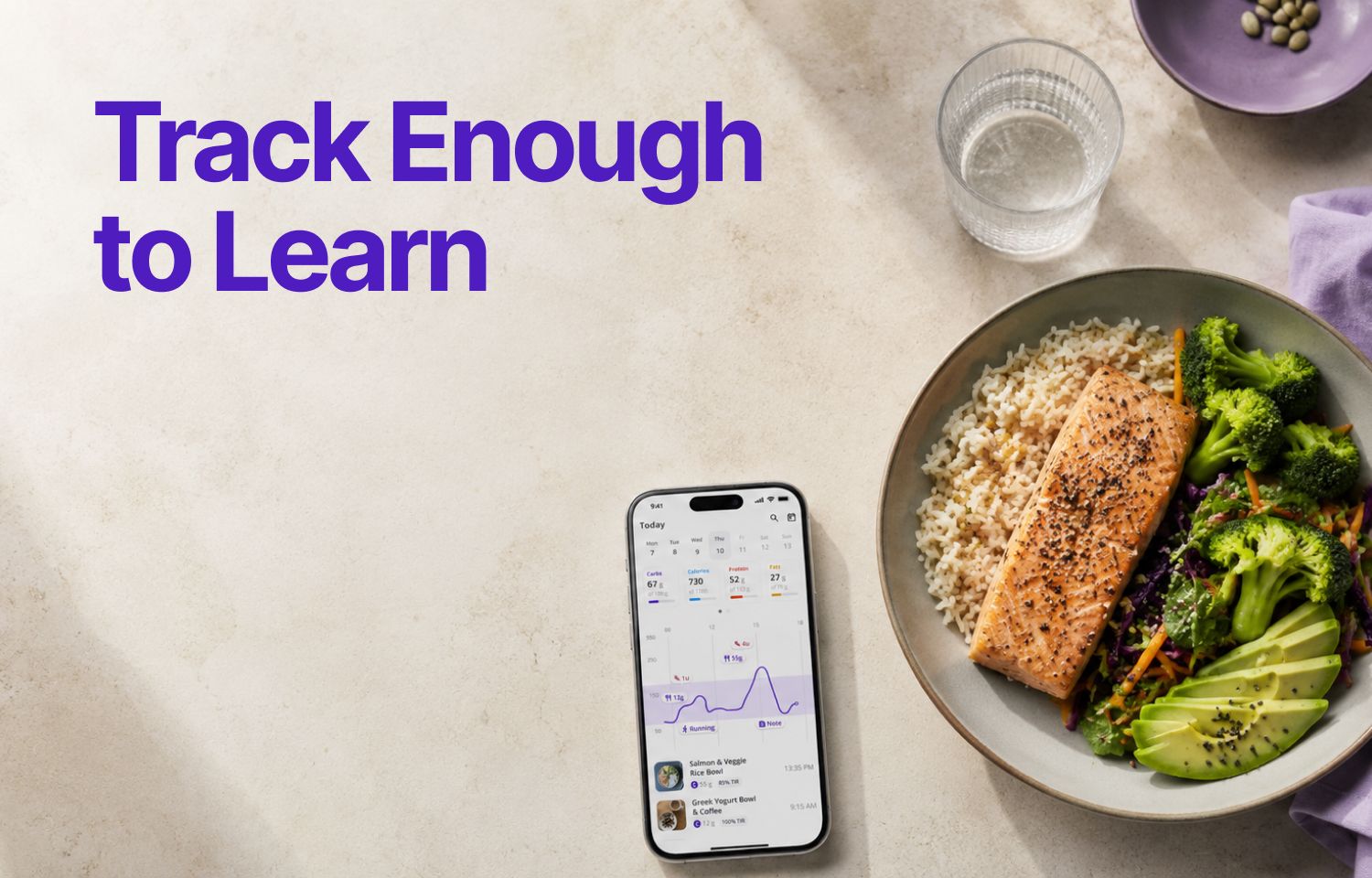
SNAQ's Snap feature estimates carbs, protein, fat, and fiber from a meal photo in seconds. You can adjust the estimate if it looks off, save the meal as a favourite, and reuse it next time. For meals you eat on rotation, Voice Logging is faster still: "Same oatmeal as yesterday, added blueberries." Done in five seconds.
Build a short list of your most common meals
Most people eat 10 to 15 meals repeatedly: the same breakfast rotation, a few standard lunches, regular dinners, go-to snacks.
Log those meals once with a little care. Save them. Reuse them. When 70% of your logging is just tapping a saved meal, the effort drops and consistency improves.
Set a two-week comparison goal
Instead of trying to track perfectly forever, aim for something smaller: enough meals over two weeks to compare the same meal at least twice.
Say you eat scrambled eggs and toast three times in two weeks. If your CGM shows similar post-meal curves each time, you have a stable breakfast option. If the curves vary, you have a specific question to investigate: was it portion size, timing, activity, or something else?
Two weeks of minimum viable logging beats two months of perfect logs that never happen.
Common Mistakes in Minimal Meal Logging
Logging meals but not reviewing them
Tracking is only useful if you look at the pattern later. Pick one review habit (Sunday morning, a mid-week check-in, whatever fits) and stick to it. Compare meals with similar carb counts or similar timing and look for repeated glucose shapes.
Treating a missed meal as a failure
You don't need a complete log to learn. Three breakfasts logged over a week can tell you more than zero breakfasts logged over a month. If you miss lunch, log dinner. If you forget dinner, log tomorrow's breakfast. Partial data still builds patterns.
Expecting the same meal to always behave the same way
The same meal can produce different glucose curves depending on your starting glucose, recent activity, stress, sleep, or where you are in your menstrual cycle. That's not a flaw in the data. It's the data. Minimum viable logging helps you spot when a meal behaves consistently, and when something else is at play.
How SNAQ Supports Minimum Viable Logging
Snap a photo of your meal and get an instant carb estimate. The meal lands on your CGM graph as a marker, so you can see the glucose response without opening three separate apps. The AI Nutritionist does the pattern-reading for you: surfacing when a meal behaves consistently, flagging when something looks different, and suggesting what to try next. It doesn't wait to be asked.
For people managing diabetes alongside work, family, or shifting appetite on GLP-1 medications, SNAQ keeps meal context, glucose data, and weight tracking in one place.