
Quick answer: Stress hormones like cortisol and adrenaline can raise blood glucose within minutes, even without eating. A single stressful event usually settles on its own within a few hours, but stress that sticks around for weeks can lower insulin sensitivity and push your baseline higher. Logging stress alongside your meals is the clearest way to tell a stress spike from a food spike.
Say you're stuck in traffic on the way to work, running so late your heart won't slow down. An hour later you check your CGM, the continuous glucose monitor stuck to your arm, and you're 40 mg/dL higher than you were at breakfast. You haven't eaten a thing.
Stress hormones can push blood glucose up within minutes, whether or not you've eaten, and depending on how long the stress lasts, the effect can stick around for hours. It's why the same breakfast can behave completely differently on a calm morning versus a rough one.
Why Stress Raises Blood Glucose
When your body perceives a threat, real or imagined, it releases stress hormones. The two most important for glucose are cortisol and adrenaline.
Cortisol signals your liver to produce more glucose. It's part of an old survival response: your body assumes you need quick energy to deal with danger.
Adrenaline increases your heart rate, redirects blood flow to your muscles, and also triggers glucose release. Both hormones work together to flood your bloodstream with fuel.
Insulin is supposed to step in and match that glucose rise. That's what happens if you don't have diabetes. With Type 1 diabetes, the automatic insulin response isn't there to begin with. With Type 2, insulin resistance means the cells that are supposed to absorb the extra glucose don't respond as well, even with insulin present.
The result is a stress-driven high, even when food intake hasn't changed at all.
How Fast Can Stress Move Your Glucose?
Adrenaline acts almost immediately, within seconds to minutes. Cortisol takes a little longer, usually peaking 20 to 30 minutes after a stressful event begins, and its effects can linger for hours afterward.
This timing matters. A single stressful event, like a tense meeting or an argument, can create a glucose rise that looks identical to a meal spike on your CGM curve. If you're troubleshooting why a particular meal "always spikes you," stress timing might be the hidden variable.
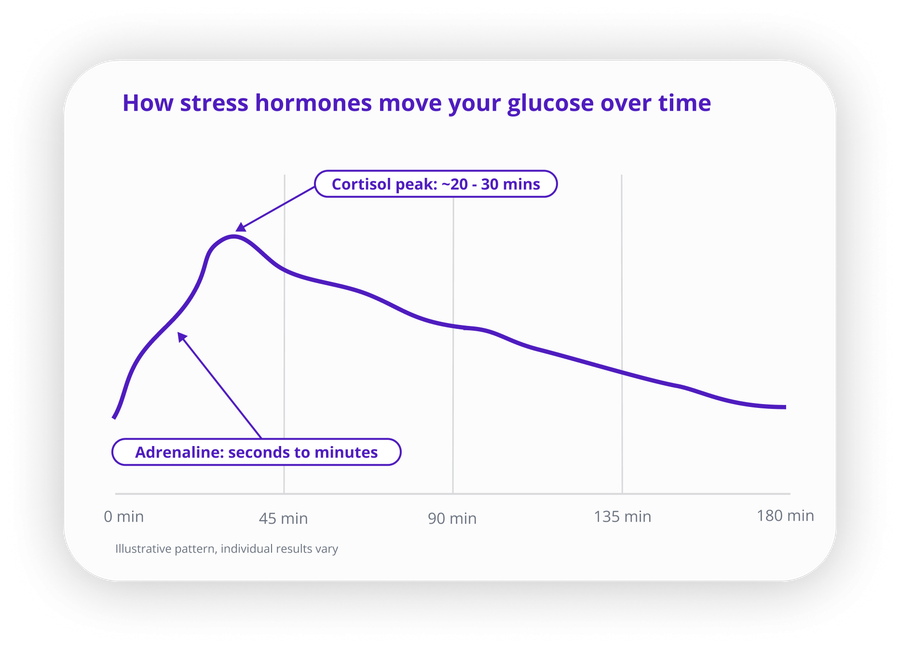
Illustrative pattern, individual results vary.
What a Stress-Driven High Actually Feels Like
Symptoms of a stress-driven high overlap with general high-glucose symptoms: fatigue, headaches, thirst, frequent urination, trouble concentrating.
Stress itself causes a lot of these same feelings, which makes the two hard to tell apart. You might feel tired because you're stressed, because your glucose is elevated, or both.
For some people, glucose rises during stress but doesn't come back down as smoothly as it does after a meal, more of a plateau than a steady decline, especially if the stressful situation is still going on.
If you want to know whether stress is affecting your glucose, try logging your emotional state or stressful events alongside your meals for a week. Look for rises that don't line up with food.
What Changes When Stress Sticks Around
A single stressful day raises glucose temporarily. For most people, that passes on its own and isn't something to panic over. It's frustrating, but it's also temporary.
A stressful season behaves differently. When cortisol stays elevated week after week, your cells can become less responsive to insulin, which makes it harder to bring glucose back down. Over time, this can raise your average glucose and shrink your Time in Range, the share of the day your glucose actually sits inside your target zone. Sustained high cortisol is a well-documented driver of insulin resistance more broadly, independent of diet (Reaven, 2011).
A few weeks of high stress can move your numbers about as much as a change in diet or medication. Logging it the same way you'd log those, instead of writing it off as "just stress," is what actually makes the pattern visible.
Practical Ways to Lower Stress and Steady Your Glucose
You can't eliminate stress completely, but a few things reliably take some of the edge off your glucose response, and they tend to stack rather than replace each other.
Mindfulness and relaxation techniques have been studied specifically in people with Type 2 diabetes. One study found that participants who completed an eight-week mindfulness-based stress reduction program showed measurable improvements in glucose control, alongside lower reported stress (Hartmann et al., 2012). The effect was modest, not dramatic, but consistent enough to be worth trying, and it doesn't require long meditation sessions. Five minutes of controlled breathing or a body scan can lower cortisol in the moment.
Movement helps too, and it doesn't need to be intense. Walking or stretching, done consistently, tends to do more for your baseline cortisol than the occasional hard workout.
Poor sleep can raise cortisol and lower insulin sensitivity on its own, and it stacks with everything above: a bad night makes you more reactive to the next day's stress, and that stress can wreck the following night's sleep right back. On a CGM, that often shows up as a higher, flatter line the next morning, before you've eaten anything at all.
And meals still matter under stress. Balanced meals with protein and fiber tend to hold up better, since a high-carb meal eaten during a stressful stretch gets hit by cortisol and the meal's carbs at the same time. For more on how meals interact with glucose day to day, see how to improve your Time-in-Range after meals.
Untangling Stress From Sleep, Meals, and Everything Else
Stress rarely shows up alone. A stressful week usually drags in poor sleep, skipped or rushed meals, less movement, and a less consistent routine. Every one of those affects glucose on its own, which makes the stress-specific effect hard to isolate without a log.
Sleep loss probably confounds this more than anything else. If stress keeps you up or wakes you at 3 a.m., your glucose the next morning reflects both the stress itself and the sleep you didn't get, which is why a stress-related high can end up feeling like it came out of nowhere. Poor and interrupted sleep can shift your glucose overnight on its own, worth ruling out before you assume a morning high is purely a stress problem.
Isolating one variable at a time works better than trying to account for all of them at once. Spend a week tracking stress events without worrying about anything else. Then a week focused on sleep quality. Then a week on activity. Comparing those weeks side by side usually makes it obvious which variable is actually moving your glucose the most, and which ones are just along for the ride.
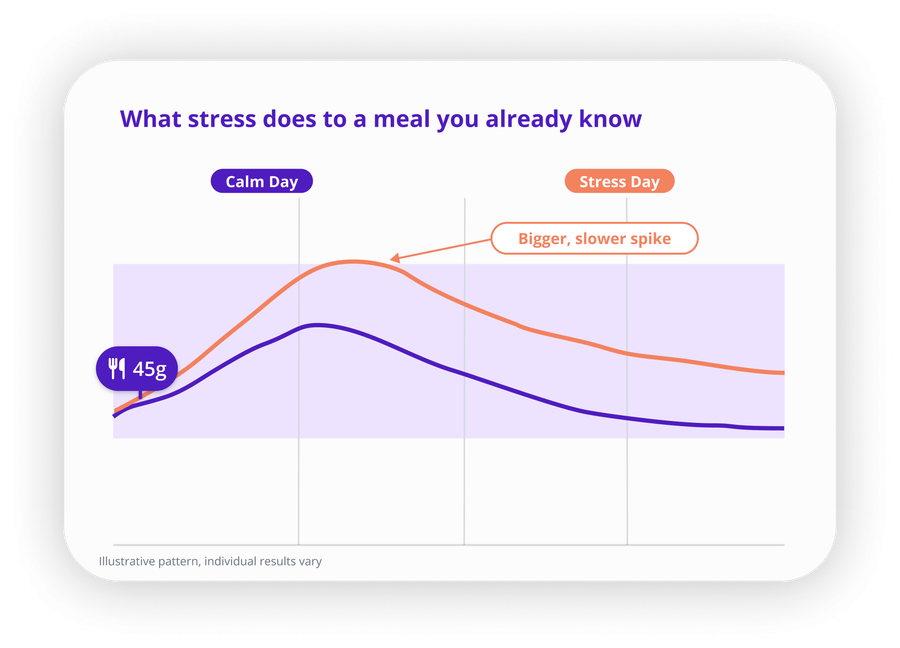
Illustrative pattern, individual results vary.
How SNAQ Helps You Actually See the Pattern
You'll see a rise on your CGM curve, but by the time you're reviewing it that evening, the tense phone call from two hours earlier has usually already faded into the background.
SNAQ lets you log meals, glucose data, and short context notes together, in one place. Tagging a reading with "stressful call" or "bad sleep" takes a few seconds, but it's the difference between a mystery spike and a spike you can actually explain later.
Over weeks, those tags start to form a shape. If Monday mornings consistently run higher, and Mondays are consistently your worst day for stress, that's not a coincidence you'd need to catch by memory alone. It's something SNAQ's pattern view can surface directly from your logged data.