

Quick answer: High-fiber meals often flatten and delay the glucose rise you'd normally see after eating, which is generally a good thing, but it also makes the curve's timing less predictable. That flat stretch, then the slow climb hours later, is fiber doing its normal job. Give the same meal a few repeats before trying to read the pattern.
You log a big lentil salad with whole-grain bread, count the carbs carefully, and wait for your usual post-meal rise. It doesn't come. Your CGM sits flat for 90 minutes, then creeps upward over the next two hours, long after you've stopped watching for it.
That slow, late climb is fiber at work. It can soften a spike, but it also blurs when the rise shows up and how big it gets, which makes it harder to tell whether your carb estimate was right. Nothing went wrong with your tracking.
One thing this piece won't cover is how to adjust your treatment around a meal like this. That belongs in a conversation with your care team, not in a blog post.
What Fiber Does to Digestion and Glucose Timing
Soluble fiber, the kind in oats, beans, apples, lentils, and barley, dissolves in water and forms a gel-like substance in the gut. That gel slows gastric emptying, so food leaves your stomach more gradually and glucose trickles into the bloodstream over a longer stretch. The sharp rise you'd expect from a high-carb meal turns into a lower, longer curve.
For most people that's a good trade. An early controlled trial in people with Type 1 diabetes found that a long-term high-fiber diet was feasible to sustain and was associated with improved blood glucose control and fewer hypoglycemic episodes (Giacco et al., 2000).
It does complicate the read, though. Eat 50 grams of carbs with 15 grams of fiber and your CGM may skip the clear peak at 60 or 90 minutes entirely, then plateau somewhere in hour two or three. By then it's hard to say whether you're looking at your carb estimate, the fiber, or something else.
Soluble vs Insoluble Fiber: Do They Affect Glucose Differently?
They do, and it's mostly soluble fiber that slows glucose absorption. You'll find it in oats, beans, lentils, apples, oranges, carrots, and barley, and it's the type that forms that gel and holds food in the stomach longer.
Insoluble fiber, in whole-wheat bread, wheat bran, and many vegetables, adds bulk and keeps digestion moving. Glucose just isn't really its department. A meal built mostly on insoluble fiber can still produce a fairly sharp rise if the carbs in it digest quickly.
So "high-fiber" on its own doesn't tell you much. Steel-cut oats with chia seeds lean heavily soluble. Whole-wheat toast with spinach leans insoluble. Both count as fiber-rich breakfasts, and your CGM may treat them very differently.
| Soluble fiber | Insoluble fiber | |
|---|---|---|
| How it behaves | Dissolves in water and forms a gel in your gut | Stays mostly intact and adds bulk |
| Effect on glucose | Slows gastric emptying, so the glucose rise comes later and lower | Doesn't slow glucose absorption the same way |
| Common foods | Oats, beans, lentils, apples, barley | Whole-wheat bread, wheat bran, many vegetables |
| Best known for | Flattening and delaying the post-meal rise | Supporting regular digestion |
Why this matters: nutrition labels lump both types into one "dietary fiber" number, so two meals with the same fiber count can still produce very different glucose curves depending on which type dominates.
For a deeper breakdown of how each type affects a meal, see Soluble vs Insoluble Fiber: What Each Can Change About a Meal.
Why the Same Fiber-Rich Meal Can Behave Differently Day to Day
Even an identical meal won't give you an identical curve every time. Fiber is one factor, and a few others can shift the response around it:
- How long the food was cooked, since longer cooking can break down fiber structure and speed digestion slightly
- What you ate earlier in the day, because a high-fat breakfast may still be slowing digestion by lunch
- How active you were before or after the meal, as movement can speed gastric emptying in some people
- How hydrated you are, since soluble fiber needs water to form its gel and dehydration may change how well that works
So the lentil bowl that gave you a smooth, flat curve on Tuesday might show a sharper rise on Thursday. None of this is on the nutrition label. Log the same meal a few times and you'll start to see which of these actually moves your numbers.
For more on why peak timing varies from meal to meal, see 5 Common CGM Curves After Meals and Why They Happen.
What a High-Fiber Glucose Curve Typically Looks Like
After a high-fiber meal, your CGM will often show some mix of these:
- A delayed rise, with glucose staying fairly flat for 60 to 90 minutes before it starts climbing
- A lower peak than the same amount of carbs would usually produce without the fiber
- A longer tail, sometimes taking several extra hours to get back to baseline
- A smoother line overall, with fewer steep jumps
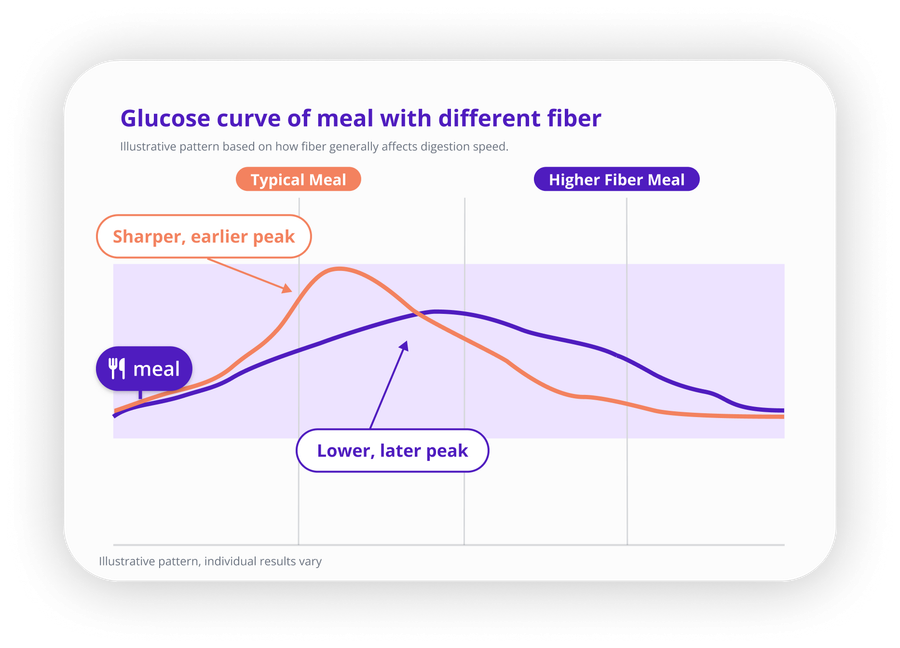
If you're used to a clear peak at 90 minutes, a curve that tops out two or three hours later can feel unpredictable, even when the total rise was smaller. That's usually where doubt about your carb estimate starts to creep in.
When Fiber Makes Carb Counting Feel Less Reliable
The delay can trip up carb counting in three ways:
- Reading the first hour as the whole story. If glucose hasn't moved after an hour, it's tempting to decide you overestimated the carbs. It may still be rising slowly in hour two or three.
- Mistaking a flat curve for a low-carb meal. A salad with quinoa, chickpeas, and tahini can hold 40 to 50 grams of carbs and still produce a curve flat enough to look almost carb-free. (Legumes carry more carbs than their fiber content suggests. See Are Beans a Protein or a Carb for Blood Sugar?)
- Changing the wrong thing. Cut fiber after a delayed rise and you give up the smoothing effect without gaining much predictability in return.
Mostly, it takes patience: give the curve three or four hours before you judge it. If you're weighing net carbs against total carbs for meals like this, Net Carbs vs Total Carbs: Which One Actually Matters for Blood Sugar? covers when the difference matters.
How to Track High-Fiber Meals More Effectively
- Log the fiber, too. Note roughly how much fiber the meal had and whether it leaned soluble or insoluble. SNAQ's meal logging records fiber alongside the carb estimate, so you don't have to work it out separately.
- Look further out. Check the curve at three to four hours instead of 90 minutes. Where did it peak, when did it come back down, and what shape did it take?
- Repeat the meal. One high-fiber meal won't tell you much. Eat the same thing three to five times over a few weeks and compare the curves side by side.
- Write down what else was different. Activity, hydration, when you last ate, how you slept. When the same meal behaves differently, the answer is often somewhere in that list.
Should You Reduce Fiber to Make Glucose More Predictable?
Usually not, because fiber has real benefits for glucose management: it moderates post-meal spikes, reduces glucose variability over time, and supports overall metabolic health. A 2025 systematic review and meta-analysis of randomized trials in people with Type 1 diabetes found that higher-fiber diets were linked to fewer hypoglycemic episodes and reduced glucose variability, though the researchers rated that evidence as low to moderate certainty (Zeng et al., 2025).
The tradeoff is that fiber makes individual meal responses harder to predict in the short term. But a predictable single meal isn't the same thing as steadier glucose over weeks and months, and if high-fiber meals are giving you the second, an occasional delayed rise is a fair price to pay.
When to Consider Adjusting Fiber Intake
There are a few cases where cutting back, at least for a while, makes sense. If you're testing a new meal and want clearer feedback, try a lower-fiber version first to see the carb response on its own, then add the fiber back and compare. If you're feeling bloated or crampy, you may have increased fiber too quickly, and building up over a few weeks gives your gut time to adapt. And a meal that's high in fiber, fat, and protein all at once can produce a very slow, hard-to-read curve, so it can help to change one of those at a time.
Most of the time, though, the better approach is to keep the fiber and give the pattern longer to show itself.
How SNAQ Helps You Track Fiber and Glucose Context
SNAQ logs the meal, puts it on your CGM graph, and lets you look at the curve over a longer window than you'd normally bother with. That's the core of how SNAQ works as a Type 1 food tracker.
Say you snap a photo of a lentil and quinoa bowl. SNAQ estimates the carbs, protein, fat, and fiber in a few seconds. Three hours later, you check the CGM graph, see a delayed but moderate rise, and save the meal as a favorite.
Two weeks later, you eat the same bowl again. SNAQ pulls up the saved meal so you can log it quickly, and you look back at both entries on your glucose graph. This time, the rise is slightly sharper, and you notice you ate the meal earlier in the day. After a few rounds like that, you have a much clearer picture of how that particular meal behaves under different conditions.
If a curve still looks odd, you can ask SNAQ's AI Coach why a high-fiber meal might have come out flatter than expected. There's more on how SNAQ connects your CGM data to your meals if you want the details.
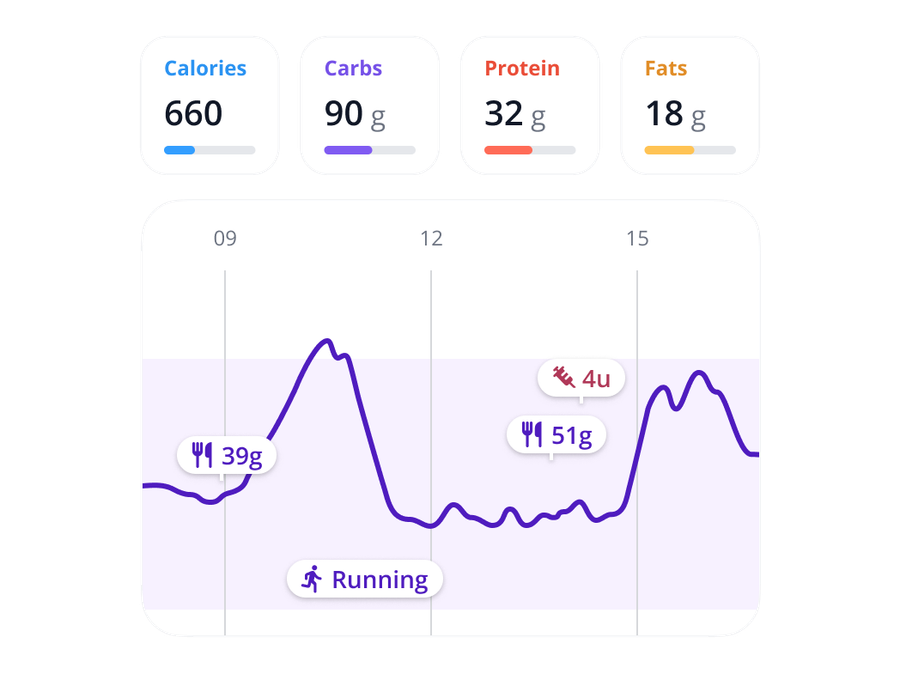
Next time a high-fiber meal hands you a flat line and a slow climb, you'll have the whole curve to look at, not just a guess at the 90-minute mark. Try SNAQ