
Quick answer: Total carbs are what the ADA and FDA recommend tracking for blood sugar management. Net carbs subtract fiber and sometimes sugar alcohols from that number, but neither the FDA nor the ADA recognizes the term, and the math does not always match what your body actually does with the food.
You're standing in the grocery aisle comparing two protein bars. One label says 24g total carbs. The other says 24g total carbs but advertises "only 4g net carbs" in bold letters across the front.
Which one will affect your glucose less?
The answer isn't as simple as the marketing suggests.
What Total Carbs and Net Carbs Actually Mean
Total carbohydrates include everything: sugars, starches, and fiber. It's the number on every nutrition label in the U.S., and it's the figure most diabetes educators and endocrinologists recommend tracking.
Net carbs are a calculation, not a regulated term. The formula subtracts fiber and sometimes sugar alcohols from total carbs. The idea: fiber doesn't raise blood sugar the way other carbs do, so why count it?
In theory, net carbs give you a number closer to what will actually affect your glucose. In practice, it's more complicated.
Why the ADA Still Recommends Tracking Total Carbs
The American Diabetes Association's Standards of Care recommend tracking total carbohydrate intake when managing blood sugar. That's because total carbs have the most direct, predictable relationship with glucose response after eating.
Fiber does slow glucose absorption and can flatten the curve. But it doesn't eliminate the glucose response. And the effect varies depending on the type of fiber, the rest of the meal, and your individual digestion.
The ADA acknowledges fiber's role in meal planning, especially for people aiming for tighter glucose control. But they stop short of endorsing net carb tracking as a primary strategy, largely because it introduces room for miscalculation and inconsistency.
Where Net Carbs Can Be Misleading
Net carb math works cleanly on paper. But in the real world, labels can be confusing and responses vary.
Sugar alcohols are inconsistent. Some are absorbed more than others. Erythritol has minimal impact on blood sugar. Maltitol can raise glucose nearly as much as sugar. But both might be subtracted in a net carb calculation.
Fiber type matters. Soluble fiber, like the kind in oats or beans, has a stronger blunting effect on glucose than insoluble fiber. Most labels don't break that down.
Portion sizes shift the equation. A food with 10g net carbs might behave very differently depending on whether you eat one serving or three.
Marketing can overstate the benefit. A product labeled "5g net carbs" might still cause a noticeable spike if it contains 30g total carbs, especially if eaten alone or on an empty stomach.
If you've ever eaten a low-net-carb bar and watched your CGM climb anyway, this is why.
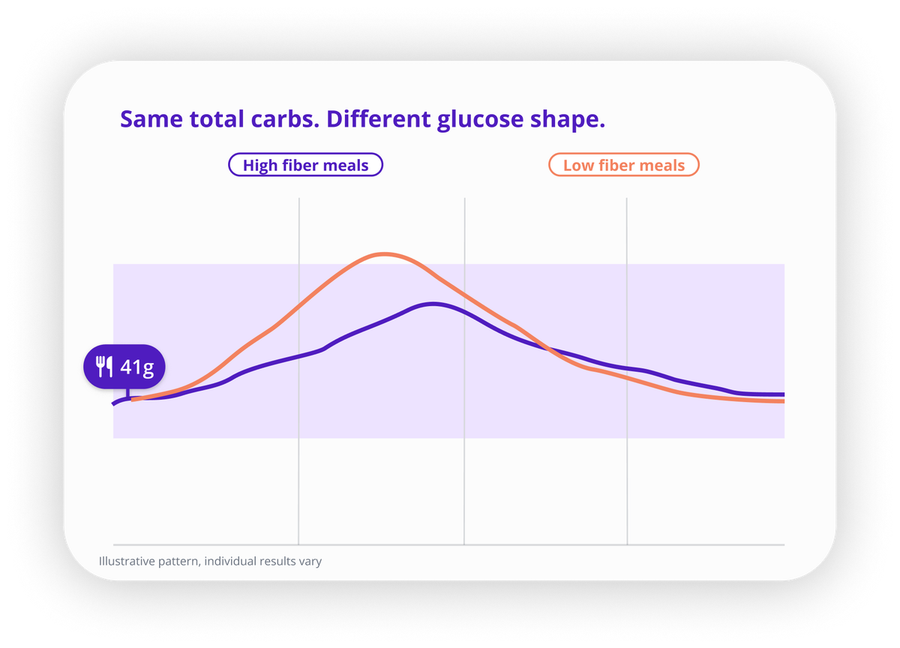
Same total carbs. Different glucose shape. High-fiber meals tend to produce a slower, lower glucose rise than lower-fiber meals with the same total carb count. Illustrative pattern, individual results vary.
When Net Carbs Might Be Useful
Net carbs aren't without value. They can help in specific contexts.
If you're eating a high-fiber meal, like a large salad with beans, chickpeas, and vegetables, the fiber load will likely slow your glucose rise. Focusing on net carbs in that case might give you a more realistic expectation of your curve.
Some people on very low-carb or ketogenic diets use net carbs to stay within their daily limit while still eating fibrous vegetables. That approach can work if the goal is ketosis, not just glucose control.
For everyday carb counting and comparing meals over time, total carbs give you a more reliable starting point.
What the Research Actually Shows
The ADA and FDA both state clearly that "net carbs" has no legal definition and is not a recognized clinical term. The FDA's guidance is to use total carbohydrates on the nutrition facts label. At the ADA's own 2022 Scientific Sessions, a registered dietitian and diabetes care specialist concluded that evidence does not support counting net carbohydrates, and recommended that people with diabetes use total carbs while monitoring their individual glucose response for high-fiber meals.
A 2009 review in Nutrition Reviews confirmed that dietary fiber helps modulate glucose response, particularly after meals. But the effect is dose-dependent and varies by fiber type. Subtracting all fiber universally, as net carb math does, oversimplifies that relationship.
The takeaway: fiber matters. But the blanket subtraction used in net carb labeling does not reliably predict what happens in your body.
How to Decide What to Track
Track total carbs if:
- You're new to carb counting and want consistency.
- You're logging meals to compare glucose responses over time.
- You want to follow the most widely supported clinical guidance.
- You use a carb counting app and want consistent, easy-to-compare data.
Consider net carbs if:
- You're on a very low-carb or ketogenic diet and need to track carb limits while eating fiber-rich vegetables.
- You're eating a meal with a significant amount of fiber and want a rough sense of how much of that total is digestible.
- You've tested the same high-fiber meal multiple times and consistently see a smaller glucose response than total carbs would predict.
In either case, let your CGM be the tiebreaker. If you log a meal as 30g total carbs and your glucose rises less than expected, that's useful information. If you log it as 10g net carbs and it spikes higher than expected, that's also useful information.
Your glucose curve is more reliable than any formula.
A Week-Long Comparison Experiment
If you're curious whether net carbs give you better predictions, try this.
Pick two similar meals you eat regularly. One should be high in fiber, like oatmeal with chia seeds or a bean-heavy salad. The other should be lower in fiber, like white rice or pasta.
For one week, log both meals and note both total carbs and net carbs. Watch your CGM response each time.
At the end of the week, compare:
- Did the high-fiber meal produce a smaller spike than its total carb count would suggest?
- Did the lower-fiber meal behave closer to its total carb estimate?
- Was one method more predictive than the other?
SNAQ can help you run this experiment without building a spreadsheet. Log meals using AI Photo Analysis, track both carb figures in your notes, and overlay your CGM data to compare responses over time. After a week, you'll have a clearer picture of which number works better for your body.
The Bottom Line
Total carbs are the clinical standard for a reason. They're consistent, well-supported, and give you a reliable starting point for tracking glucose impact.
Net carbs can be useful in specific cases, especially for high-fiber meals or very low-carb diets. But they're not a universal improvement, and they can be misleading when the label math doesn't match your body's actual response.
Track what works, test it against your CGM, and adjust based on patterns, not just formulas. Your glucose curve will tell you more than the label ever could.
Download SNAQ to log meals, compare carb figures, and see how both relate to your glucose data.