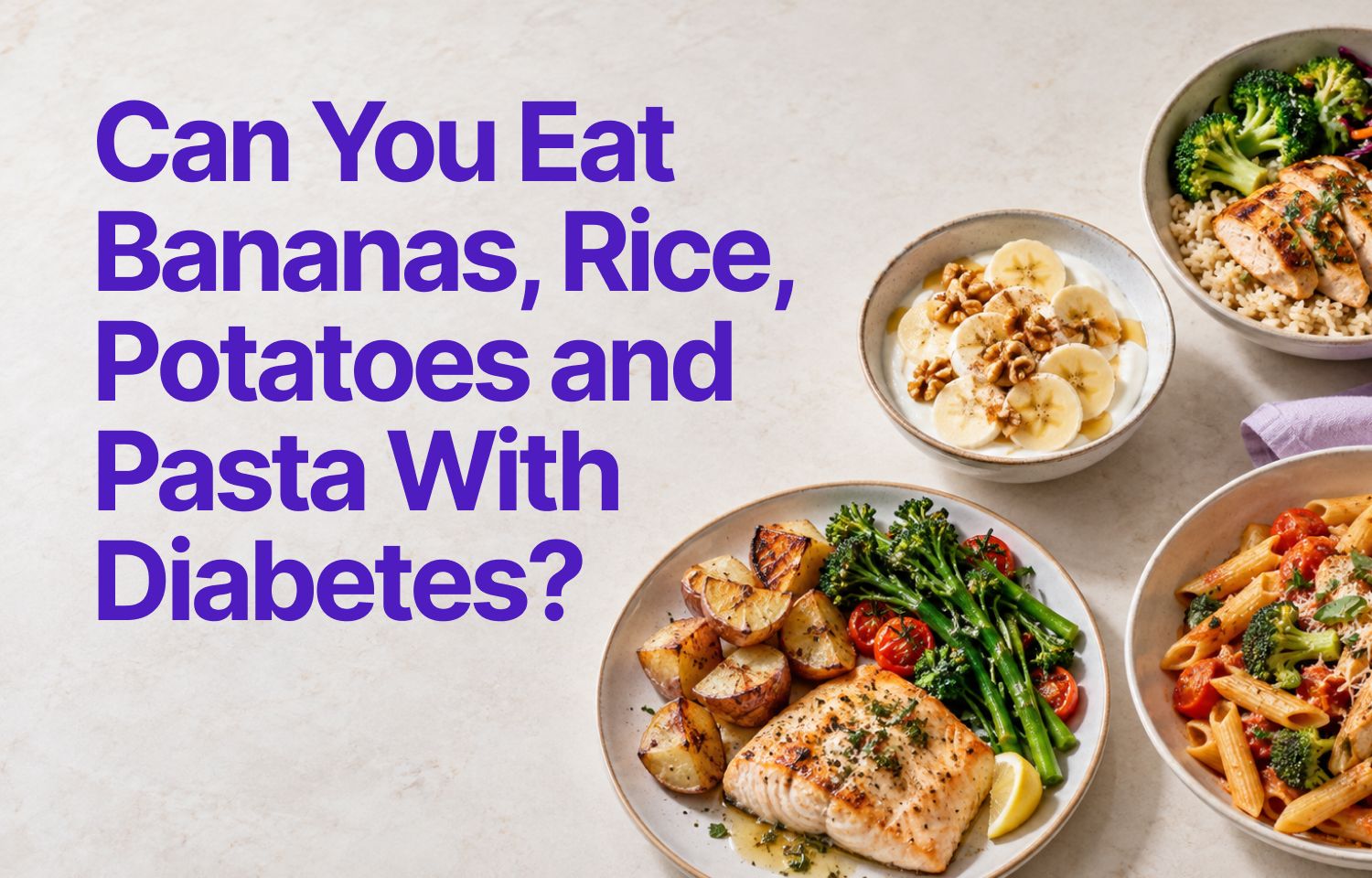
Quick answer: None of these four foods is off limits by default. All four are carb-dense, so portion size matters, and ripeness, cooking method, and what else is on the plate all change how much your glucose rises. Responses also vary a lot from person to person, which is why your own glucose readings are the most reliable guide.
If you've been told to stay away from bananas, rice, potatoes, and pasta, you're in good company, because these four sit on a lot of "foods to avoid with diabetes" lists and the reasoning is easy to follow: they're high in carbs, and carbs raise glucose. The guidelines and the research on how these particular foods behave turn out to be a good deal more flexible than the list.
Why did these four foods end up on the "avoid" list?
A blanket ban skips over most of what shapes a glucose response: how big the portion is, how ripe or how cooked the food is, what else is on the plate, and who's eating it. It also overlooks that all four are everyday staples in many cultures, which makes the advice hard to follow in real life.
What do the guidelines say?
The American Diabetes Association's 2019 consensus report on nutrition therapy says no single eating pattern works for everyone with diabetes and calls for individualized plans. NICE, the UK guideline body, tells adults with type 2 diabetes to favor high-fiber, low-glycemic-index sources of carbohydrate such as fruit, vegetables, whole grains, and pulses, within advice tailored to the person, and Diabetes Canada's guidelines also describe an individualized approach to nutrition therapy.
What are GI and GL, and how much should you trust them?
The glycemic index (GI) ranks carb-containing foods by how quickly they raise blood glucose compared with a reference, with 55 or under counting as low, 56 to 69 as medium, and 70 or above as high. Glycemic load (GL) factors in portion size by combining GI with the grams of carbohydrate in a serving, which is why a low-GI food in a big portion can still push glucose up quite a bit, as a Diabetes & Primary Care overview of the guidance points out. Watermelon is the classic example of the opposite: a high GI but a low GL, because a typical slice has few carbs.
The evidence behind GI and GL is thinner than most people assume. A 2019 analysis in The Lancet rated the certainty of the evidence linking them to long-term disease outcomes as low to very low, compared with moderate for fiber, and NICE still recommends low-GI carbohydrate sources, so GI works best as a rough tiebreaker when you're choosing between two similar foods.
How do bananas, rice, potatoes, and pasta compare?
Here's how the four stack up, using approximate USDA carb figures for the serving shown. GI varies by source, variety, and preparation, so treat the numbers as a starting point.
| Food | Serving and carbs | Typical GI | What shifts it |
|---|---|---|---|
| Banana | 1 medium, about 27 g carbs | Low to medium, depending on ripeness | Less ripe tends to score lower than fully ripe |
| Rice | 1 cup cooked long-grain white, about 45 g carbs | Low to high, depending on variety | Variety, cooking time, and cooling then reheating |
| Potatoes | 1 medium, about 30 to 37 g carbs | Medium to high, depending on preparation | Boiled or roasted scored lower than baked or mashed |
| Pasta | 1 cup cooked, about 40 to 45 g carbs | Low when cooked al dente | Overcooking raises the GI |
How to read this: carb figures are approximate USDA values for the serving shown, and GI ranges vary by source. GI is a rough guide, and your own glucose response may differ.
Can you eat bananas with diabetes?
A medium banana has about 27 grams of carbohydrate, which makes a whole one a real carb serving, and ripeness shifts how it behaves. Greener bananas hold more resistant starch, a type of starch that resists digestion in the small intestine, and in one Malaysian Journal of Nutrition study of a single banana variety they scored lower on GI than fully ripe ones. You also get potassium and fiber along with the carbs.
Can you eat rice with diabetes?
Rice varies a lot by type, and research from CSIRO and the International Rice Research Institute covering 235 kinds of rice found GI differed widely from one to the next, with most scoring low to medium, so "white versus brown" doesn't settle much on its own. A systematic review in the British Journal of Nutrition found brown rice produced lower glucose responses than white at short cooking times, but the gap shrank and became inconsistent at the longer cooking times normally used for brown rice.
Cooling and reheating adds another wrinkle. In a small 2015 trial of 15 healthy adults, white rice that had been cooked, refrigerated for 24 hours, and reheated produced a lower glucose response than freshly cooked rice. A 2022 study of 32 people with type 1 diabetes found lower peak glucose after the cooled rice too, but low-glucose episodes in the following hours were more common (12 of 32 people, compared with 3 of 32 after fresh rice), which is a good reason to check with your care team before changing how you prepare rice. If you do try it, get the rice into the fridge promptly instead of leaving it out. Our article on cooled rice and blood sugar goes deeper on the research.
Can you eat potatoes with diabetes?
A medium potato carries roughly 30 to 37 grams of carbohydrate, and how it's cooked can move the GI from the medium range to the high range. A Tufts Health & Nutrition Letter summary reported that boiled and roasted potatoes scored lowest, baked came in higher, and mashed and instant scored highest, and that waxy potatoes like red and fingerling scored lower than starchy ones like Russet and Idaho. For more on how different starchy carbs behave, see our guide to rice, oats, potatoes, and bread.
Can you eat pasta with diabetes?
Cooked al dente, meaning firm to the bite, pasta is a low-GI food, and overcooked pasta has a higher GI, according to Diabetes Canada. Low GI still doesn't mean low carb, though, since one cup of cooked pasta has about 40 to 45 grams of carbohydrate and the serving size ends up driving the rise. Whole-grain versions add more fiber on top of that.
What else changes the response, whatever the food?
Portion size comes first. The amount of carbohydrate in a serving drives the size of the rise, and a low GI can't make up for a large portion, so half a cup of rice and a full plate of it are very different meals. Fiber, protein, and fat on the same plate then change the rise further.
Fiber slows how quickly carbohydrate is digested, and NICE recommends high-fiber carbohydrate sources. In the 2019 Lancet analysis, every extra 8 grams of fiber a day was linked to a 5 to 27 percent lower risk of type 2 diabetes, coronary heart disease, colorectal cancer, and early death. Those links are mostly observational, so they describe long-term risk and not what happens after any one meal. Beans, lentils, nuts, seeds, and non-starchy vegetables are easy ways to add fiber to a plate built around rice, pasta, or potatoes.
Adding protein and fat to a carb-heavy food can lower its glycemic response, according to the Tufts summary, because both slow gastric emptying, which is how quickly food leaves your stomach. It isn't guaranteed, and fat in particular can shift the timing, so a rise may show up later than you'd expect.
Why does the same meal hit people so differently?
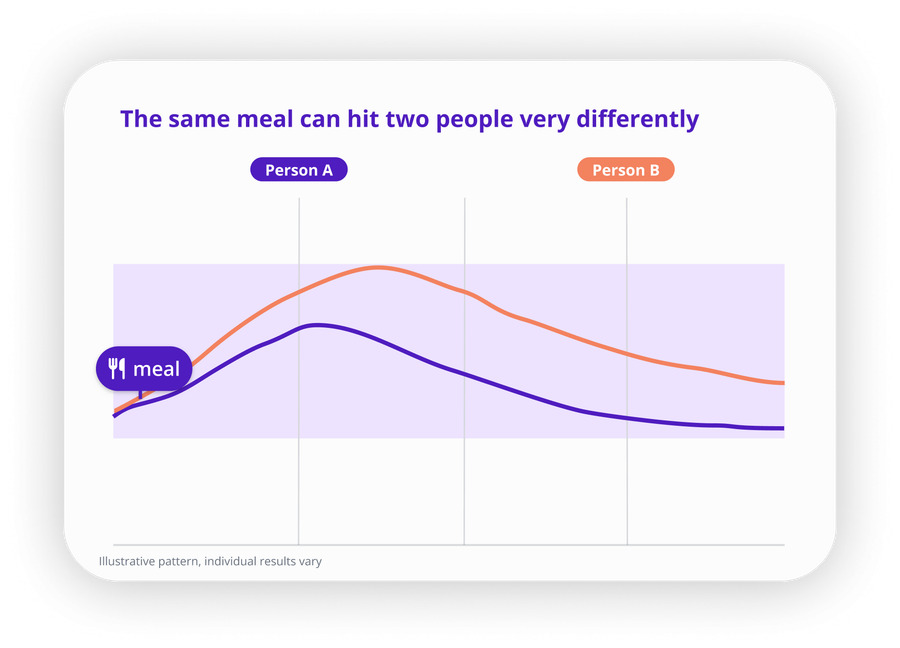
Two people can eat the same meal and see very different results. In a 2015 study in Cell, Weizmann Institute researchers had 800 adults wear glucose monitors for a week, tracked responses to 46,898 meals, and found large differences between people eating identical meals. In one example the team shared, a participant's glucose rose sharply after bananas but not after cookies with the same calories, while another participant showed the opposite pattern. Even within one person, the same food landed differently depending on things like whether exercise or sleep came before it.
How can you find out what works for you?
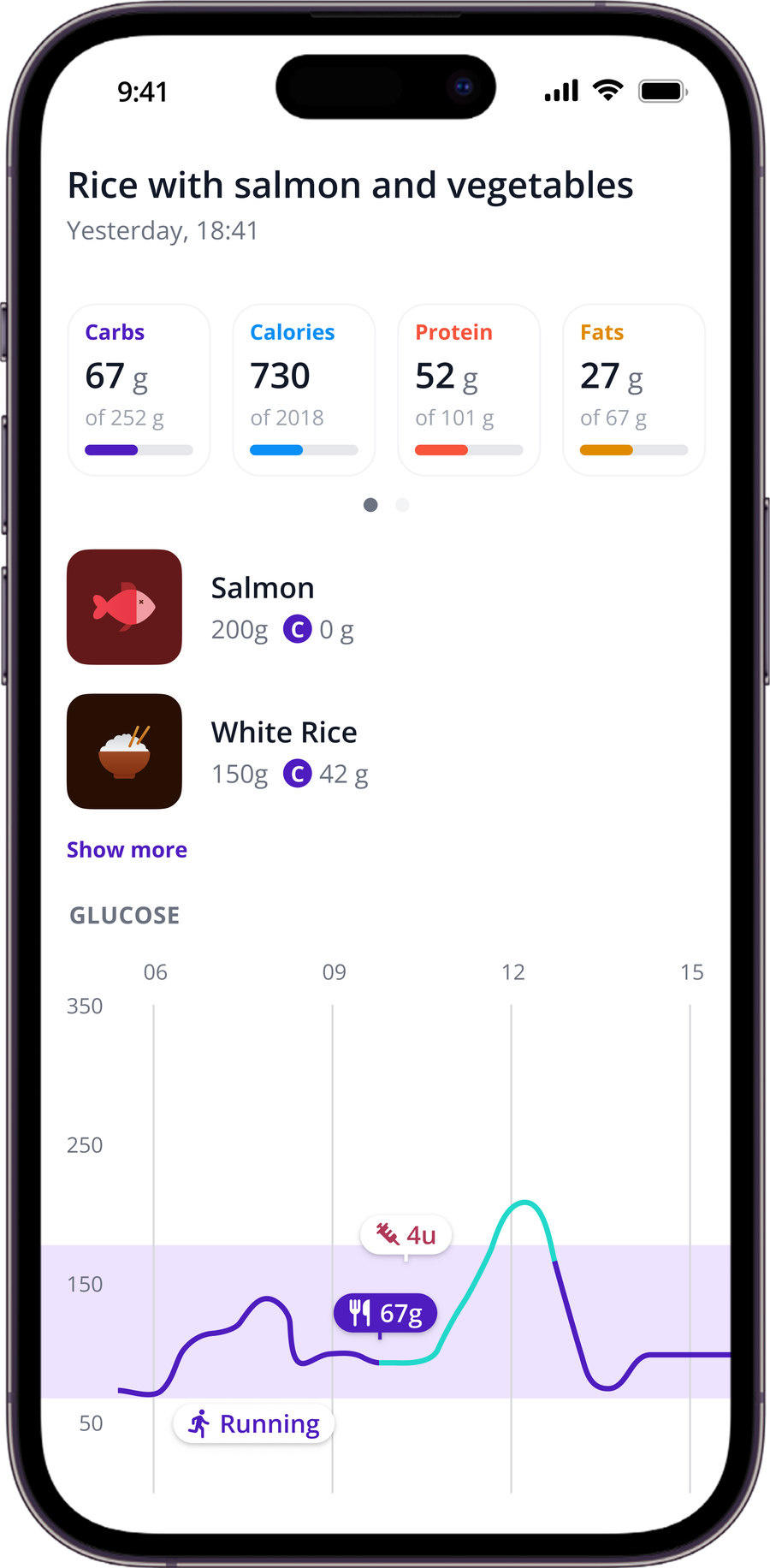
The most practical way to learn your own response is to log a meal, look at what happened afterward, change one thing, and compare. In SNAQ you can log a meal with a photo, a barcode, a quick voice description, or a search, and it estimates the carbs, protein, fat, and fiber. If you use a compatible CGM such as Dexcom or FreeStyle Libre, SNAQ also places the meal on your glucose curve, so you can see how that meal affected you.
Take two pasta dinners: marinara on Monday, olive oil with chicken and broccoli on Wednesday. You can ask the AI Coach how the two compare, and if you wear a CGM, both meals sit on your glucose graph for a side-by-side look. If the same meal treated you differently on two days, that can come down to things like sleep, activity, and what else was on the plate, not something you did wrong. Over time the patterns show which portions and pairings work for you, and you can export your meals and glucose data to share with your care team.