Quick answer: During perimenopause, shifting estrogen and progesterone levels can change how your body handles glucose, which means meals you have eaten for years may start producing unfamiliar patterns. This is a change in the underlying conditions, not a change in your discipline. Tracking what you ate alongside what your glucose did is the fastest way to see what is actually different, and it gives your care team something concrete to work with. This article focuses on type 2 diabetes.
Your breakfast routine has not changed in months. Same oatmeal, same portion, same time of day.
But lately the numbers after that meal look different, and nothing obvious explains it.
If you are in your 40s or early 50s and managing type 2 diabetes, the answer might not be the food at all.
If your routine has not changed, why have your numbers?
This is the part worth saying plainly, because most people arrive at this article having already blamed themselves.
You did not get sloppy. The conditions changed underneath a routine that was working.
Perimenopause is the stretch of years leading up to menopause, and during it your hormone levels stop following a predictable monthly rhythm. That has knock-on effects for how your body processes carbohydrates. So the meal is the same, the portion is the same, the timing is the same, and the result is different. That is frustrating, but it is not evidence that you are doing anything wrong.
It does mean the assumptions you built your routine on are worth revisiting. Not overhauling. Revisiting.
What perimenopause does to blood sugar
Perimenopause usually starts in the mid to late 40s, though it can begin earlier. Ovarian hormone production becomes irregular. Estrogen rises and falls unevenly. Progesterone declines. Cycles get longer, shorter, or simply unpredictable before stopping.
Those two hormones pull in opposite directions when it comes to glucose. Estrogen tends to have a glucose-lowering effect, while progesterone tends to have a glucose-raising one. When both are moving around week to week, the balance between them moves too.
That is the short version of why your numbers may have become less predictable. It is also why the change can feel inconsistent rather than like a clean step up. Some weeks look normal. Some weeks do not.
Diabetes UK notes that these hormonal changes can make diabetes harder to manage during this phase. How much they affect any individual varies a lot.
How glucose patterns may shift
Not everyone sees all of these, and some women notice very little change at all. But these are the patterns that come up most often.
| What may shift | What it can look like | Worth checking |
|---|---|---|
| Morning numbers | Waking readings that sit higher than they used to, even when dinner and your evening routine have not changed. | Is it happening most mornings, or only some? How has your sleep been over the same stretch? |
| Size of the after-meal rise | Meals that used to produce a gentle curve now producing a sharper one. Breakfast is often where this shows up first. | Is it every meal, or mainly one meal? Log that meal a few more times before drawing a conclusion. |
| How long it takes to come back down | The peak may not look unusual, but glucose takes longer than it used to before settling. | Where are you two hours after eating compared to before? Many care plans use a peak after-meal goal of under 180 mg/dL, though targets are individual. |
| Day to day consistency | The same meal producing noticeably different results on different days, with no obvious change in activity, stress, or timing. | This is the one that most often tracks with hormonal shifts. Note roughly where you are in your cycle when a day looks unusual. |
| Unexpected lows | Drops that arrive without a clear reason, sometimes in the same week as unusually high readings. | Note when they happen and what came before. Bring the pattern to your care team rather than acting on it alone. |
Why the same meal can behave differently now
Here is the thing that trips people up most.
Before perimenopause, a familiar meal was close to a fixed quantity. You knew roughly what it would do. That predictability is what let you stop thinking about it.
When insulin sensitivity shifts, that meal stops being a fixed quantity. The food is identical. The response is not. Same oatmeal, different Tuesday.
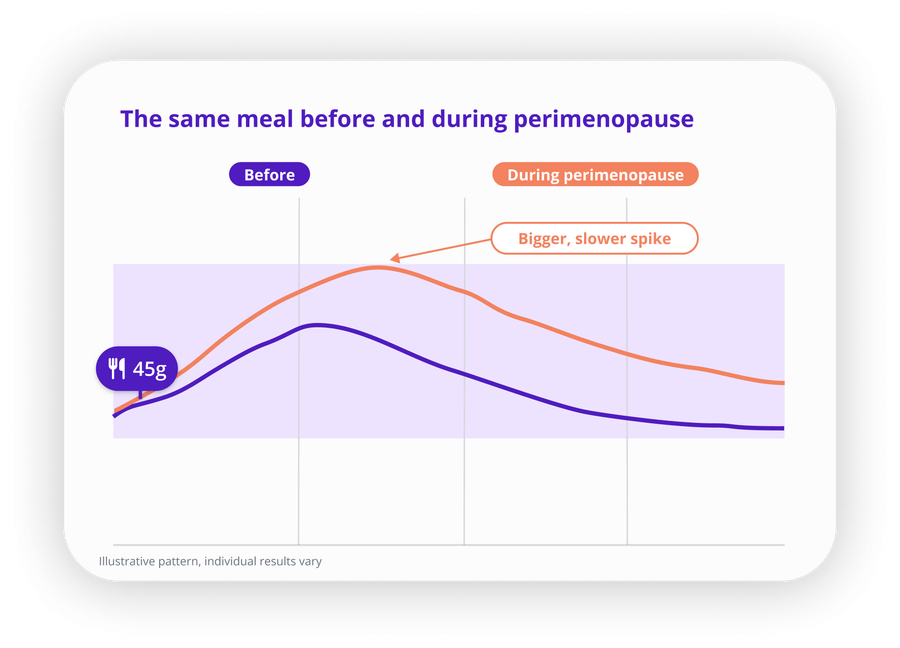
The same meal, before and during perimenopause. The rise is steeper, the peak arrives later, and glucose is still on its way down at the two hour mark. Illustrative pattern, individual results vary.
This is why a single reading is less useful right now than it used to be. One high number after breakfast could be the hormonal shift, or it could be a short night, or stress, or the fact that you ate twenty minutes later than usual. On its own it tells you almost nothing.
What tells you something is the same meal, logged repeatedly, over a few weeks. That is when the noise starts separating from the signal, and you can see whether breakfast has genuinely become a harder meal or whether last Tuesday was just Tuesday.
If you are already using a continuous glucose monitor, a wearable sensor that reads your glucose throughout the day, this is the phase where it earns its keep. Not because the readings are more accurate, but because the full curve shows you the shape of what is happening rather than a single point on it. If you can also see what you ate next to that curve, you can start telling the difference between a meal problem and a week problem.
You can read more in our guide to choosing a CGM.
What is worth tracking right now
You do not need to rebuild your routine. A few things are just worth writing down while everything is in flux.
The same meal, more than once
Pick two or three meals you eat regularly, especially breakfast, and log them repeatedly rather than logging everything once. Repetition is what makes a pattern visible. Logging every meal for a week and then stopping tells you less than logging the same breakfast fifteen times.
Where you are in your cycle
If you are still having periods, even irregular ones, jot down roughly where you are when a day looks unusual. Some women find their glucose runs higher in the two weeks before a period. For others it clusters somewhere else, or nowhere in particular. A couple of months of rough notes is usually enough to tell which camp you are in. You will need to keep this note yourself, in whatever calendar or app you already use for cycle tracking.
Sleep and stress
Perimenopause often arrives with night sweats, broken sleep, and a higher background stress level. All three can affect glucose. If your sleep has fallen apart, that may account for a real share of the variability you are seeing, and it is worth separating from the hormonal picture before you conclude anything. We covered this in more detail in how sleep changes glucose the next day.
Whether breakfast has become the hard meal
Breakfast is often the meal that shifts first. If yours has, it is worth knowing that specifically rather than concluding that everything has changed. More on why breakfast tends to spike glucose more than other meals.
What to bring to your next appointment
"Talk to your doctor" is easy advice and hard to act on, especially if you have had appointments where symptoms in this age range got waved off.
What changes the conversation is arriving with something specific. Roughly:
- A date. When you first noticed patterns changing, even approximately.
- A repeated meal. One meal you eat often, with what it used to do and what it does now. This is more persuasive than a general sense that things are worse.
- Your CGM export or logbook for the last few weeks, rather than a summary from memory.
- What else changed. Sleep, stress, weight, activity, any new medication.
- Your cycle notes, if you have been keeping them.
- The question you actually want answered. Whether your targets still make sense. Whether this warrants a change in your treatment. Whether anything else should be ruled out.
You are not going in to diagnose anything. You are going in with evidence that something shifted, which is a much harder thing to dismiss than a description.
A note if you have type 1
The hormonal shifts described here apply to you too, and so does everything above about tracking and about what to bring to an appointment. What differs is what happens next, and those are questions worth taking to your care team directly.
Where SNAQ fits
The tracking above is the useful part. SNAQ exists to make it less tedious.
Photo-based meal logging means capturing a meal takes seconds instead of a database search, which matters when the whole point is logging the same breakfast many times rather than logging one week perfectly. SNAQ estimates the nutrition and places the meal on your timeline.
Because SNAQ connects with major CGMs, that meal sits next to your glucose curve instead of in a separate app. When you want to know whether Thursday's breakfast really behaved differently from Tuesday's, the comparison is right there.
That is the whole job here. Not fixing anything, and not predicting anything. Just making it easy enough to see what your own data is doing that you can walk into an appointment with something real.