
Quick answer: Three to five repeats is a reasonable practical minimum, and researchers have shown that two is too few. What repeating gives you is a range for that meal rather than one true curve, so you end up learning roughly where it usually lands for you and how far it tends to swing.
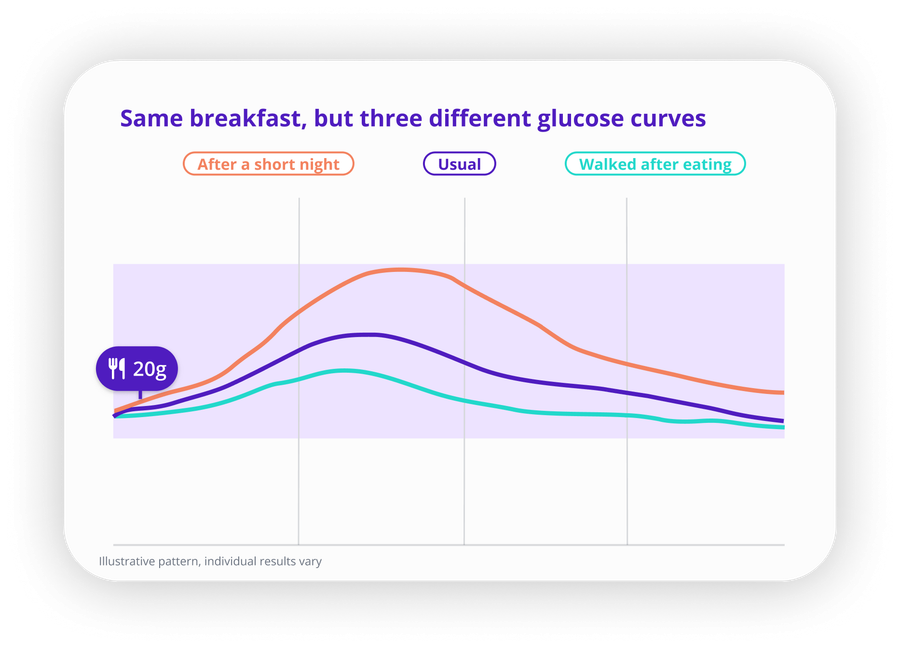
You have the same breakfast on Monday, Wednesday and Friday, and your CGM hands back three different answers: a more or less flat line, then a sharp climb to 180 mg/dL, then a slow drift up to 160 mg/dL that sits there for most of the morning. The oats came out of the same bag, the bowl was the same bowl, and you ate at roughly the same time on each of those days.
So which of the three was the real breakfast?
The honest answer is mildly infuriating, and it's better to hear it now than after two weeks of eating porridge for science.
How Many Repeats Do You Actually Need?
Somewhere between three and five attempts is a reasonable place to start, mostly because it's enough to stop you reacting to one strange morning while still being few enough that you'll actually see it through.
Treat that as a rule of thumb rather than a research finding, though, because no study has settled on a number. What research has settled is the lower bound. In a 2025 study from the National Institutes of Health, participants ate duplicate meals about a week apart in an inpatient unit where the food, the timing and the daily routine were all held tight, and the researchers concluded both that two measurements are too few and that working out the right number remains an open question.¹
Three to five will get you moving, then. Most people finish those attempts expecting a verdict, which is usually where the disappointment sets in.
What the Research Actually Found
The NIH team gathered more than a thousand paired meal responses. If repeating a meal reliably reproduced the same curve, those pairs should have lined up reasonably well, and they didn't. The correlation between someone's first and second response to the same meal came out weak to moderate, and how much a person's response varied between two servings of the identical meal turned out to be roughly as large as how much it varied across completely different meals.¹ All of that happened with the same food on the same plate, in weighed portions, in a ward where the lights went off at the same hour every night.
The study looked at adults without diabetes, so it isn't a direct read on what happens with type 1 or type 2, and it ran indoors on a fixed schedule, which the authors point out probably makes it something close to a best case. Ordinary days, with ordinary sleep, are likely to vary more rather than less.¹
If you've ever put two curves from the same breakfast side by side and quietly assumed you'd mismeasured something, this is the part to hang on to. The variation turned up in a metabolic ward with weighed food, which means your kitchen was never really the problem.
What Changes Between Attempts
The meal is the only variable you're genuinely holding still, and the NIH researchers went looking for what accounted for the rest. They tested what they could measure, including glucose before the meal, how much people ate, how long they took over it and whether they exercised afterwards. Those factors did matter, but together they explained at most a quarter of the variation.¹
The two carrying the most weight were your glucose level right before the first bite and how much carbohydrate actually went in on that occasion, both of which you can note without much effort.¹
| What changes | Why it can matter | What to note |
|---|---|---|
| Where you started | Pre-meal glucose was one of the strongest predictors of how different two responses to the same meal were. | Your reading just before the first bite. |
| How much you actually ate | Small differences in the carb amount consumed showed up as differences in the response, even when the meal was nominally identical. | Whether you finished it, and roughly the same portion each time. |
| Movement after eating | A short bout of light activity after a meal was linked to a lower response in the same study. | Did you walk, or sit for the next two hours? |
| Sleep the night before | In separate research using standardised meals, shorter and more disrupted sleep was associated with poorer glucose control the next morning. | Rough night, or a normal one. |
| Time of day | The same food eaten at different times can produce a different response, so timing shifts turn one test into two. | Clock time of the meal, within a 30-minute window. |
| Everything else | Stress, illness, cycle phase and the meal before can all play a part. Measured factors explained at most a quarter of the variation between repeats. | Anything that made the day unusual. |
Sleep sits slightly outside that study but belongs in the picture. In separate research using standardised meals, shorter and more broken sleep was linked to poorer glucose control the following morning,² so the rough night before Wednesday's oats may genuinely be part of the story rather than an excuse you're reaching for.
The sensor is doing its job through all of this. Glucose response leans heavily on context, and repeating a meal is how you work out which parts of that context matter for you specifically.
What to Keep Consistent Across Repeats
You can't hold everything steady, but you can clear out the obvious noise.
Portion size introduces more variation than anything else on this list, so use the same bowl or the same packet each time rather than eyeballing it.
Timing wants to stay inside the same 30-minute window, because breakfast at 7 and breakfast at 9:30 are effectively two different experiments wearing the same clothes.
Where you started matters more than most people expect, since pre-meal glucose was one of the strongest predictors of how far apart two responses landed.¹ If one attempt begins well above the rest, mark it and leave it out of the comparison.
What you did afterwards counts too, because a short bout of light exercise after eating showed up in the NIH data as a measurable influence on the response.¹ A walk after Tuesday's lunch and a chair after Thursday's is a variable you introduced yourself.
Clear out that much and a pattern will usually surface on its own.
For a wider look at what shifts glucose beyond carbs, see Factors Impacting Your Glucose Levels and What You Can Do About It.
When One Attempt Is Already Telling You Something
Repeating is really for the murky middle, meaning peaks that land in a similar zone without being the same, or return times that drift half an hour in either direction. Return time here just means how long it takes to come back down to where you started.
Some results aren't murky at all. If a meal takes you well outside your usual range and parks you there for hours, you don't need four more attempts to see it, and that one belongs in a conversation with your care team rather than a blog post.
When Repeating Stops Helping
Sometimes five attempts only confirm that a meal is chaotic, which is a frustrating kind of answer but an answer nonetheless.
When the curves scatter even though you've held the context steady, something inside the meal itself is usually moving. Restaurant portions differ between visits, a homemade recipe can drift in fat content from one batch to the next without anyone noticing, and some foods simply refuse to behave.
More attempts won't settle that, so it's worth picking something simpler and more repeatable to use as your baseline instead.
For more on why restaurant meals are especially hard to pin down, see Restaurant Carbs Are Hard: 7 Reasons Your Estimate Is Off.
What Three to Five Attempts Actually Give You
After a handful of tries you can usually see roughly where this meal lands for you, how far it swings and which attempts broke the pattern, which is a more useful thing to be holding than a single curve. A meal that's usually gentle but occasionally isn't is a different animal from one that behaves the same way every time, and repeating is how you tell the two apart.
There's also a trap buried in the NIH data. The meals that looked best on the first go came out much less impressive the second time, and the worst offenders turned out considerably tamer,¹ which means extreme first impressions tend to soften on their own. A meal that looks like a miracle or a disaster on attempt one has earned another try before you build a week around it.
What you do with any of this is a conversation for you and your care team. Repeating just means you walk into that conversation with a pattern to show them.
Using SNAQ to Compare Repeated Meals
By the fourth attempt, nobody can honestly recall whether Monday's oats came after a walk or after four hours of sleep, and most people who try to hold this in their head find it quietly falls apart.
SNAQ saves every meal you log, so each attempt at the same breakfast stays there next to the last one. You log it with a photo, the nutrition estimate comes with it, and your glucose response sits alongside, which saves scrolling back through screenshots trying to rebuild a week from memory.
The AI Coach can help you work out what actually differed between attempts, whether that was timing, portion, where you started or what you did afterwards. That's the step that turns four scattered mornings into something you can compare.
You don't need to log every meal forever. A handful of repeats, written down properly, is enough to learn from. Try SNAQ here.