

Quick answer: Most adults do well somewhere in the range of 25 to 38 grams of fiber a day, and the average American eats about 16. Soluble fiber is the type most likely to soften your post-meal glucose rise, and reviews of viscous fibers like psyllium and oat beta-glucan suggest measurable effects tend to show up around 10 grams a day. The catch is pace. Adding a lot of fiber in a few days is what causes the bloating, so increase by roughly 5 grams a week and watch how your own meals respond.
There is a version of this that happens to almost everybody who reads that fiber helps with glucose. You do a big shop on Sunday, come home with oats and lentils and the brown bread, start adding vegetables to everything, and by Wednesday afternoon you are bloated, gassy and quietly wondering whether fiber is one more thing that works for other people.
The advice was fine. What almost nobody mentions alongside it is pace, and pace turns out to matter at least as much as the number you are aiming for.
What Fiber Does for Glucose
Fiber is carbohydrate your body cannot break down, so it travels through you largely intact and changes how the food arriving alongside it gets absorbed. That is the entire mechanism, and the part of it that matters for glucose is fairly narrow.
Soluble fiber, which is what you are getting from oats, beans, lentils, apples and chia, dissolves in water and turns gel-like in the gut. Carbohydrate suspended in that gel reaches your bloodstream more slowly than carbohydrate arriving on its own, which can take the sharp edge off a post-meal rise. Insoluble fiber, the kind in whole grains, nuts, seeds and broccoli, stays solid and adds bulk instead. It is genuinely good for you and it has very little to say about your glucose curve.
So when people talk about fiber and blood sugar, they are mostly talking about soluble fiber, and the research reflects that. Systematic reviews in people with type 2 diabetes link higher fiber intake to better average glucose markers, and reviews looking specifically at viscous soluble fibers such as psyllium and oat beta-glucan tend to find measurable effects starting somewhere around 10 grams a day. Those are averages across large groups of people eating an enormous variety of meals, which tells you which direction to walk in without telling you much at all about your own Tuesday breakfast.
Where Fibermaxxing Goes Wrong
The term comes out of online nutrition communities and the premise is exactly what it sounds like: push fiber as high as you can tolerate and collect the metabolic and digestive benefits. Plenty of people do this quite happily. The ones it goes badly for have usually hit one of four things.
Water. Fiber pulls fluid in as it moves through you, and on a dry day it stalls, so the thing you added to keep yourself regular ends up doing the opposite with some enthusiasm.
Supplements. A powder can fill a real gap, and it also arrives as a concentrated dose stripped of the vitamins, minerals and everything else that came attached to the plant. A gut with no warning tends to have a view about that.
Somebody else's number. One person eats 40 grams a day and feels wonderful, another is uncomfortable at 25, and the threshold really is that individual. Most fibermaxxing experiments come apart at the point where somebody chases a stranger's total and finds out theirs is lower.
Assuming the label settles it. Steel-cut oats and a slice of high-fiber bread can carry the same grams and hand you two completely different afternoons. If that has happened to you, the bread was doing something, and it was not a lapse in your own consistency. Portion size, what else is on the plate, and timing all still matter.
How Much, and How Fast
Reference intakes for adults sit somewhere around 25 to 38 grams a day depending on age and sex, and national survey data puts the actual American average at about 16. So for most people there is a real gap, and the gap itself is the boring part. The speed at which you try to close it is what causes trouble.
The reason is the bacteria doing the fermenting. The population in your gut adjusts to what it gets fed regularly, so going from 14 grams to 30 overnight hands it a job nobody staffed for, and the bloating and cramping that follow feel like a verdict on fiber when they are really a verdict on the schedule. Most people quit around day four, having proved only that they can change their diet quickly.
Five grams a week is the pace that tends to survive contact with an actual life. That is one extra serving of vegetables, or brown rice where the white was, small enough that you will keep doing it and slow enough that when something feels off you can work out which change caused it.
Treat the four-week version below as a starting shape. If a week is uncomfortable, stay on it until it settles, since there is no prize for finishing in four.
| Week | What to change | What to watch |
|---|---|---|
| Week 1 | Add one extra serving of vegetables to one meal. Roughly half a cup cooked or one cup raw. Leave everything else alone. | Digestion. If this week is easy, you have room to keep going. |
| Week 2 | Swap one refined grain for a whole grain. White rice to brown, regular pasta to whole wheat. Pick the meal you are most relaxed about. | Whether that swapped meal changes shape on your CGM. |
| Week 3 | Add a fiber-rich snack. An apple with the skin on, a handful of almonds, carrot sticks and hummus. | Fullness and timing. Some people find the snack shifts their next meal. |
| Week 4 | Bring in a legume-based meal once or twice. Lentil soup, black bean tacos, chickpea curry. | Legumes are usually where tolerance shows up. Go slow here. |
How Do You Know If Fiber Is Actually Helping Your Glucose?
This is the question the population data cannot answer for you, and it is worth being precise about why. A meta-analysis tells you what happened on average to several hundred people over several weeks. Your Thursday is a different question entirely, because that depends on the rest of the plate, your sleep, how long you went without eating beforehand, and a handful of variables nobody has measured yet.
What you can do is run the comparison yourself, which takes about a week and will tell you more than any general guideline.
Pick a meal you eat regularly. Say it is two scrambled eggs and white toast. On Monday you eat it exactly as you normally would and let your CGM record it. (A continuous glucose monitor, if the term is new, is the sensor that tracks glucose through the day, so what you get is the shape of a meal rather than a single number from a single moment.) On Thursday you eat the same eggs, swap in whole-grain toast, add half a cup of berries, and hold everything else as close to Monday as you reasonably can: same time of day, similar portion, similar amount of moving around beforehand.
Then you put the two curves next to each other.
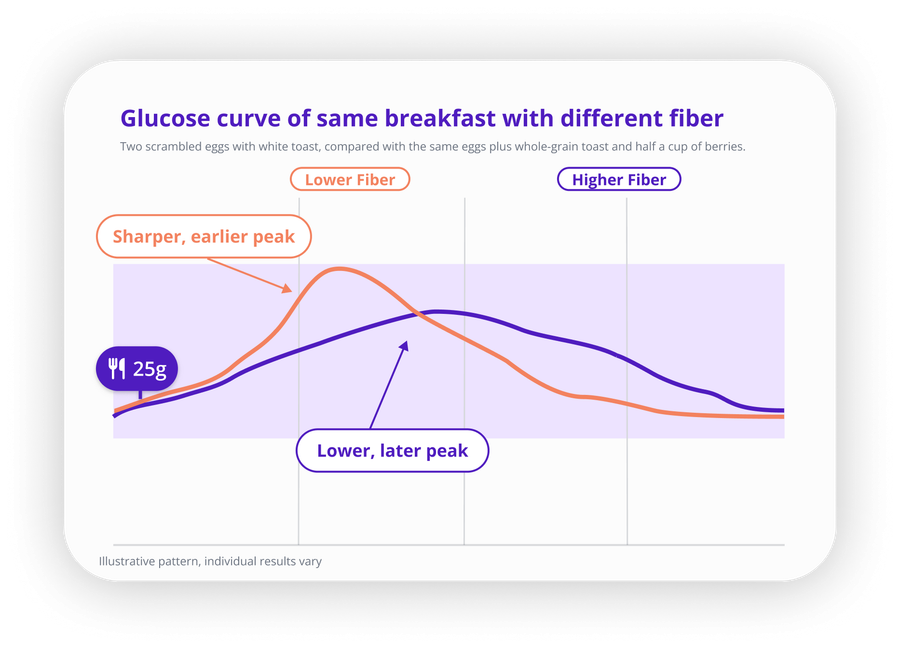
The 25g marker is the carb count for the meal, the way SNAQ shows it in the app. The shaded band is a usual range, not a target: your own targets come from your care team.
If Thursday climbs more gently, or peaks lower and later than Monday did, fiber is doing something for that meal and it is probably worth extending to others. If the two curves are near-identical, fiber is the wrong lever for that particular breakfast, and you have found that out in three days rather than three months of assuming.
Do this with two or three meals you eat on repeat and you will know more about your own response than any guideline can offer. Logging them with photos and stacking the curves side by side is more or less what SNAQ exists for, largely so a week of screenshots stays legible when you come back to it.
Added Fiber vs Natural Fiber
A lot of packaged food now has fiber added to it, listed as inulin, chicory root fiber or resistant starch. The first two are plant fibers extracted from one food and dropped into another, where they ferment quickly. Resistant starch is starch that escapes digestion in the small intestine and behaves like fiber further down.
All of them raise the number on the label, and they do not all behave the same way once they are inside you. Some are considerably more sociable about it at higher doses. Added fiber can affect your glucose differently than fiber that arrived inside the food it grew in.
The reasonable approach is whole food first, fortified products as backup, and some attention paid to which ones your own gut gets along with, because that varies a great deal between people.
When More Fiber Isn't the Answer
Fiber has a ceiling. A rise driven by something other than the makeup of the meal will stay roughly where it is no matter how much oatmeal you add to the morning.
If you are already eating reasonably and your post-meal numbers still climb higher than you would like, the louder variables are usually these:
- the type and amount of carbohydrate on the plate
- whether you moved afterwards, and where the meal landed in your day
- sleep, stress and hormonal shifts
- how your body handles carbohydrate in general, which belongs in a conversation with your care team and not in a blog post
Fiber cannot cancel out a large carbohydrate load, and asking it to carry an entire strategy is how people end up disappointed in something that was doing its actual job perfectly well.
Pulling It Together
Fiber is one of the few nutrition levers with genuinely decent evidence behind it for glucose, and most people are eating roughly half of what they could be, so there is real room to move here. What makes it work is patience, because the common way to fail at fiber has almost nothing to do with eating too little of it and almost everything to do with eating a great deal over one weekend and abandoning the idea by Wednesday.
A reasonable place to start is one meal, one change, and more water than feels strictly necessary, followed by a week of leaving everything else alone. Then eat the same breakfast twice and look at what your curve actually did. You can try SNAQ here if you would rather see the two side by side than hold them in your head.