
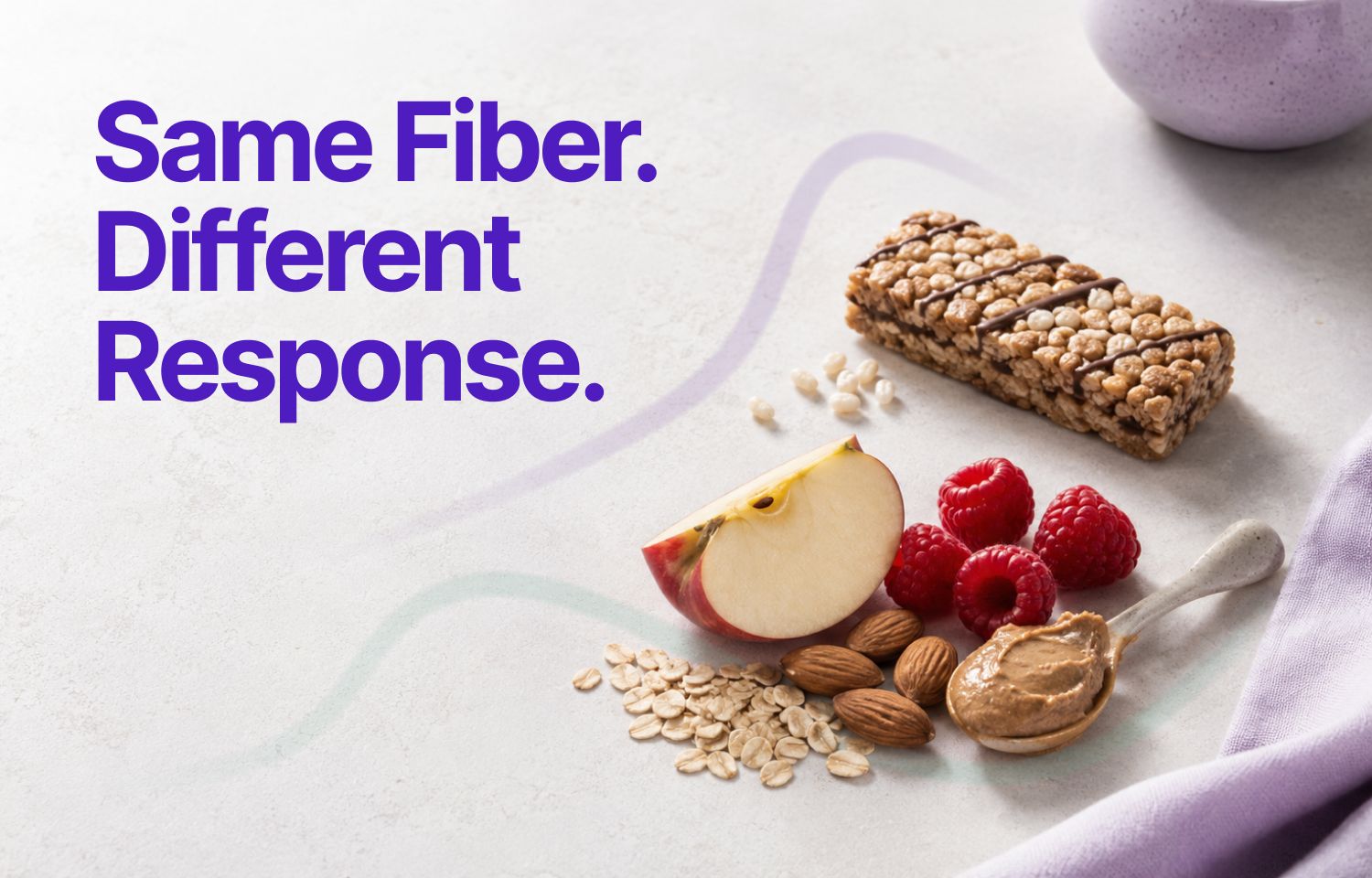
Quick answer: Not always. Natural fiber comes bundled with a food's structure, fat, and protein, which slows digestion. Added fiber is often mixed into a refined base that can still digest quickly, so two labels with the same fiber count can produce very different glucose curves.
You pick up two breakfast bars. One is made with oats, berries, and almonds. The other is a processed bar fortified with chicory root fiber and inulin. Both labels claim 10 grams of fiber per serving.
Will your glucose respond the same way?
Probably not. Fiber comes in more than one form, and where it comes from changes how your body handles it.
What Makes Fiber "Natural" or "Added"?
Natural fiber comes intact with the food: the skin on an apple, the hull on oats, the cell walls in lentils. You get it when you eat whole fruits, vegetables, grains, legumes, nuts, and seeds.
Added fiber is extracted, synthesized, or isolated, then mixed into foods that wouldn't normally contain much fiber. Common examples include inulin, chicory root fiber, polydextrose, resistant maltodextrin, and cellulose.
Both can bump up the fiber count on a nutrition label. They don't necessarily act the same way once they reach your gut or show up on your glucose curve.
How Fiber Type Affects Glucose Response
Fiber gets split into soluble and insoluble in most explainers, though that split only tells part of the story. What matters more is how the fiber interacts with digestion.
Soluble fiber dissolves in water and forms a gel-like substance in your digestive tract. This slows the movement of food and the absorption of glucose. Soluble fiber is found naturally in oats, barley, beans, lentils, apples, and citrus fruits.
Research shows that soluble fiber can improve after-meal glucose levels by slowing digestion and moderating glucose absorption. It's one of the reasons oatmeal often produces a gentler glucose curve than toast, even when carb counts are similar.
Insoluble fiber doesn't dissolve. It adds bulk and helps move food through your system, but it has less direct impact on glucose absorption. You'll find it in whole grains, wheat bran, nuts, seeds, and the skins of many vegetables.
What About Added Fiber?
Added fibers vary widely. Some behave like soluble fiber. Others are fermented by gut bacteria but don't slow glucose absorption much. A few are poorly fermented and pass through with minimal metabolic effect.
Inulin and chicory root fiber, for example, are soluble and fermentable. They can support gut health and may contribute to satiety, but they don't always slow glucose absorption as effectively as the fiber in a bowl of lentils or a handful of raspberries.
Resistant maltodextrin and polydextrose are designed to resist digestion, which is why they're often added to low-carb products. They contribute to the fiber total without adding digestible carbohydrate. Their impact on glucose curves, though, can be minimal next to eating a serving of vegetables or legumes.
Natural fiber usually comes bundled with the food's structure, water content, and other nutrients, and that bundling is what slows things down. Added fiber gets mixed into a refined base that can still digest fast, fiber boost or not.
The Evidence on Fiber and Glucose Control
A 2012 meta-analysis found that dietary fiber, particularly soluble fiber, was associated with improved glucose control in people with Type 2 diabetes. The benefit was clearest when fiber came from whole food sources.
Another review highlighted that fiber supplementation could support glucose management, especially when dietary intake was low. The effect varied, though, depending on the type of fiber, the dose, and the food matrix it was consumed with (the fat, protein, and structure surrounding it in a meal).
The American Diabetes Association recommends that adults aim for 25 to 30 grams of fiber daily, with an emphasis on naturally fiber-rich foods. That guideline reflects both the glucose benefits and the broader nutritional value of whole foods.
If You Don't Have Diabetes
You may still notice differences in how you feel after eating high-fiber whole foods versus processed foods with added fiber. Satiety, energy stability, and digestive comfort can all vary. Natural fiber tends to come with vitamins, minerals, phytonutrients, and slower-digesting carbohydrates, which can make the overall eating experience more satisfying.
Why the Same Fiber Gram Count Can Produce Different Curves
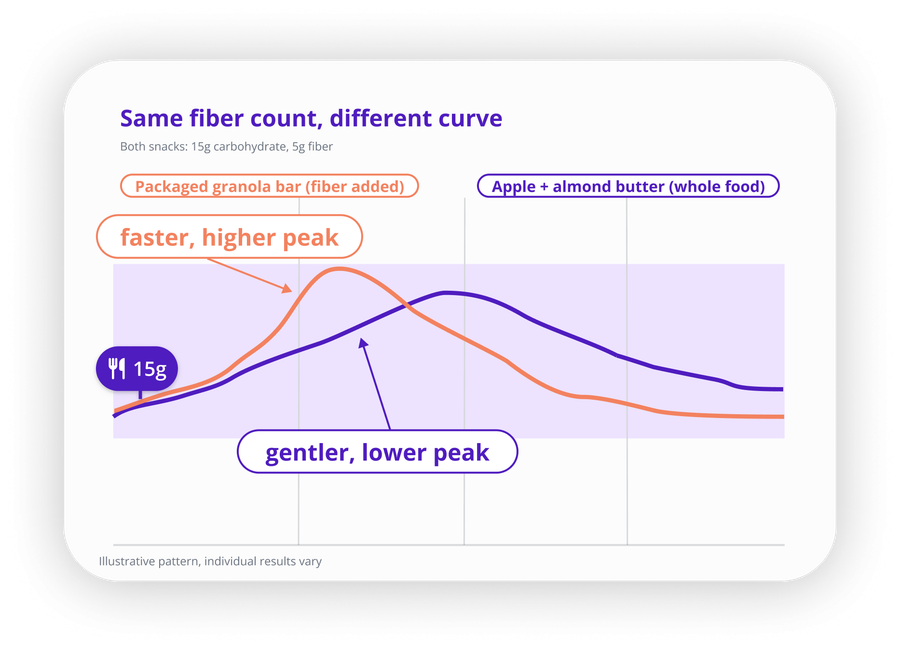
Imagine two snacks, each with 15 grams of carbohydrate and 5 grams of fiber.
One is a small apple with almond butter. The other is a fiber-fortified granola bar made with rice crisps, sugar, and added inulin.
The apple delivers fiber as part of its intact structure. The sugars are bound in the fruit's cells. Digestion takes time. The almond butter adds fat and protein, further slowing absorption.
The granola bar's base is processed grain and added sugar. The fiber is stirred in, but it doesn't change the fact that the carbohydrate source digests quickly. Your glucose curve may rise faster and higher, even though the fiber grams match.
This is why net carbs can be misleading. Subtracting fiber gives you a number, but it doesn't tell you how fast those carbs will hit your bloodstream or how your body will respond.
For a deeper look at how net carbs and total carbs affect glucose differently, see Net Carbs vs Total Carbs: Which One Actually Matters for Blood Sugar?
Should You Still Eat Foods with Added Fiber?
Sometimes, yes. Fiber-fortified foods can help you reach daily fiber targets, especially if whole food sources are hard to access or if appetite is low.
Added fiber isn't a shortcut to the same glucose response you'd get from whole foods, though. It tops up your fiber intake. It doesn't stand in for a plate of vegetables, legumes, fruit, and whole grains.
If you're choosing between two packaged foods, check the ingredient list. A product made with whole oats, flaxseed, or chia will likely give you more stable glucose than one made with white flour and added resistant starch, even if the fiber totals look similar.
How to Track Your Personal Fiber Response
Your glucose response to fiber depends on the type of fiber, the food it's in, the rest of the meal, and your gut microbiome.
The best way to know how a food affects you is to track it.
Log the meal. Note the fiber source: was it a whole food or a fortified product? Check your glucose curve 1 to 2 hours later. Repeat the same meal a few times to confirm the pattern.
Compare your response to a high-fiber whole food meal versus a similar meal with added fiber. You may see a gentler curve, a lower peak, or a faster return to baseline with the whole food version.
SNAQ can help you log meals with photo-based nutrition estimates, overlay your glucose data, and stack repeated meals over time. Instead of guessing whether fiber type matters for you, you can see it on your own curve.
If you don't have a CGM, you can still track this with fingerstick readings. For a guide to meal tracking without continuous glucose data, see How to Track Meals and Learn What Affects Your Blood Sugar Without a CGM.
Practical Takeaways
Fiber supports glucose control, but the source and type matter.
Whole food fiber has the edge here. Soluble fiber, in particular, has the strongest evidence behind it, and it works best when it's still attached to the food it came from.
Packaged foods with added fiber can still help you hit daily targets. Just don't expect them to swap in evenly for a serving of lentils, berries, or a bowl of oatmeal.
The label tells you the fiber count. Your curve tells you what actually happens after you eat it. Put a whole food source and a fortified one side by side and let your own data settle the question.
SNAQ makes it easier to compare how different fiber sources affect your curve by keeping meal context, nutrition estimates, and glucose data in one place. Start tracking with SNAQ.