Quick answer: On a CGM, breakfasts built on fast-digesting carbs, like white bread or sugary cereal, usually show a quicker, taller rise followed by a faster fall. Breakfasts that pair carbs with protein, fat, and fiber tend to rise more slowly and settle more gradually. Your own curve will still vary from person to person and from day to day, so the most reliable way to learn what your breakfast does is to log it and compare it on your own CGM.
Picture two mornings. On Monday you eat two slices of whole grain toast with peanut butter. On Tuesday you eat two slices of white toast with jam. Same type of food, same time of day, same you.
On a CGM (continuous glucose monitor, a small sensor that tracks your glucose around the clock and draws it as a curve), those two breakfasts can still look very different. The first often climbs gradually and rounds off. The second tends to rise faster and higher, then fall back sooner.
This article covers what common breakfast patterns usually look like on a CGM, why they look that way, and how to build a breakfast with a smaller, slower rise. That is all "flatter" means here. It also covers why the exact same breakfast can look different from one morning to the next.
What do common breakfasts look like on a CGM?
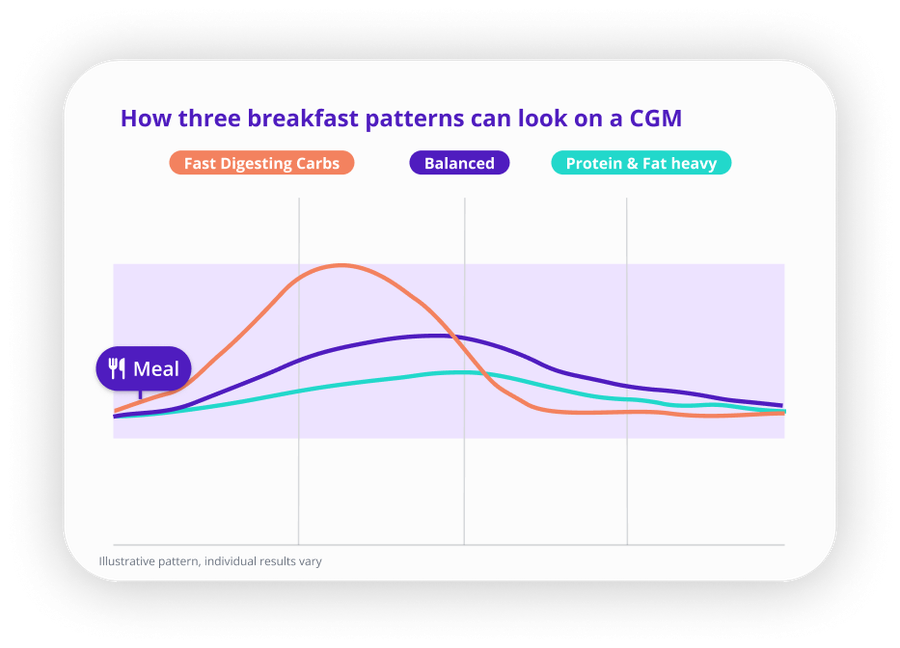
Three broad patterns show up most often. Treat them as typical shapes, not predictions. Individual responses to the same food can differ a lot, and we get to that below.
Fast-digesting carbs: a quicker, taller rise
White bread, sugary cereal, pastries, and instant oatmeal packets break down into glucose quickly. A bowl of frosted flakes with low-fat milk is a classic example. On a CGM, that usually looks like a rise that starts soon after the first bite, a high peak, and a faster fall afterward. Some people notice hunger coming back sooner after a curve like this.
Protein and fat heavy: a slower, lower rise
Scrambled eggs with cheese, half an avocado, and a handful of cherry tomatoes contain very few carbs, so the curve tends to look like a low, gentle hill, if it moves much at all. The tradeoff is that this breakfast is very low in carbohydrates. Some people feel great on it. Others feel low on energy without a quick source of fuel in the morning.
Balanced: carbs with protein, fat, and fiber
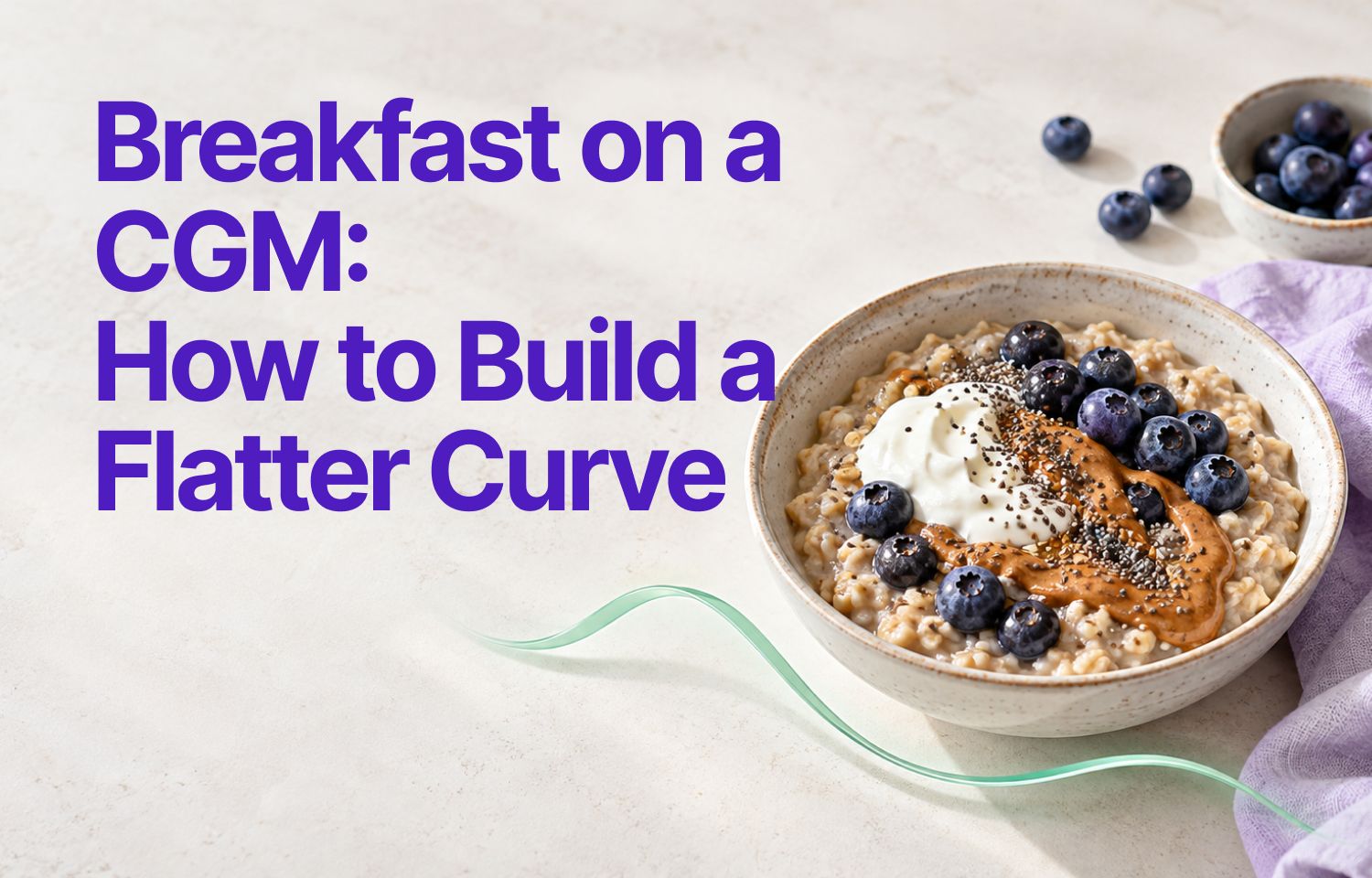
Steel-cut oatmeal with plain Greek yogurt, a spoonful of almond butter, and a handful of blueberries is a good example. It still has carbs for energy, but protein, fat, and fiber come along for the ride. The curve usually lands between the other two: slower than the cereal, more visible than the eggs.
Why do breakfasts look so different on a CGM?
It mostly comes down to how fast a meal is digested and absorbed.
How the food is processed matters. Glycemic index (GI) ranks how quickly a carb-containing food raises glucose compared with a reference food. A systematic review of oat products found that steel-cut and large-flake oats had GI values around 55 and 53. It also found that smaller particle size and more starch gelatinization (the starch swelling and softening with cooking and steaming) tended to raise the glucose response.¹ That is why plain steel-cut oats and an instant packet can behave very differently, even though both are "oatmeal."
What you eat with the carbs matters too. Reviews of research on protein and fat eaten before a meal point to fat as the strongest at slowing how fast food leaves the stomach (called gastric emptying), with protein having a smaller effect.² In one small study of healthy adults, a meal with carbs plus fat, protein, and fiber together produced a lower glucose response than the same carbs on their own, while adding just one of those nutrients made little difference.³ That was a preliminary study, so treat it as a useful hint rather than a rule.
The order you eat in can play a role. A systematic review in healthy adults found that eating fiber-rich vegetables or protein before carbs tended to lower the glucose response after a meal, although the size of the effect varied.⁴
If you want a deeper look at low glycemic index foods and how they affect glucose, we cover them in a separate article.
Why can the same breakfast look different from one morning to the next?
Two things are at work: you are not identical to anyone else, and you are not identical to yourself at every hour of the day.
Individual differences. In a widely cited 2015 study, researchers tracked glucose in about 800 people across more than 46,000 meals and reported high variability in how different people responded to the same foods.⁵ Other researchers have questioned how large that variability really is,⁶ so the safe takeaway is this: published averages are a starting point, and your own CGM data is the better guide.
Time of day. In the early morning, hormones including cortisol and growth hormone signal the liver to release glucose, a pattern called the dawn phenomenon. It typically happens between about 3 and 8 AM.⁷ ⁸ For people with diabetes, this can mean waking up with higher glucose than expected, which can give breakfast a higher starting point. We look at why breakfast often spikes glucose more than lunch or dinner in a separate article.
That does not mean breakfast always spikes the most. In controlled studies, the same kinds of meals tended to produce a bigger glucose response at dinner than at breakfast on average.⁹ ¹⁰ Averages hide a lot, though, and your mornings may look different. That is exactly why watching your own curve beats guessing.
If your mornings run higher than you would like on a regular basis, bring the pattern to your care team. A CGM export gives them something concrete to look at.
How do you build a breakfast with a smaller, slower rise?
Think in four building blocks: a carb base, protein, fat, and fiber. Pick one option from each and see how it looks on your curve.
| Block | Examples | What it adds |
|---|---|---|
| Carb base | Steel-cut or rolled oats, whole grain toast, a small serving of fruit | Energy. Less processed forms, like steel-cut oats, tend to digest more slowly than instant ones. |
| Protein | Eggs, Greek yogurt, cottage cheese, nut butter | A smaller slowing effect on how fast food leaves the stomach, plus a more filling plate. |
| Fat | Avocado, nuts, seeds, cheese | The strongest slowing effect of the three on stomach emptying. |
| Fiber | Berries, chia seeds, flaxseed, spinach, other non-starchy vegetables | Bulk that slows digestion. Eating fiber-rich foods first has lowered post-meal glucose in studies of healthy adults. |
How to read this: pick one example from each row, keep portions steady for a few mornings, and compare the curves.
Portions: how much of each block is right for you is a question for your care team or dietitian.
Here is a simple way to test it:
- Pick a base and one option from each of the other blocks.
- Keep your portions roughly the same for a few mornings so the curves are comparable. Here is how many times to repeat a meal before drawing conclusions.
- Log what you ate, then check the curve afterward. Add a quick note about anything unusual, like a bad night of sleep or a morning walk.
- Change one thing at a time. Swapping instant oats for steel-cut, adding eggs or Greek yogurt, adding berries or chia seeds, or eating the protein and vegetables first are all common experiments.
What counts as "too steep" depends on your own targets, so ask your care team or dietitian which range makes sense for you before you change how you eat. The goal is a breakfast you will actually eat most mornings and whose curve you can predict.
How can SNAQ help you compare your breakfasts?
Comparing breakfasts is much easier when what you ate sits right next to how your glucose responded.
SNAQ is a food and glucose tracking app for diabetes and metabolic health. You can log breakfast with a photo, a barcode, a quick description, or a search, and SNAQ places the meal on your CGM curve (it works with Dexcom and FreeStyle Libre, among others). Scroll back through past mornings and you can see which breakfasts rose more slowly and which ones climbed higher than you expected. SNAQ can also show a predicted glucose peak before you eat and offer meal tips based on your own data.
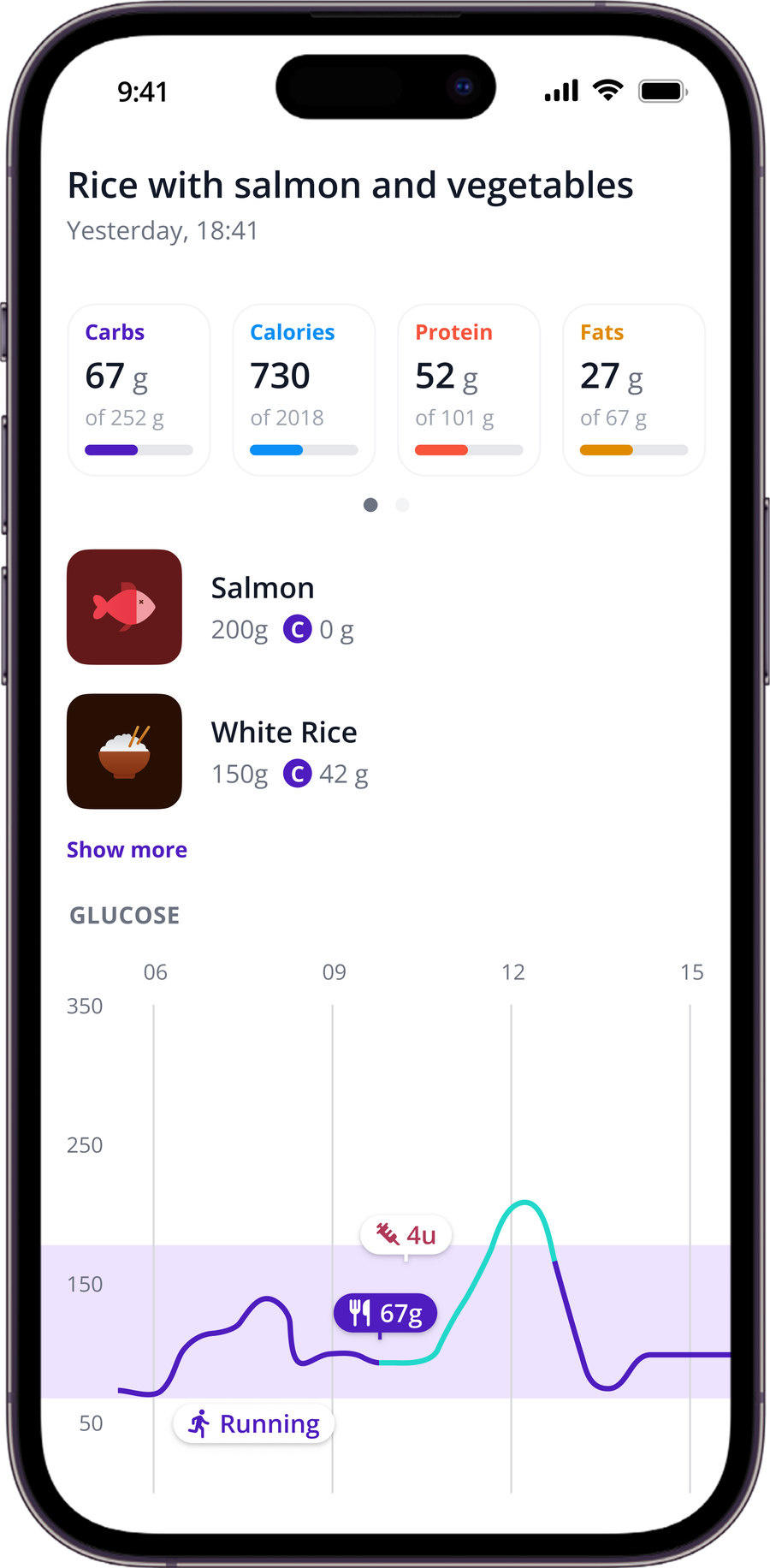
That makes small experiments easy to read: instant oats against steel-cut oats, one egg against two, breakfast at 7 AM against 8 AM. If you want to see how your own mornings look, try SNAQ here. You can also read more about the SNAQ CGM food tracker or how SNAQ can analyze your CGM data with AI.