By the SNAQ Team
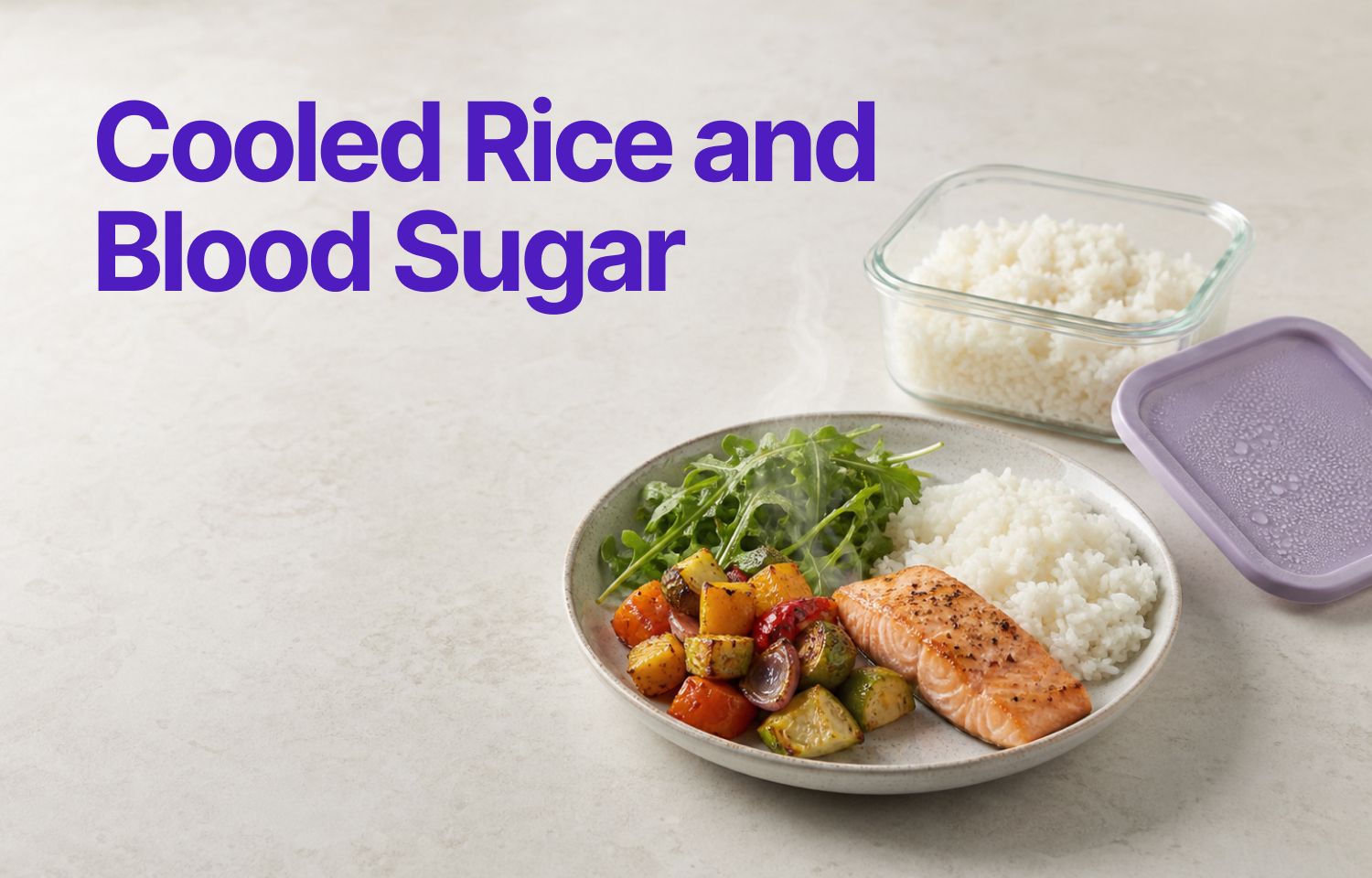
Quick answer: Cooling cooked rice does form resistant starch, and studies in both healthy adults and people with type 1 diabetes found a lower glucose rise compared with rice eaten fresh. Reheating doesn't wipe it out. The catch is that the effect is small, it didn't show up in every trial, and portion size still does more to your curve than temperature does.
You cool your leftover rice overnight, warm it up at lunch the next day, and an hour later your CGM is climbing.
Cold rice is supposed to be the better option. So what gives?
The idea behind it holds up. Cooling rice converts some of its starch into a form your body can't break down as easily. But the internet oversold it. The effect is small, it doesn't show up for everybody, and it was never going to flatten a curve on its own.
What Happens When Rice Cools
Cooking does most of the damage, in glucose terms. Heat blows open the starch granules and leaves a structure your digestive enzymes can tear through fast.
Cooling reverses a little of that. Some of the starch reorganizes into tight crystals enzymes can't get a grip on. Scientists call it retrogradation. Same thing happens to potatoes and pasta in the fridge.
What survives is resistant starch. It acts less like a carb and more like fiber, and much less of it ends up in your bloodstream as glucose.
Does Cooling Rice Actually Lower Blood Sugar?
Usually, a little.
One team cooked white rice three ways and weighed the resistant starch in each batch. Fresh out of the pot: 0.64 g per 100 g. Left on the counter for 10 hours: 1.30 g. Refrigerated at 4°C for a full day and then reheated: 1.65 g. They fed that last batch to 15 healthy adults against a fresh control, and glucose response came out significantly lower.
The study worth more of your attention ran in people who actually deal with this. Thirty-two adults with type 1 diabetes. Two standardized meals of long-grain white rice, one fresh and one chilled 24 hours then reheated, tracked for three hours on a FreeStyle Libre. Peak glucose came in lower on the cooled version, and the area under the curve was less than half.
That same study found something else worth knowing. Participants had significantly more low-glucose episodes in the three hours after the cooled rice: 12 episodes compared with 3 after the fresh rice. Everyone in the trial used an insulin pump and took the same amount for both meals, even though the cooled rice released less usable carbohydrate. The researchers flagged it as something to work out with a clinician. If you use insulin, that's the reason to talk to your care team before you start swapping cooled rice into your regular meals.
Now the inconvenient one. A randomized crossover trial found no meaningful difference at all between cooled and freshly cooked rice. Its authors put it plainly: cooling starchy foods often lowers glucose response, but not always.
Which leaves you somewhere annoying. On average it helps a bit. Whether it helps you is not a question a study can answer.
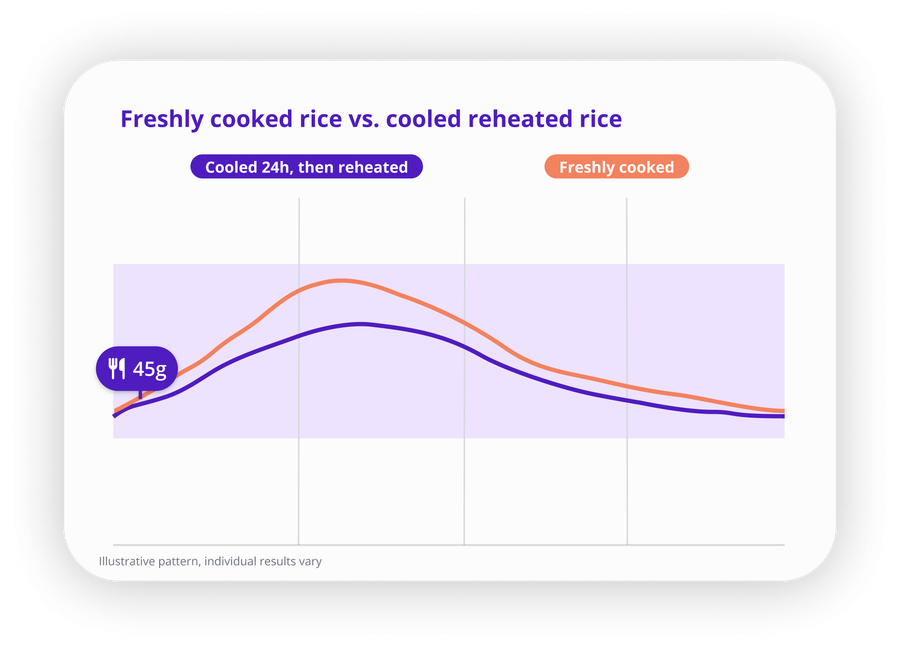
An illustration of how the two curves typically compare, based on published study findings. Not measured data, and not a prediction of your own response.
Does Reheating Undo the Benefit?
No. And the popular version of this advice has it exactly backwards.
You've probably read that reheating melts resistant starch back into ordinary starch, so cold rice salad counts but yesterday's warmed-up leftovers don't. Go look at the actual studies. Both trials above ran on rice that spent 24 hours in the fridge and got reheated before anyone ate it. In the first one, the chilled-and-reheated batch carried more resistant starch than the batch that just sat out on the counter.
Work on parboiled rice explains why. Refrigeration pulls the starch out of a loose, disordered arrangement into an ordered crystalline one, and that crystal structure holds up when you warm the rice back up.
You do lose some to reheating. Just not enough to matter, judging by the trials.
So those leftovers you microwaved at lunch? Those are the ones with the research behind them.
Which Rice You Use Changes How Much Forms
Varieties don't retrograde equally, and it comes down to which of two starch molecules dominates.
Amylose is straight and tightly packed. It resists digestion better, and it's what reorganizes into resistant starch as things cool. Amylopectin is branched, loose, quick to break apart. More amylose, more resistant starch after a night in the fridge.
Here's where people get tripped up. Grain length tells you almost nothing. Jasmine is long-grain and sits at the low end of the amylose range, which is exactly why it cooks up soft and clumps a little. Basmati is also long-grain and runs considerably higher.
| Rice | Typical amylose | What that tends to mean when it cools |
|---|---|---|
| Basmati | Higher, roughly 22 to 25% | More amylose to reorganize, so more resistant starch tends to form. Cooks up firm and separate. |
| Jasmine | Lower, roughly 15 to 18% | Long-grain, but lower in amylose. Softer and slightly sticky, and less resistant starch tends to form. |
| "Long-grain white" | Varies a lot | A shelf label, not a starch profile. Jasmine is long-grain and sits low. Check the variety, not the grain length. |
| Short-grain, sushi, glutinous | Lowest | Mostly amylopectin, which is what makes it sticky. The least resistant starch forms on cooling. |
Those ranges move with cultivar, growing region, and milling. Two bags with the same word on the front won't always act the same.
Why the Same Rice Can Give You a Different Curve
Same variety, same portion, same 24 hours in the fridge, and your numbers still wander.
That's expected. Gut bacteria, insulin sensitivity, how you slept, what you did that afternoon, how stressed you were: it all feeds into how a meal lands. Two people can eat out of the same pot and get curves that look nothing alike.
Time of day pulls its own weight here. Plenty of people run more insulin resistant in the early morning, partly down to the dawn phenomenon, which is the glucose rise that happens on its own in the hours before you wake up. The same bowl at 7am and 7pm won't necessarily draw the same shape.
A spike after cooled rice doesn't mean the resistant starch did nothing. Could be the portion. Could be that the plate was almost all carbohydrate. Or your body just handled it differently that day.
We got into why a food's number on paper rarely predicts what your body does with it in this piece on low glycemic index foods.
What Matters More Than Cooling
Cooling is a small lever. Four things pull harder.
Portion size. Cold rice is still rice.
What you eat with it. Protein, fat and fiber all slow digestion down. Rice sitting next to salmon and a pile of vegetables behaves differently from a bowl of plain rice, and that gap is usually wider than anything cooling gets you.
Which bag you buy. A higher-amylose variety can produce a gentler response served hot, no fridge involved.
Time of day. Morning insulin resistance can amplify the rise from any carbohydrate, rice included.
Treat those as variables to watch, not rules to follow. Your own readings will sort out which ones matter for you, and your care team is the right audience for whatever you find.
Rice isn't the only staple that behaves unpredictably. We looked at a few others in why simple carbs don't all affect blood sugar the same way.
How to Test It on Yourself
One meal proves nothing. The effect is small and the noise around it is loud, so a single reading tells you about that reading and not much else.
Set it up properly instead. Same rice, roughly the same portion, same sides, same time of day. Once fresh, once chilled overnight and reheated. Run it a few times. What you're after is the pattern across the set.
Testing is the easy part. Recalling three weeks later whether that particular Tuesday bowl was the fresh one or the fridge one, while you're squinting at your data hunting for a pattern, is where this usually falls apart.
SNAQ handles the record-keeping. Log the meal, tag whether the rice was fresh or cooled, and the glucose response is sitting right next to it when you go back through. Save it as a favorite and next time it's one tap, so you're comparing the same thing instead of something close to it. You log from a photo, so no kitchen scale required.
Do that across a dozen meals and you'll have an answer for your own kitchen. Which is more than the research can hand you.
Download SNAQ to log meals and review your glucose patterns in one place.