
Quick answer: Coffee, even black coffee with no sugar or carbs, can raise glucose in some people with diabetes. Caffeine temporarily lowers insulin sensitivity and triggers stress hormones that release stored glucose from your liver, and that effect can show up on a CGM within 30 to 90 minutes. Not everyone reacts the same way, so testing your own response is the only real way to know.
You take a sip of black coffee. No sugar, no cream, no carbs. An hour later, your CGM shows a rise you didn't expect.
This happens to plenty of people with diabetes, and it's not about what you added to the cup. It's about what caffeine does inside your body before glucose from food ever arrives.
Does Caffeine Affect Insulin Sensitivity?
Caffeine is a stimulant. It affects your central nervous system, but it also influences how your cells respond to insulin.
In some people, caffeine temporarily reduces insulin sensitivity. That means it takes more insulin to move the same amount of glucose into your cells, and if your body can't keep pace with that shift, it can show up as a rise on your CGM.
This effect is most noticeable in the first hour or two after drinking coffee. A review of clinical trials found that caffeine can acutely raise blood glucose by affecting insulin pathways, particularly in people with diabetes.[1]
Not everyone reacts the same way, and the gap can be wide: one person's CGM won't move a bit, while another's climbs noticeably within the hour. What decides it is how often you drink coffee, how sensitive you generally run to insulin, and whatever else is going on in your body that morning.
Why Does Black Coffee Still Raise Glucose?
Black coffee has almost zero carbohydrates. But glucose can rise without carbs if something else changes how your body uses insulin.
Caffeine triggers the release of stress hormones like cortisol and adrenaline. These hormones signal your liver to release stored glucose. That's useful if you're running from danger. It's less useful if you're sitting at a desk with a latte.
For someone without diabetes, the pancreas responds by releasing more insulin to cover the extra glucose. For someone with Type 1 diabetes, the body doesn't make that extra insulin on its own, so the glucose rise tends to be more noticeable. For someone with Type 2 diabetes or insulin resistance, the body's response may be delayed or insufficient, and controlled trials have measured exactly that effect after caffeine.[4]
The result: a glucose rise that looks like it came from food, but didn't.
Does Decaf Coffee Do the Same Thing?
Not usually.
Decaffeinated coffee has most of the caffeine removed, which means it's far less likely to affect insulin sensitivity or trigger a glucose release from the liver. A systematic review of clinical trials in healthy adults found no significant effect of decaf coffee on blood glucose, which lines up with caffeine, not coffee itself, being the main driver.[2]
If you see a rise after decaf, it's worth checking what else is in the cup. Milk, flavored syrups, sugar, or even certain sugar substitutes can contribute carbs or affect digestion timing.
Some people still notice a small glucose shift with decaf, possibly due to other compounds in coffee or individual digestive patterns. But the effect is usually much smaller than with caffeinated coffee.
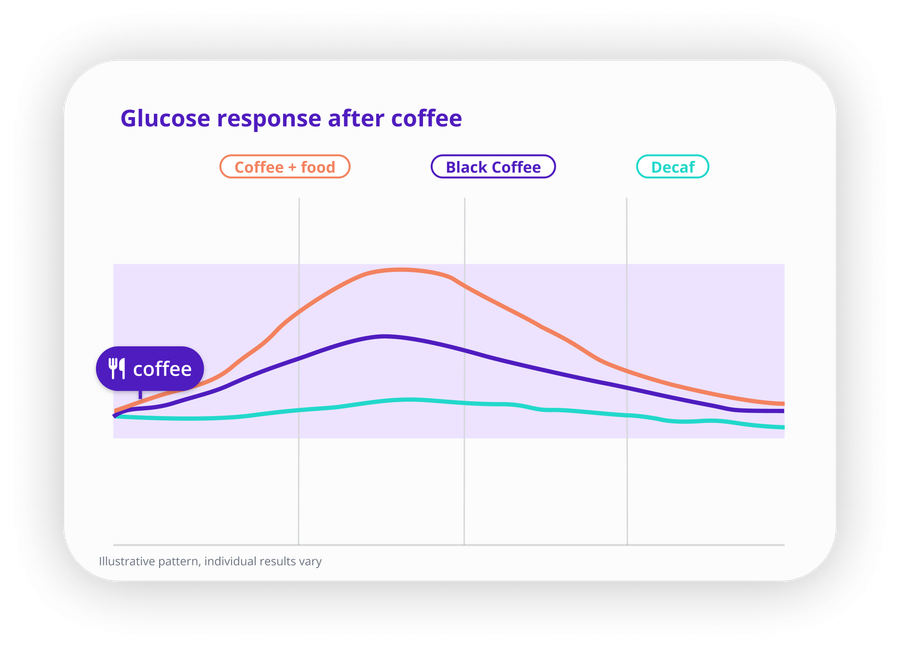
Illustrative pattern only. Individual glucose response to coffee varies by person.
What About Milk, Cream, or Sugar?
Adding milk or sugar changes the glucose picture immediately.
Milk contains lactose, a sugar that raises blood glucose. Whole milk, skim milk, oat milk, and almond milk all contribute different amounts of carbohydrate. A splash may not matter much. A full cup does.
Sugar, honey, or flavored syrup will raise glucose directly. That rise may happen faster than the caffeine-related effect, so the two can overlap on your CGM graph.
Even cream, which is low in carbs, can slow digestion slightly and shift the timing of a glucose rise if you're also eating something alongside your coffee.
If you're trying to figure out whether coffee itself is the issue, test black coffee on its own first. Then test it again with your usual additions. That way you know which part of the routine is driving the curve.
| Coffee type | What it might do to glucose | What to check next |
|---|---|---|
| Black coffee | Can raise glucose on its own in some people. Comes from caffeine's effect on insulin sensitivity and stress hormones, not from carbs. | Was it on an empty stomach? How long since your last cup? |
| Decaf coffee | Rarely raises glucose on its own since most of the caffeine is removed. A small shift is possible, but usually minor. | Check what else is in the cup, like milk, syrup, or sugar substitutes. |
| Coffee with milk | Adds lactose, a natural sugar, on top of any caffeine effect. The amount depends on the milk type and quantity. | How much milk, and which kind? A splash is different from a full cup. |
| Coffee with sugar or syrup | Raises glucose directly, often faster than the caffeine-related effect, so the two can overlap on your CGM graph. | Test the same coffee black first, so you know how much of the rise is the added sugar. |
How to Test Your Own Coffee Response
The best way to know what coffee does to your glucose is to run a small experiment.
Pick a morning when you haven't eaten yet. Drink black coffee and log it. Watch your CGM for the next two hours. Note the timing, the peak, and how long it takes to return to baseline.
Try the same test on a different morning with decaf. Keep everything else the same: same time, same fasting state, same activity level.
If you normally add milk or sugar, test that version separately so you can compare all three scenarios.
You may find that coffee on an empty stomach causes a rise, but coffee after a meal doesn't. Or that your first cup of the day has a bigger effect than your second. These details matter because they help you decide whether to adjust timing, switch to decaf, or simply expect a small rise and plan around it.
If you're tracking multiple mornings and want to compare the same coffee routine across different days, SNAQ can help you log the drink, mark the timing on your CGM graph, and spot patterns that might not be obvious from a single data point.
Does It Matter if You Drink Coffee Every Day?
Possibly.
Some research suggests that habitual coffee drinkers may develop partial tolerance to caffeine's effects on insulin sensitivity. In one controlled trial, two weeks of daily caffeine did blunt the response in people who hadn't been drinking it, but their glucose handling was still disrupted at the end. So the effect may soften over time rather than disappear.[5]
Other studies show that regular coffee consumption is associated with a lower risk of developing Type 2 diabetes in people without diabetes.[3] But that doesn't mean coffee improves glucose control in people who already have diabetes, those are two different questions with two different answers.
If you've been drinking coffee for years and suddenly notice a new glucose pattern, it's worth reviewing what else changed: your medication, your meal timing, your sleep, or your activity level. Coffee may not be the only variable.
If tolerance is part of what's going on for you, week one and week three of the same coffee habit can look genuinely different on a CGM. That's the comparison worth watching, not just one morning against another.
What to Try if Coffee Keeps Spiking Your Glucose
If coffee consistently raises your glucose and you'd rather avoid that, here are a few options:
Switch to decaf. This removes most of the caffeine-related insulin sensitivity effect. You keep the ritual, the flavor, and the warmth without the glucose rise.
Drink coffee with a meal instead of before it. Food slows caffeine absorption and may blunt the stress hormone response. The glucose rise from the meal may mask or smooth out the coffee effect, depending on what you eat.
Try smaller amounts. A full mug may trigger a noticeable rise. A half cup may not. You can also dilute regular coffee with decaf to reduce caffeine gradually.
Move coffee later in the morning. Dawn phenomenon and morning insulin resistance can make the first few hours after waking especially sensitive to anything that affects insulin. Coffee at 10 a.m. may behave differently than coffee at 7 a.m.
Pair coffee with protein or fat. A handful of nuts, a hard-boiled egg, or a piece of cheese won't stop the caffeine effect, but it may reduce the size or speed of the glucose rise by slowing digestion and providing a steadier fuel source.
Running these experiments over a week or two? That's exactly the kind of side-by-side comparison SNAQ was built for, so you're not stuck holding it all in your head.
When Coffee Isn't the Problem
Sometimes the glucose rise you see after coffee has nothing to do with the coffee itself.
If you're drinking coffee first thing in the morning, you may be seeing dawn phenomenon: a natural rise in glucose caused by hormones your body releases before you wake up. Coffee just happens to be there at the same time.
If you're drinking coffee during a stressful morning, the stress response may raise glucose independently. Cortisol from stress and cortisol from caffeine can overlap, making it hard to separate the two.
If you're drinking coffee alongside breakfast, the timing of the meal may matter more than the drink. A high-carb breakfast will raise glucose whether or not you add coffee. The coffee may make the rise slightly steeper, but it's not the main driver.
To figure out what's actually happening, you need context. That means logging the coffee, the meal, the timing, and the sleep quality from the night before. Patterns across a few days are more useful than one surprising spike.
The Bottom Line
Coffee can raise glucose in some people with diabetes, even when it's black, and the reason has nothing to do with carbs. Caffeine's short-term effect on insulin sensitivity, combined with a stress hormone response, can be enough on its own.
Whether that happens to you, and how much, comes down to your own body and habits. The only way to know for sure is to test it: black coffee on an empty stomach, then decaf, then your usual routine with milk or sugar, all compared on your CGM.
If the pattern is one you'd rather not have, switching to decaf, pairing coffee with food, or moving it later in the morning are all reasonable places to start. And if you want to run these comparisons across a few mornings without losing track of which cup did what, SNAQ can help you log it all and see the pattern side by side.