
Quick answer: Eating vegetables and protein before carbs really does blunt the glucose spike that follows, and the evidence is strongest in people with Type 2 diabetes. It's a smaller effect if you don't have diabetes, and it barely matters if the meal was mostly refined carbs to begin with.
You eat the exact same lunch two days in a row, and somehow your glucose behaves completely differently, calm one day, spiking past 200 the next.
One theory floating around diabetes forums and Instagram reels says the order matters more than the meal itself: vegetables first, then protein, carbs last.
Does that actually hold up, or does it just sound true?
What the Research Found
Fiber slows digestion first, protein slows it further, so by the time the carbs show up they get absorbed more gradually and the spike that follows tends to be smaller.
Shukla and colleagues tested this directly in 2015, feeding 11 people with Type 2 diabetes the same meal on different days, once vegetables-and-protein-first, once carbs-first. Eating vegetables and protein first dropped glucose by 28.6% at 30 minutes, 36.7% at 60 minutes, and 16.8% at 120, compared with eating carbs first.
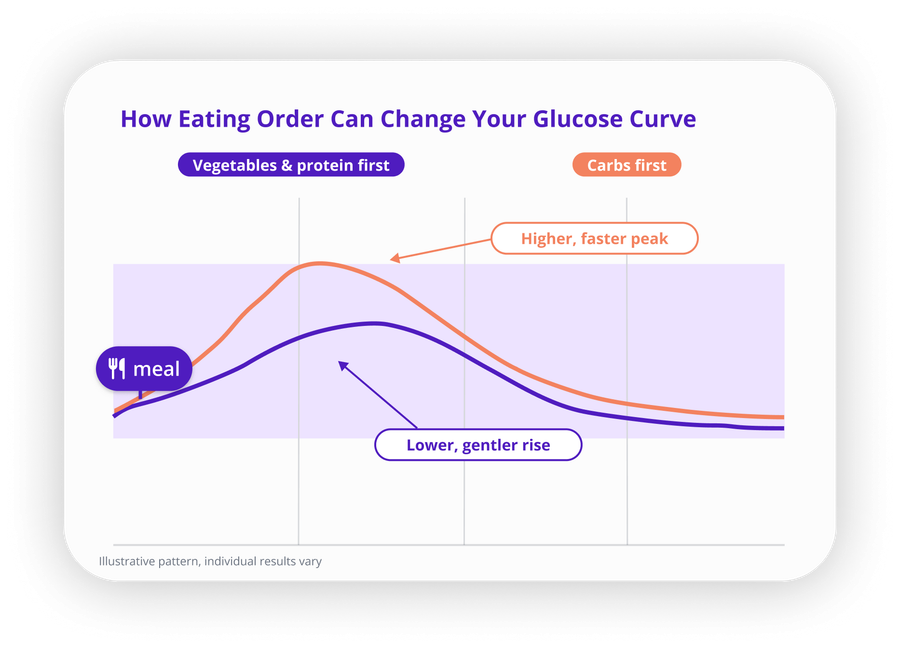
Eleven people isn't a large study, but it's a real head-to-head comparison, and the drop wasn't trivial.
The Mechanics of It
Vegetables slow how fast glucose can hit the bloodstream, mostly just by getting there first. Protein works a different angle: it triggers gut hormones called incretins, GLP-1 among them, which push the pancreas to release insulin and tell the stomach to slow down.
A separate, smaller study looked at the protein piece on its own. Eight people with Type 2 diabetes drank a protein preload before a carb-heavy meal back in 2009, and it took noticeably longer for their stomachs to empty afterward, with a smaller glucose rise to match.
Neither of these is a large trial. What they share is the same underlying physiology, and that's harder to dismiss than either study would be on its own.
If You Don't Have Diabetes
The effect is smaller without diabetes, but it's still there. A 2013 study out of Japan put people with Type 2 diabetes and people with normal glucose tolerance on CGMs side by side, feeding both groups the same meals in different orders. Glucose swings evened out for both groups, just less dramatically for the non-diabetic one.
If you landed here without diabetes, this can still help with that post-lunch crash. Most of the underlying research, though, was built around people managing Type 2.
Where This Falls Apart
Changing the order doesn't change the total. A meal with 120 grams of carbs still has 120 grams of carbs no matter what order you eat it in, and the American Diabetes Association points to total carb intake, and how it's spread through the day, as the more reliable lever. Sequencing works around the edges of that.
It also won't do much for everyone. Some people watch their CGM flatten out the moment they flip the order; others see almost nothing change. If you're in that second group, that's usually not on you. It typically means the meal didn't have much fiber or protein to begin with.
Should You Try It?
If you're already using a CGM, this is one of the easier things to test yourself. Pick a meal you eat often, log it as usual for a few days, then flip the order, vegetables, protein, carbs, and log it again.
Watch three things: does the peak come in lower, is the climb slower, does it return to baseline sooner. That tells you more than chasing one perfect-looking line.
Give it a week and you'll have a real answer instead of a guess.
Where SNAQ Fits In
Doing this yourself means eating the same meal twice, in two different orders, and remembering what happened well enough to actually compare the results. That's the tedious part.
SNAQ handles the logging: snap a photo of the plate, note the order you ate it in, then pull up the CGM overlay whenever you're ready to look. After a few repeats, the pattern is usually obvious.
SNAQ won't tell you what to eat first. It'll show you what happened when you did.
For more on this: how to improve your Time-in-Range after meals, why low-GI foods still spike some people anyway, and how many times you should repeat a meal before trusting what you're seeing.