
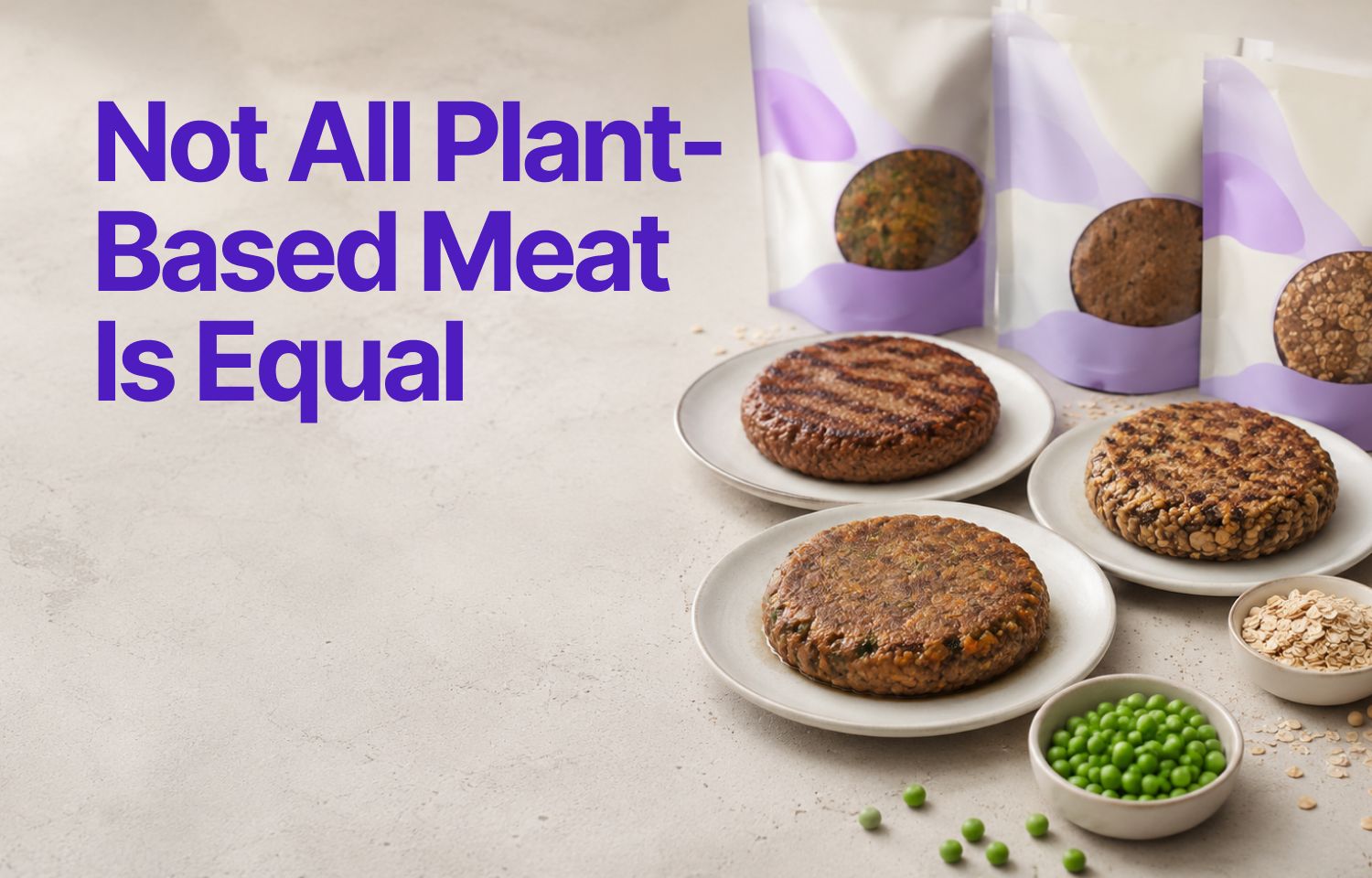
Quick answer: Plant-based meats vary widely in carbs, fiber, and added sugar, so the brand alone won't tell you how a product affects your glucose. Check total carbohydrate, fiber, and the ingredient list for hidden sugars first, then confirm how you personally respond with your own readings after eating.
Walk down the plant-based aisle and you'll see Beyond Meat next to Impossible Foods next to Quorn, all promising to taste like the real thing. What they don't promise is the same nutrition. A plant-based burger patty can have 3 grams of carbohydrate or 15. One brand's sausage might contain methylcellulose and pea protein isolate, while another lists whole grains and legume flour.
If you're managing diabetes with a CGM, the label tells you what your glucose curve will respond to. Here's what actually matters.
Why Plant-Based Meats Aren't Nutritionally Interchangeable
Traditional meat contains almost no carbohydrate. Plant-based alternatives are built from legumes, grains, soy, or textured vegetable protein, and most contain at least some carbs.
That difference shows up on your CGM, sometimes as a flatter curve and sometimes as a spike you didn't expect from a burger.
A few products are engineered to sit close to real meat on paper: high protein, low carb, barely any glucose impact. Plenty more are built for taste and texture instead, and lean on starches, binders, or sweeteners that push the carb count up fast.
The category is too varied to make blanket assumptions. You have to read the label.
| Check | Why it matters | What to look for |
|---|---|---|
| Total carbohydrate | The biggest driver of your post-meal glucose response. | Check serving size first, then compare grams across brands. Ranges from about 3 to 18g per serving. |
| Fiber | Slows absorption and can flatten the curve. | Look for 3g or more per serving. Whole grains, legumes, or added fiber sources push this higher. |
| Added sugars | Can add fast-digesting carbs you don't expect from a savory product. | Scan the ingredient list for cane sugar, dextrose, maltodextrin, maple syrup, or agave. |
| Sodium | Doesn't affect glucose directly, but matters for blood pressure. | Aim for 400mg or less per serving where possible. |
| Protein | Slows digestion and can moderate the glucose rise. | Most products run 15 to 20g per serving. More protein at a similar carb count often means a flatter curve. |
How Many Carbs Are in Plant-Based Meat?
This is the number that matters most for post-meal glucose response.
Check the serving size before anything else. One brand might list nutrition per patty. Another might use 100 grams, or a serving size noticeably smaller than what you'd actually put on your plate.
Then compare total carbohydrate across products. A 4-ounce burger alternative might have anywhere from 3 to 18 grams of carbs depending on the brand and formula.
If you're using carb counting to guide meal decisions, treat the label number as your baseline estimate, just as you would with any other packaged food.
Fiber Helps, But Check How Much
Fiber slows glucose absorption. It doesn't raise blood sugar the way digestible carbs do.
Plant-based meats tend to have more fiber than animal meat, which is a real advantage, though the amount swings a lot from brand to brand.
You'll see 1 gram of fiber on some labels and 4 or 5 grams on others, usually because those products lean on whole grains, legume flour, or an added fiber source like inulin or chicory root.
More fiber generally means a gentler curve. If two products look similar everywhere else, the one with more fiber is usually the one to pick.
For more on how fiber fits into broader glucose patterns, see how carb estimates can differ in real-world scenarios.
Do Plant-Based Meats Have Hidden Sugars?
Seasoning is one thing. Added sugar for flavor or browning is another, and it's easy to miss on a savory product.
Check the ingredient list for:
- Cane sugar
- Brown sugar
- Dextrose
- Maltodextrin
- Maple syrup
- Agave
- Natural flavors (sometimes includes sweeteners)
Even small amounts add up. 2 to 4 grams of carbohydrate per serving is common in anything marinated, glazed, or built to taste like barbecue or teriyaki.
If fast-digesting carbs are something you watch closely, look for zero or minimal added sugar instead.
Sodium and Saturated Fat Matter for Overall Health
Sodium and saturated fat won't move your glucose in the moment, but they're still worth a look if you're managing diabetes for the long haul.
Most plant-based meats beat red meat on saturated fat, which is a genuine plus for heart health. Sodium is the trade-off: heavily seasoned or processed products can run high.
If blood pressure is also on your radar, compare sodium across brands and aim for 400 mg or less per serving where you can.
What About Glycemic Index?
You'll see some plant-based meat brands lead with a low glycemic index (GI) number in their marketing. GI measures how fast a food raises blood glucose compared to pure glucose, and foods under 55 are generally less likely to cause a rapid spike.
Here's the catch: GI is tested in a lab, on that food alone. Put the same patty in a bun with sauce and fries, and the meal behaves nothing like the number on the package.
Treat GI as a signal, not a guarantee. Your own reading after eating the meal the way you actually eat it will tell you more than the marketing ever will.
For a deeper look at how low-GI foods sometimes spike anyway, see why low-GI foods still spike blood sugar.
Protein Content Is Usually High
Most plant-based meat alternatives are protein-forward, usually 15 to 20 grams per serving. Protein slows digestion, and paired with carbohydrate, it tends to soften how fast your glucose rises after the meal.
Between two products with similar carb counts, the one with more protein is usually the one that produces a slower, flatter curve.
It also keeps you fuller longer, which matters if appetite or meal timing is part of what you're managing.
Ingredients You Might Not Recognize
Plant-based meats often include binders, texturizers, and flavor compounds:
- Methylcellulose: a plant-based binder with no caloric impact
- Konjac or xanthan gum: thickeners that don't affect blood sugar
- Pea protein isolate or soy protein isolate: concentrated protein sources
- Sunflower oil or coconut oil: fat sources that slow digestion
Most of these don't touch your glucose directly, but they shape the bigger picture. Fat content is the one that matters most here: it slows carb absorption and can smooth out your curve.
If an ingredient list feels too processed or unclear, you can stick with simpler products made from whole beans, lentils, or tofu.
Are Plant-Based Meats Good for Diabetes?
Plant-based proteins can absolutely fit into a balanced diabetes diet, as long as you're accounting for the carbs and pairing them with non-starchy vegetables or healthy fats.
They're not automatically better or worse than animal protein. It comes down to the specific product and what else is on the plate.
Swapping high-saturated-fat red meat for plant-based options can support better cholesterol and cardiovascular health over time. A systematic review and meta-analysis of randomized controlled trials found that vegetarian diets modestly lowered both HbA1c and fasting glucose in people with diabetes, an effect researchers linked to higher fiber intake and lower saturated fat (see reference 4 below).
That upside holds up best when the products are minimally processed and the rest of the meal keeps carb load in check.
Compare Products Side by Side
If you're trying plant-based meats for the first time, compare a few options.
Buy three different brands of plant-based burger patties, for example, and check the labels:
- Which has the lowest total carb count?
- Which has the most fiber?
- Which has the least added sugar?
- Which fits your usual carb budget for that meal?
Then try each one in a similar meal, at a similar time, and see what your CGM shows afterward. That's the step the label can't do for you. Two products can look nearly identical on paper and still land completely differently for you.
How SNAQ Can Help
That's really what this whole article comes down to: a label can only ever get you an estimate. SNAQ is built for the part after that. Log the meal, snap a photo if the label isn't handy for a rough carb estimate, and your glucose curve shows up right next to it.
Testing a few brands? That side-by-side view is what actually tells you which one works for you, not just which one has the cleaner label. Favorite the ones that hold up, and you'll have a pattern built up without ever opening a spreadsheet.
Try SNAQ here if you want a simpler way to connect plant-based meals with your glucose data.