If you use a CGM, hybrid closed loop, or any insulin-dosing workflow that does depend on carb entry, you already know the real problem is not just what you are eating. It is how much.
Food recognition gets most of the attention in AI nutrition apps because it is easy to demo. Snap a photo, watch the app label a plate. But for diabetes decisions, portion estimation is the harder and more clinically relevant task, and the one most apps still get wrong.
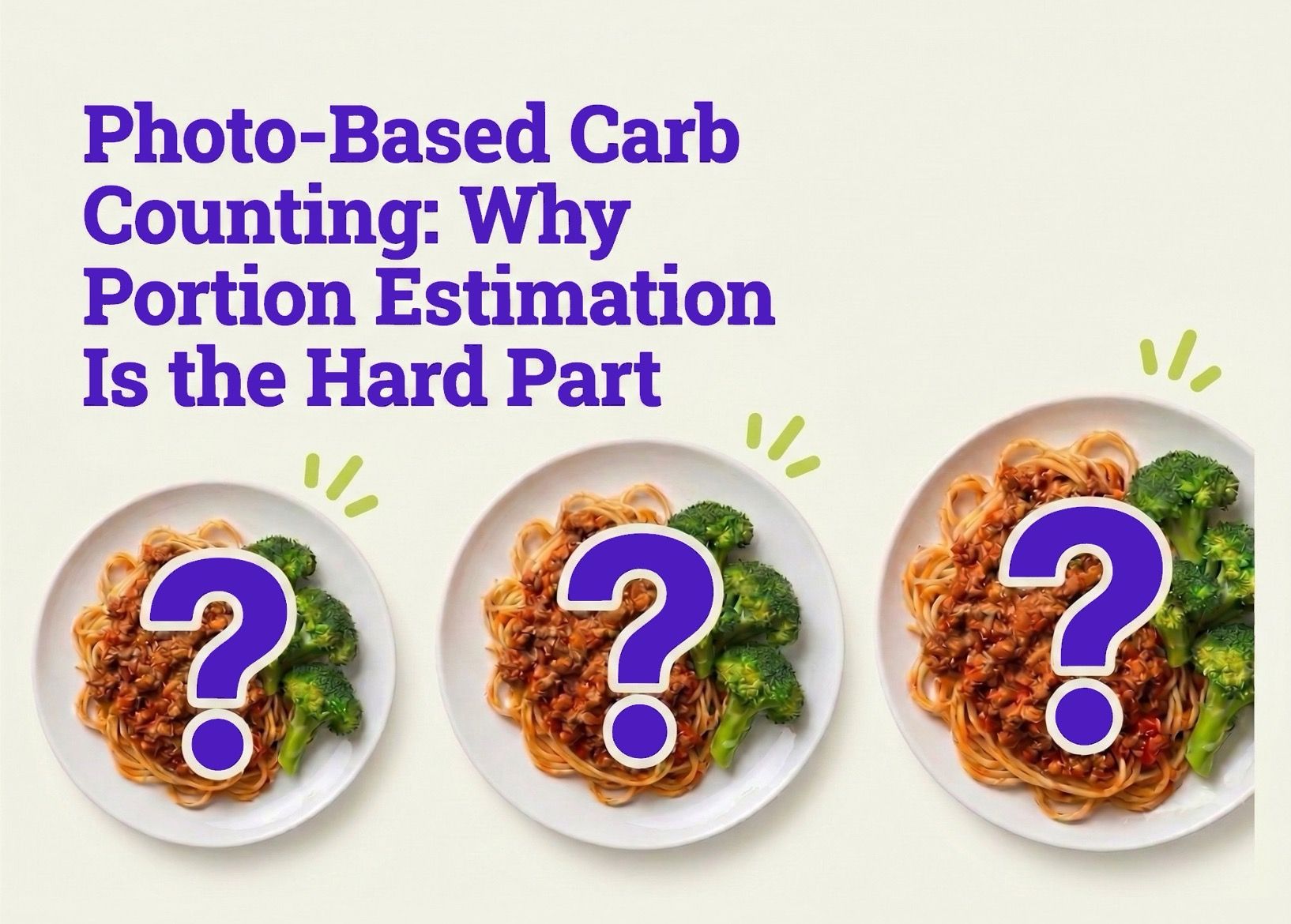
That distinction matters because a meal label alone does not help much if the portion is wrong. Recognizing "rice" is not the same as knowing whether the plate contains 25 grams of carbohydrate or 60 grams. For glucose management, that difference is essential.
In diabetes, the bar should be high. Meal analysis tools should not just look convincing in a demo. They should be backed by peer-reviewed accuracy data and, ideally, clinical outcome studies, because meal estimates can influence glucose control.
Food Recognition and Portion Estimation Are Not the Same Problem
A meal analysis system has to solve at least two distinct technical problems.
The first is recognition: identifying what foods are on the plate. The second is quantification: estimating how much of each food is there.
The second step is harder. It becomes especially difficult with mixed meals, nonstandard portion sizes, unusual plating, partial servings, or foods that look similar but differ substantially in weight or carbohydrate content. That is one reason image-based meal analysis has been promising for diabetes, and one reason many solutions remain better at convenience logging than at reproducible estimation.
The Three Ways Photo-Based Apps Estimate Portions
Most photo-based food logging apps fall into one of three categories.
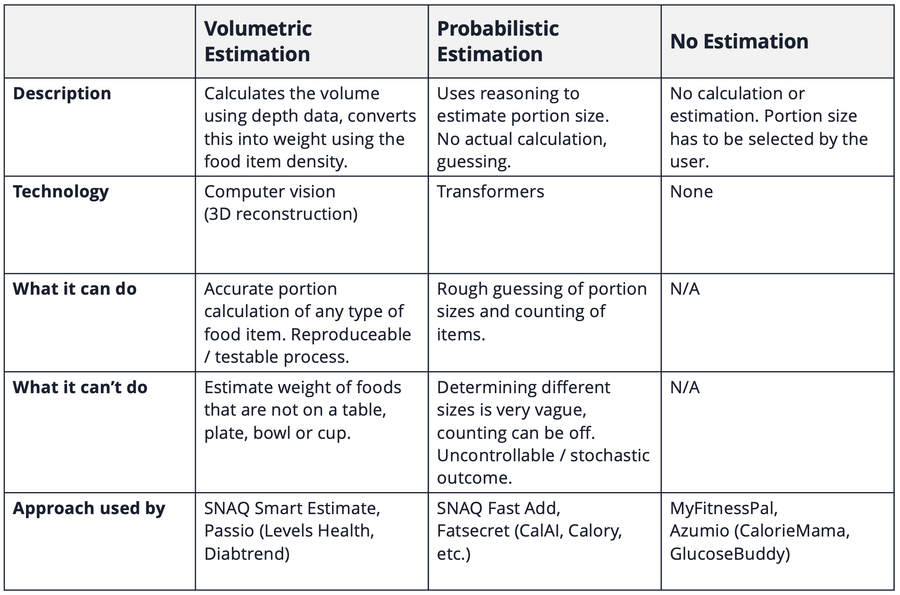
No estimation. The app may identify the food, but the user still has to select the portion manually. This can work for general lifestyle tracking, but it does not reduce the hardest part of the task. Apps in this category include MyFitnessPal, Azumio (CalorieMama, GlucoseBuddy).
Probabilistic estimation. The app makes a guess based on visual patterns, typical serving sizes, or category averages. This is fast and often plausible, but it is still a guess. Results vary meal to meal and are difficult to test consistently against weighed reference values. Apps using this approach include SNAQ Fast Add, Fatsecret (CalAI, Calory).
Volumetric estimation. Instead of inferring a generic serving size, the system estimates the physical volume of the food using depth data, converts that volume into weight using food-specific density models, and derives carbohydrate and other nutrient values from a nutrition database. This is the approach used by SNAQ Smart Estimate, Passio (Levels Health, DiabTrend) and is the only one that produces a reproducible, testable result but depends on camera sensors for depth data.
For a diabetes audience, that difference is not academic. If the goal is glycemic decision support, the important question is not whether an estimate looks plausible once. It is whether the method can be benchmarked against ground truth, consistently.
How Volumetric Estimation Works
Volumetric estimation follows a physical pipeline rather than a purely visual one.
The app captures a meal image and segments the different food regions. Running in parallel, the camera captures a depth map of the same scene. Together, these inputs are used to reconstruct the meal in 3D and estimate the volume of each food item. That volume is then converted into weight using a density model for the specific food, and from there the system calculates carbohydrate, fat, protein, and energy values from a nutrition database.
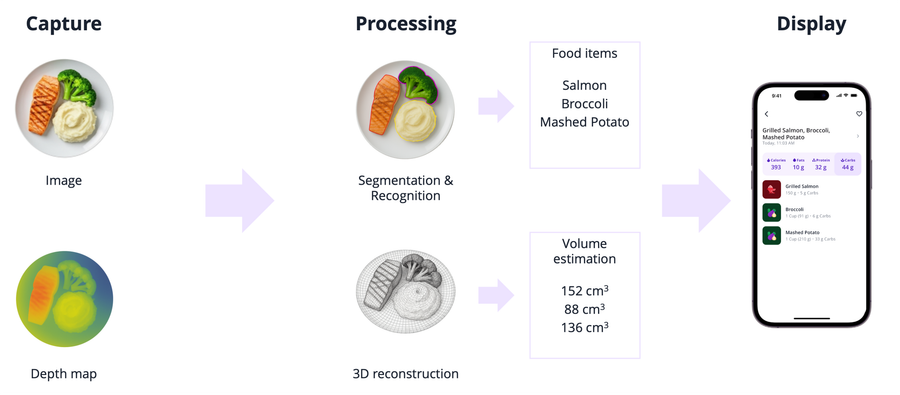
In 2020 a peer-reviewed preclinical study, evaluated this approach across 48 meals comprising 128 food items using SNAQ. The mean absolute carbohydrate error was 5.5 g, with a relative absolute error of 14.8%, alongside high segmentation performance and low processing time.¹
This is also why SNAQ's two product modes are worth distinguishing clearly. Smart Estimate uses volumetric estimation: an actual physical pipeline from volume to weight to carbs. Fast Add uses a probabilistic approach, which is useful when speed matters more than measurement precision, but is a fundamentally different method. Many apps in this space get grouped together as "AI food logging" even though they are solving different problems under the hood.
What the Validation Studies Actually Tested
For a technically-minded diabetes audience, the key question is not whether an app looks impressive in a demo. It is what validation protocol was used.
The peer-reviewed SNAQ accuracy studies evaluated smartphone-based food quantification against weighed ground-truth nutrient values. The preclinical study analyzed 48 meals with 128 food items. A subsequent comparative study tested 26 meals across three defined portion sizes, comparing estimates from adults with type 1 diabetes, SNAQ, and Calorie Mama, all assessed against weighed reference values using standard error and agreement metrics.
The comparative study reported a mean absolute carbohydrate error of 13.1 g for SNAQ, versus 21 g for participants and 24 g for Calorie Mama. The authors concluded that SNAQ may provide effective carbohydrate estimation support, particularly for people whose own estimates are inconsistent or inaccurate.²
SNAQ's differentiator is not only accuracy data. It also has published clinical outcome evidence. A randomized controlled trial in adults with type 1 diabetes using hybrid automated insulin delivery found that short-term use of SNAQ improved glucose control versus usual care, including a baseline-adjusted improvement in time in range of 6.6 percentage points over three weeks.³
That distinction matters. Accuracy studies show whether a method is technically sound. Clinical outcome studies show whether it translates into real glucose benefit for real people. In diabetes, both are necessary. Most apps have neither.
Why Reproducibility Matters More Than a Plausible-Looking Estimate
In diabetes, an estimate should not just sound reasonable. It should be reproducible enough to test, compare, and improve.
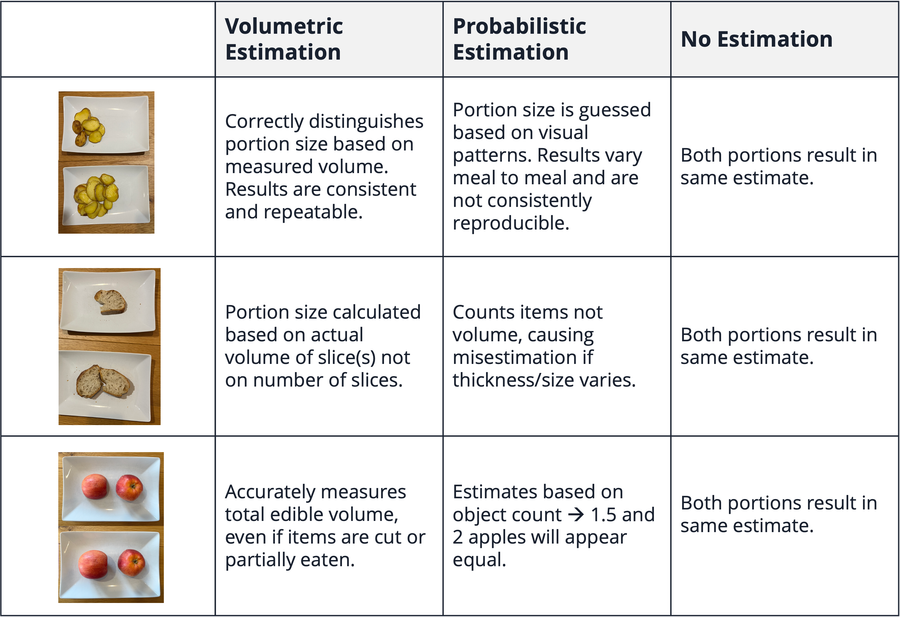
The practical difference between the three approaches comes down to this: volumetric estimation distinguishes portion size based on measured volume and produces consistent results when the same food appears in different quantities. Probabilistic estimation may look plausible, but results vary with visual pattern matching and are not reliably reproducible. With no estimation, different portions collapse into the same result unless the user manually corrects them.
That reproducibility is exactly why it matters for clinical validation, regulatory work, and medical outcome claims. In diabetes, peer-reviewed studies are not a nice-to-have. They are a core requirement for evaluating whether a meal estimation system is actually fit for use.
Where Photo-Based Estimation Still Has Limits
None of this means meal analysis is solved. Hidden ingredients, oils, sauces, layered foods, restaurant meals, and foods with unusual density remain difficult. The preclinical study itself noted performance differences across meal types and acknowledged that testing was conducted on hospital meals, not home settings.¹
The right mental model is not "perfect carb counting from a photo." It is a more scalable and often more reproducible support tool than manual database searching or pure portion guessing, but one that still requires human judgment.
The Bottom Line
Photo-based carb counting is not really about food recognition alone. For diabetes, the harder and more important problem is portion estimation, and that requires a fundamentally different technical approach than simply labeling a plate.
The difference between an app that recognizes a meal and one that tries to quantify it is not cosmetic. For anyone using CGM or making day-to-day glucose decisions, it is foundational.
For SNAQ specifically, that case rests on peer-reviewed accuracy data and published clinical outcome evidence from a randomized controlled trial: the kind of evidence that should be the baseline expectation for any tool used in diabetes management.