
Quick answer: Estrogen and progesterone shift throughout your menstrual cycle, and that shift can change how your body responds to the same meal. Many people see steadier glucose in the follicular phase and higher, slower-to-settle peaks in the luteal phase. Research on this is genuinely mixed though, and it doesn't show up the same way for everyone.
You've had the same breakfast for three weeks straight, steel-cut oats with almonds and a little cinnamon, and most mornings your CGM barely moves. Then one morning, with nothing else obviously different about your day, it spikes hard.
You've probably already gone looking for a reason. Maybe you slept badly, work was stressful, or dinner ran later than usual. None of that actually explains it though. More often than not, the missing piece is simpler than people expect. It comes down to where you are in your cycle.
The Hormonal Variable Most CGM Users Overlook
Estrogen and progesterone do more than run your cycle. They also shape how your body handles insulin and glucose, and since both hormones rise and fall throughout the month, the way a meal hits your bloodstream can shift right along with them.
The menstrual cycle has two main phases after menstruation starts: the follicular phase (roughly day 1 to ovulation) and the luteal phase (ovulation to the next period). Insulin sensitivity often rises during the follicular phase when estrogen climbs. After ovulation, progesterone takes over, and insulin sensitivity typically drops for many people.
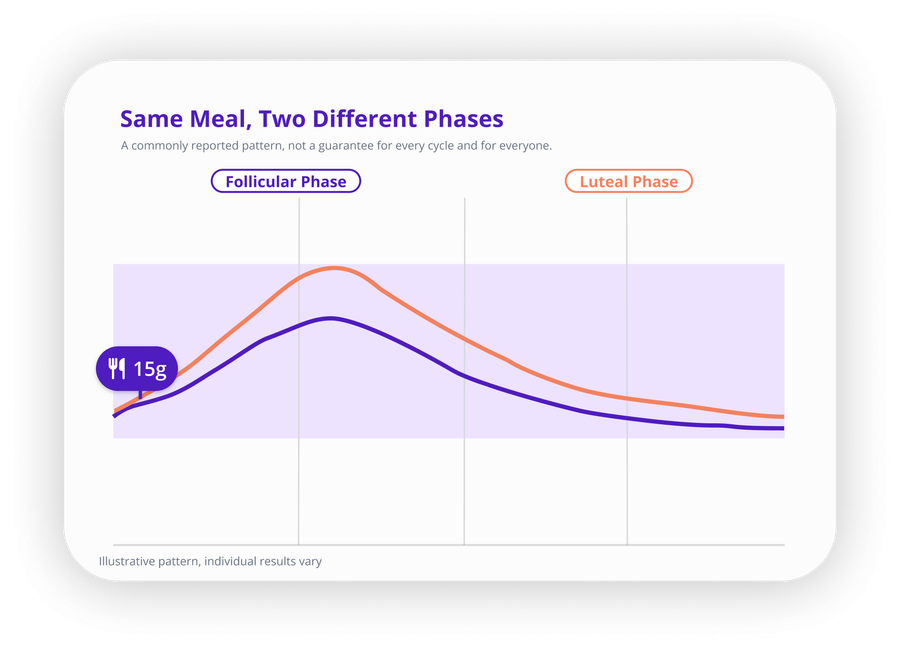
That shift can mean the same carb load produces a higher glucose peak in the luteal phase compared to the follicular phase.
What the Research Actually Shows
A handful of studies have actually looked into this, and they don't all point the same way. A long-running study of 257 women, the BioCycle Study, tracked insulin resistance across full cycles and found it did shift alongside hormone levels.¹ A 2023 study in Nature Metabolism found a similar phase-dependent effect, though its focus was specifically on how the brain regulates insulin sensitivity.⁴
Then there's the other side of the research. A 2021 analysis of NHANES data found the cycle's effect on insulin sensitivity was inconsistent, and depended heavily on a person's BMI, fitness level, and activity.² One of the earliest studies on this exact question, from 1984, found no significant difference in insulin sensitivity between phases at all.³
Put together, these studies don't agree on much, except that your cycle probably plays some role in glucose response. How much of a role, and for whom, is still something researchers are working out.
What to Look For on Your CGM Graph
CGM variability during your cycle might look like this:
Follicular phase (day 1 to ovulation): steadier curves, smaller post-meal peaks, easier Time in Range, the percentage of the day your glucose sits within your target range.
Luteal phase (post-ovulation to next period): higher peaks for the same meals, a longer return to baseline, and meals that need more attention when you're planning ahead.
You might also notice that meals you thought were reliable suddenly behave differently in the second half of your cycle. That's a hormonal shift, not something you're doing wrong.
Practical Adjustments You Can Test
Once you know the pattern's there, it's worth testing a few adjustments phase by phase.
Dietary tweaks during the luteal phase
A few tweaks are worth testing here, like bumping up fiber at meals, leaning a little harder on protein and fat, or shifting more of your carbs earlier in the day when insulin sensitivity tends to run higher. Small changes like these can smooth out the glucose response when progesterone is elevated.
Plenty of people lean toward more fat and protein relative to carbs in this window. Others just trim portions slightly, or swap a higher-GI carb for something slower to digest.
Movement and meal timing
Exercise can improve insulin sensitivity, which helps offset some of that luteal-phase swing. A short walk after meals, resistance training, or even a few minutes of light movement can help blunt the glucose response during this phase.
Meal timing also matters. If you notice breakfast spikes more in the luteal phase, you might shift your largest carb load to lunch or adjust your breakfast routine based on what your CGM shows across the month.
Stress and sleep support
Stress and poor sleep can make insulin resistance worse too, on top of whatever progesterone is already doing. During the luteal phase, prioritizing sleep quality and managing stress through mindfulness, breathing exercises, or routine adjustments can support more stable glucose levels.
Tracking Cycle and Glucose Together
The only way to know for sure is to track both together, consistently. That means logging meals, noting cycle phase, and reviewing CGM data across at least two or three full cycles. If you also have PCOS, there is a specific comparison worth running.
A lot of users just mark cycle days right in their CGM app notes. Some prefer a separate period tracker and compare the two manually. Either way works, and the goal is just to see whether glucose patterns line up with hormonal phases.
For some people, the cycle turns out to be a real factor. The same meal genuinely behaves differently from one phase to the next, and that's worth planning around. For others, a few cycles of tracking show no real difference, which is useful information too. It rules the cycle out and points you toward something else. Understanding what affects your glucose levels becomes easier when you track the right context alongside your meals.
How SNAQ Can Help Track Cycle-Driven Patterns
SNAQ makes it easier to log the same meal repeatedly and see it next to your CGM data, so you can watch how the response changes across cycle phases. Instead of juggling separate apps for food, glucose, and cycle tracking, everything lives in one place. You log a meal with a photo or a voice note, and the curve shows up right alongside it.
Say you log your usual breakfast every few days throughout the month. You'll be able to compare the CGM response during your follicular phase against your luteal phase side by side. SNAQ's pattern detection can help surface a trend you'd probably miss reviewing day by day.
If you're already tracking meals and CGM data in separate apps, SNAQ brings them into one view. If you haven't built the logging habit yet, photo-based logging and AI carb estimates make it a lot easier to keep up across a full cycle.
If you want to see whether your cycle is part of the pattern, try SNAQ to see what your own data shows.