Quick answer: Most blood tests don't need fasting. Fasting glucose and lipid panels usually do, typically 8 to 12 hours without food. A1C never requires it. If you use a CGM (continuous glucose monitor), a single fasting number can look different from your week's trend data, and that's usually just a timing quirk.
A quick note: This is general information, not medical advice. Ask your doctor or care team about your own results and medication timing.
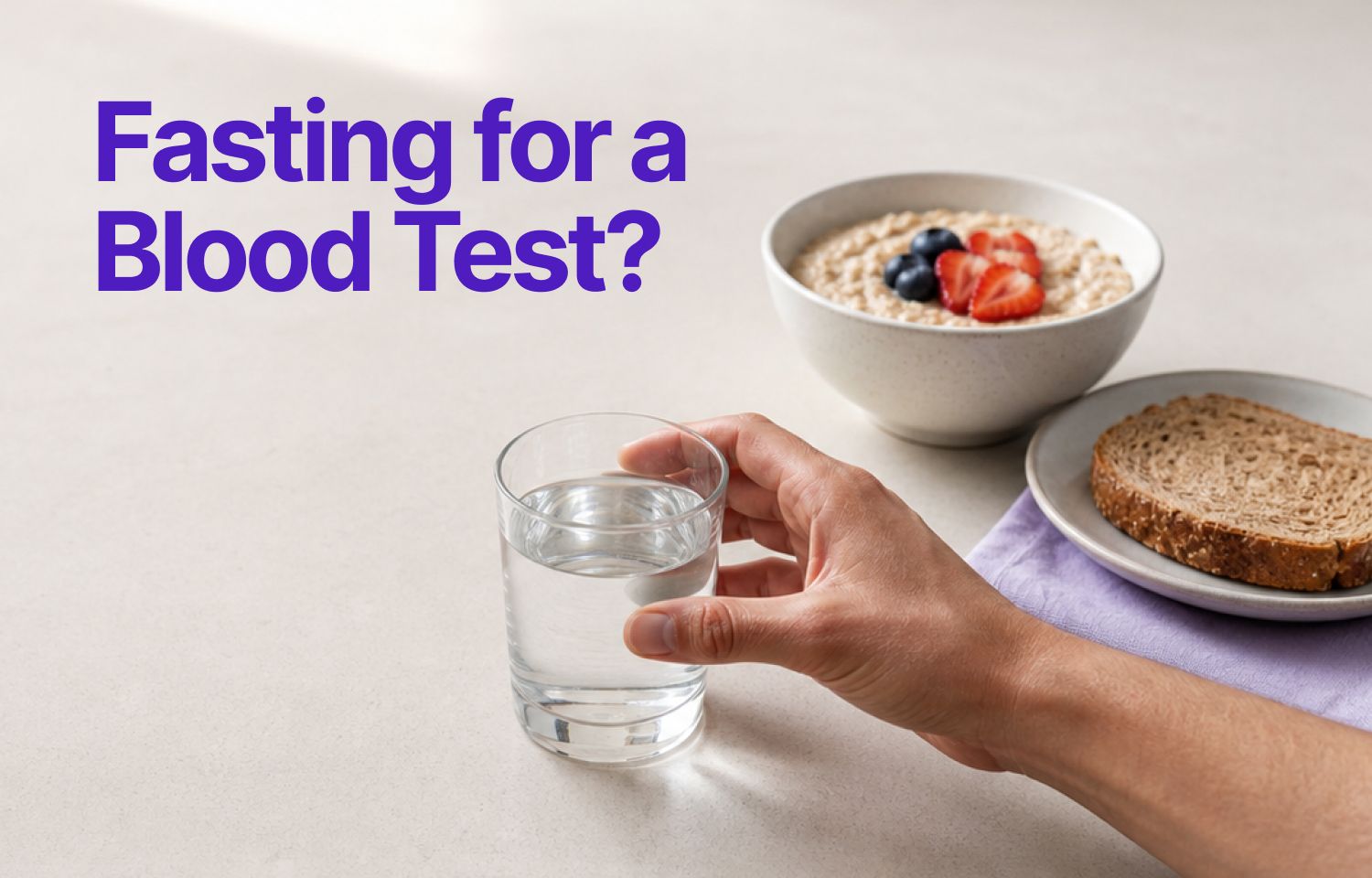
The instructions are almost always the same maddening one-liner: fast for 8 to 12 hours before your appointment. No mention of coffee, no mention of what to do if you already ate breakfast by accident.
Not every blood test needs this. Here's the real breakdown.
Which Tests Actually Require Fasting
Fasting glucose and lipid panels are the two most likely to make you skip breakfast, usually for 8 to 12 hours. Eating raises blood glucose fast, and it can push up triglycerides for a few hours too, which muddies your baseline.
The goal, if your doctor ordered one of these, is to see what your body looks like at rest, not mid-digestion. Eat beforehand and your numbers can run higher than they'd be otherwise, best case a slightly off reading, worst case you're back for round two.
Cholesterol guidance has loosened up in recent years. A lot of cardiology guidelines now say routine lipid panels don't need fasting for most people, and save it for cases where triglycerides come back very high. Plenty of clinics still ask you to fast anyway, so keep following your own instructions. The old blanket rule just isn't as absolute as it used to be.
Liver function tests trip people up too. On their own, they aren't affected by fasting. If your clinic tells you to fast before one anyway, it's usually because the liver panel is riding along with a glucose or lipid draw in the same visit.
Confirm your specific window with your clinic. It changes depending on what's ordered together.
The A1C Test Does Not Require Fasting
A1C works differently. It measures your average blood glucose over the past 2 to 3 months, based on how glucose attaches to hemoglobin in your red blood cells, so nothing you ate this morning moves that number.
That's part of why it's such a practical test for people with diabetes. No scheduling around meals, no adjusting your morning routine. If you're also getting a fasting glucose test at the same visit, you'll still need to fast for that one, the A1C itself doesn't care either way.
For more on how A1C compares to daily glucose metrics, see our guide to understanding GMI, TIR, and A1C.
| Test | Fasting typically needed? | Why |
|---|---|---|
| Fasting glucose | Yes, usually 8–12 hours | Eating raises blood glucose quickly, which affects the baseline reading. |
| Lipid panel (cholesterol) | Often, but guidance is shifting | Many current guidelines allow non-fasting for most people. Some clinics still default to fasting, so confirm ahead of time. |
| A1C | No | Reflects a 2–3 month average, so same-day food doesn't affect it. |
| Liver function tests | Not on their own | May still be requested if drawn alongside a fasting glucose or lipid test in the same visit. |
| Complete blood count (CBC) | No | Not meaningfully affected by recent food intake. |
What You Can Drink, and What Happens If You Slip
Water's fine, and encouraged, it makes your veins easier to find. Coffee, tea, juice, anything with calories needs to wait for the window to end. Even black coffee can throw off certain results, so unless your clinic tells you otherwise, hold off.
Medications are the part people usually get stuck on. Ask your doctor or pharmacist whether your morning dose is okay to take before the draw. Some are. Some aren't.
If you already ate before you remembered you were fasting, don't spiral. Tell the lab before the draw, not after. Glucose usually peaks 1 to 2 hours after eating, and triglycerides can run high for a few hours depending on what you had, so the number that comes back may not be your real baseline. Worst case, you reschedule.
Why This Gets More Complicated If You Use a CGM
If you use a CGM or check your blood sugar regularly, a fasting test can throw you a real curveball. A sensor reading in the 90s all week and a lab result of 118 are just two different measurements, taken different ways, at different moments.
Before anything else, check the boring stuff. Were you really fasted, since black coffee doesn't count and plenty of people don't realize that. Or was that particular morning just off somehow, worse sleep than usual, an earlier alarm. That covers most of it.
If neither explains it, bring it to your care team along with your CGM data.
How SNAQ Can Help You Prepare
If you're already logging meals and glucose patterns, that history earns its keep right around a lab appointment. SNAQ logs meals with photo-based carb estimates and overlays them with your CGM data, so a mismatch like the one above has an actual paper trail behind it. Pull that week up next to lab day and see what's different. That's a better starting point for your care team than a single number on its own.