

Quick answer: Crossing time zones can shift your glucose patterns for a few days, driven mostly by disrupted sleep and a mismatch between local time and your body's internal clock, not by any single meal. Track meal timing against how your body feels as much as the clock, note rough meal composition, sleep, and any big activity changes, then look for patterns across several days rather than any single reading. This article sticks to tracking and reading your data. For anything about adjusting insulin or medication schedules, that's a conversation for your care team.
Your plane lands at 9 PM local time. You're exhausted, but your body insists it's 3 AM. Your CGM (continuous glucose monitor) alarm goes off. The number doesn't match how you feel, and you haven't eaten anything unusual yet.
Travel strips away the scaffolding most people with diabetes rely on: consistent meal timing, predictable sleep, familiar foods, and a stable daily rhythm. What remains is a glucose pattern shaped by circadian disruption, stress, unpredictable activity, and meals you didn't prepare yourself.
Why Time Zone Changes Affect Glucose
Your body runs on an internal clock. That clock regulates insulin sensitivity, cortisol release, glucose production, and how your cells respond to food throughout the day.
When you cross time zones, the external day-night cycle shifts faster than your internal clock can adjust. Research on circadian rhythm disruption shows this mismatch can temporarily reduce insulin sensitivity and alter glucose metabolism.
Jet lag is a physiological desynchronization that can influence glucose control for several days after arrival, well past the point you stop feeling tired.
If you have Type 1 diabetes, this can show up as your body's sensitivity to insulin shifting in ways that feel unpredictable for the first few days, a pattern worth flagging to your care team rather than reacting to on your own. If you have Type 2 diabetes or prediabetes, fasting glucose and post-meal peaks may run higher even when you're eating similarly to how you do at home.
What Actually Changes During Travel
Sleep disruption hits glucose first
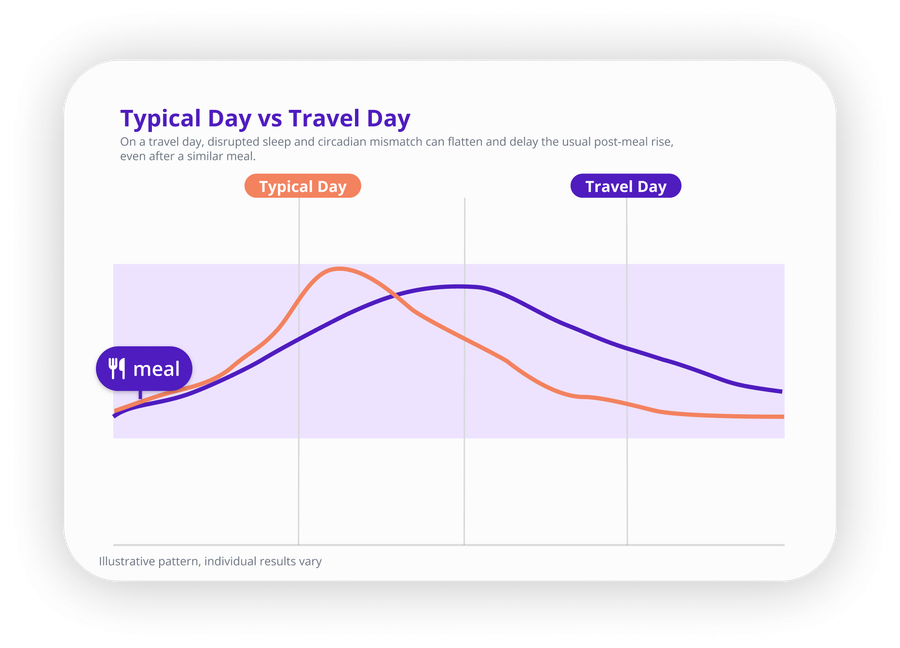
Poor sleep increases cortisol and reduces insulin sensitivity. One night of disrupted sleep can raise fasting glucose the next morning and flatten your usual post-meal curve into a longer, slower rise.
If you're traveling east and losing hours, your body may still be producing peak cortisol when you're trying to sleep. If you're traveling west and gaining hours, you may eat dinner when your body thinks it's bedtime, leading to a delayed or exaggerated glucose response.
Meal timing becomes unpredictable
You may eat breakfast at what feels like 3 AM, or skip meals entirely because you're not hungry at the "right" time. Skipping meals or shifting meal timing can change how your body responds to the next meal you do eat.
Morning insulin resistance is usually highest at your body's internal morning, not the clock's morning. If you eat at 8 AM local time but your body thinks it's 2 PM, your glucose response may look different than expected.
Same clock position, different body time
Example: 6 time zones east (illustrative, not a fixed rule)
Eating "on schedule" by the local clock can still mean eating at an unusual time for your body. That mismatch, not the meal itself, can shape how the glucose response looks.
Unfamiliar foods add noise
Restaurant meals, airport food, and unfamiliar cuisines make carb counting harder. You're estimating portion sizes without your usual reference points, and sauces, cooking methods, and hidden ingredients become variables you can't control. Eat the new foods anyway. Just expect noisier data, and treat any single meal's reading as a data point, not a verdict.
Stress and activity patterns shift
Travel stress raises cortisol. Walking through airports, carrying luggage, and navigating unfamiliar places increases activity in ways that don't match your usual exercise routine.
More activity usually lowers glucose, but the combination of stress and irregular activity can create unpredictable effects, especially if you're also dealing with disrupted sleep and shifted meal timing.
What to Track: A Minimal, Useful Approach
You don't need to track everything. You need to track enough to spot patterns and separate predictable changes from true problems.
Meal timing relative to your internal clock
Log when you eat and note what time it feels like to your body, not just the local clock. This helps you later identify whether a spike happened because of the food or because you ate at an unusual circadian time.
For example: "Ate lunch at 1 PM local, but body time was 7 AM."
This context explains why your glucose may have spiked higher than expected, even if the meal was similar to what you'd normally eat.
Keep your apps on the same clock
Check that your CGM app and your food log are reading the same time zone, early in the trip if you can. If one updates automatically and the other doesn't, meal markers and glucose readings drift out of sync, and it gets harder to tell later whether a pattern is real or just a timestamp mismatch.
Meal composition, even roughly
You don't need perfect carb counts. You need enough detail to recognize patterns later. Note the main carb source, approximate portion size, and any significant protein or fat.
For example: "Large bowl of rice, grilled chicken, vegetables, some sauce" is more useful than "lunch" but less stressful than trying to count every gram.
SNAQ can help with this. Taking a photo and letting the app estimate nutrition gives you a rough baseline without turning every meal into a math problem. You can review the log later and compare similar meals across different days or time zones.
Sleep quality and duration
Note how many hours you slept and whether sleep was continuous or disrupted. A formal sleep score isn't necessary here, a simple note like "slept 4 hours, woke up twice" is enough.
This helps explain why your fasting glucose or morning post-meal response may look different than usual.
Any large activity changes
Note if you walked significantly more or less than usual, or if you did something physically demanding like hiking, swimming, or carrying heavy bags for hours.
Step counts aren't the point here. A general sense of whether activity was higher, lower, or similar to your normal routine is enough.
Glucose patterns you don't usually see
If your CGM shows a pattern you don't recognize, a slow climb overnight, a delayed post-meal peak, or a drop that doesn't match your usual response, note it and check whether sleep, meal timing, or activity might explain it.
Some patterns will resolve once you adjust to the new time zone. Others may signal a need to adjust your care plan.
How to Make Sense of Noisy Data
Travel data is noisier than home data. Single meals won't tell you much. Look for repeated patterns across several days instead.
If your glucose is consistently higher in the mornings for three days after arrival, that's more useful than a single high reading on day one.
If every restaurant meal spikes higher than expected, that's a pattern. If one meal spikes and the next doesn't, it's more likely a carb estimation error or an ingredient you didn't account for.
What SNAQ Can Do When Context Keeps Changing
SNAQ keeps meal timing, estimated nutrition, and glucose curves in one place, even when your routine is unstable, and its AI Coach looks for the pattern in that mess so you're not the only one trying to piece it together after a long flight.
You can log meals with a photo or voice note, so you're not hunting for carb counts in an unfamiliar restaurant or typing long entries at the airport. SNAQ places meal markers on your CGM graph, so you can see when you ate relative to glucose changes, even if the timing was unusual.
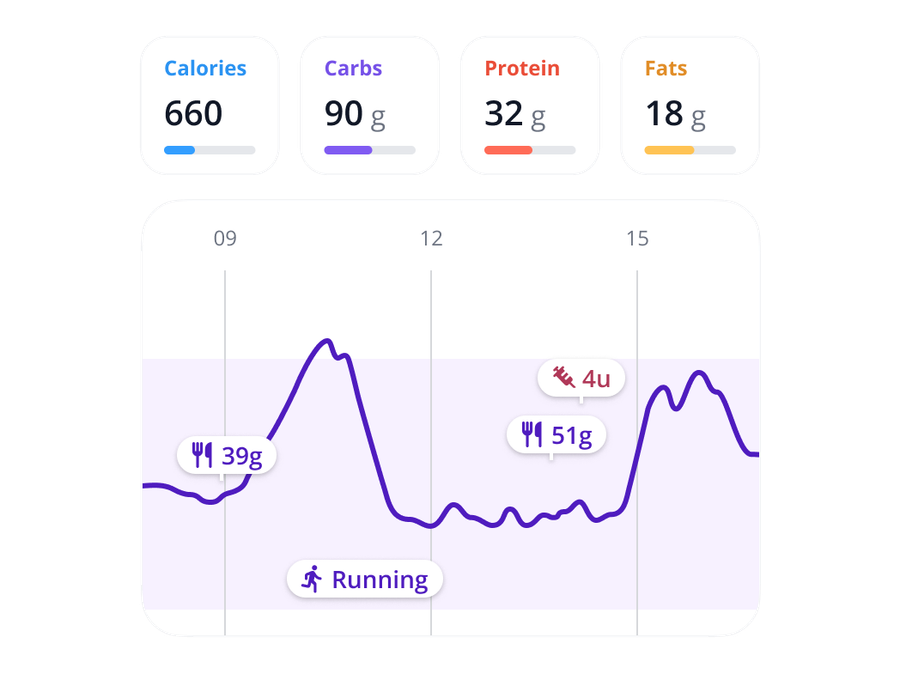
Later, when you're home, you can review the trip and see whether your glucose patterns shifted because of circadian disruption, meal timing, food choices, or activity changes. That review helps you make better decisions the next time you travel.
SNAQ can also help track repeated meals across time zones. If you eat similar breakfasts on three different mornings, you can compare the glucose response and see whether the pattern stabilizes as your body adjusts to the new time zone.
Quick recap for the road
- Log meal timing against how your body feels, not just the local clock
- Note roughly what you ate, your sleep, and any big activity changes
- Keep your CGM app and food log on the same time zone
- Look for patterns across several days, not single readings