
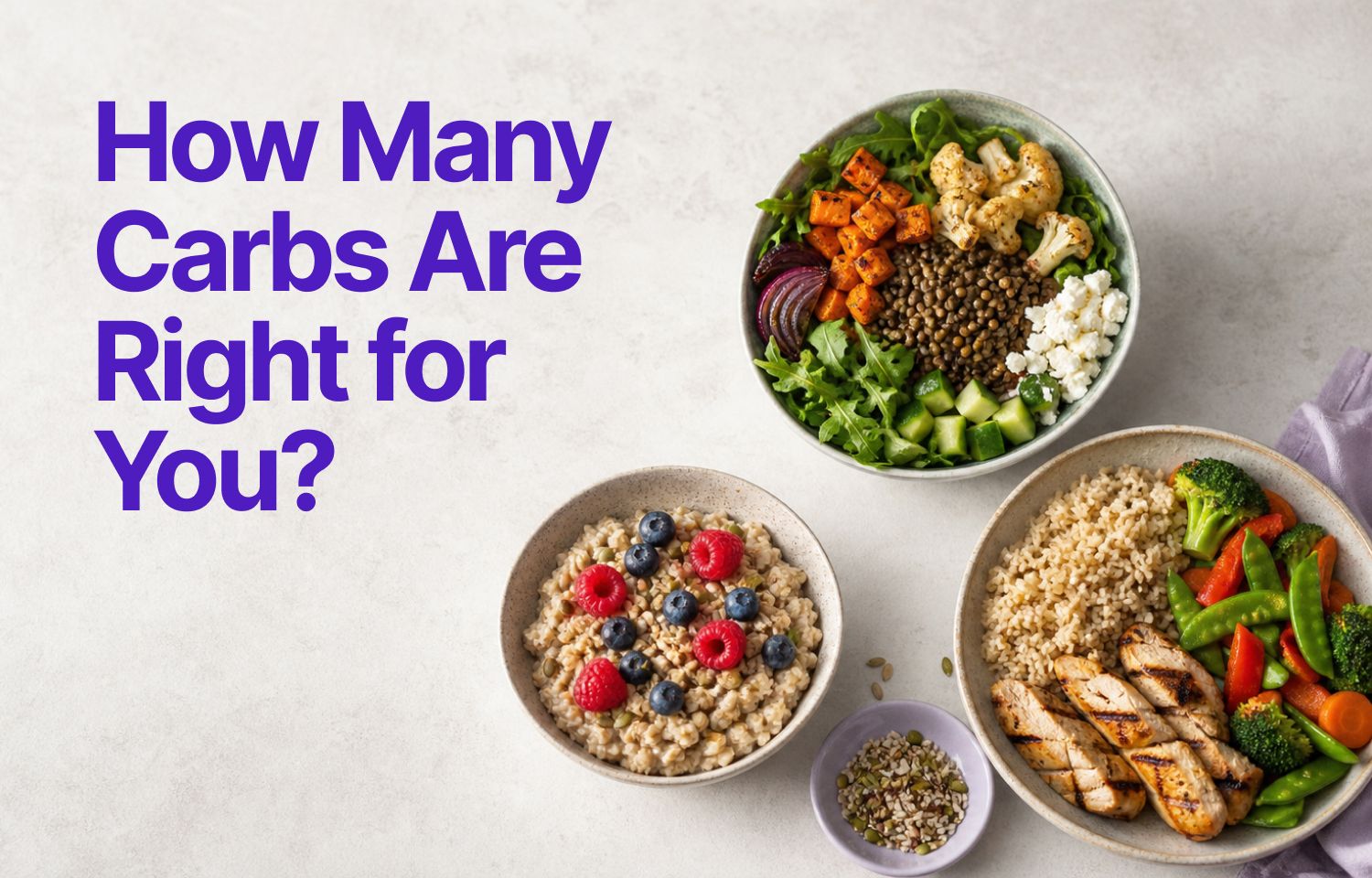
Quick answer: There's no single daily carb number that fits everyone with diabetes. Research shows a wide range works, anywhere from under 130 grams to well over 300, depending on your body, activity, and treatment. The most reliable way to find your number is tracking your own meals and glucose response, and if you take mealtime insulin, working through carb changes with your care team since they affect your dosing.
If you search for a daily carb target, you'll find numbers ranging from 30 grams to 300 grams. That's not contradictory advice. It reflects how different carb needs are, person to person, based on your body, your treatment, and what you're trying to achieve.
The American Diabetes Association doesn't give a universal carb prescription. Instead, their guidelines call for personalized targets based on your health goals, activity level, medication, and glucose patterns.
This article walks through the evidence on carb intake for diabetes, explains why rigid numbers don't work for everyone, and shows how to use your own glucose data to find what fits, whether or not you take mealtime insulin.
Why There's No Single Answer
Your carbohydrate needs depend on factors that shift daily: how active you are, what medication you take, whether you're managing weight, and how your body responds to different meals at different times.
One factor matters more than most: whether your treatment includes mealtime insulin. If it does, changes in how many carbs you eat usually need to line up with your insulin plan, so that's worth working through with your care team rather than adjusting on your own. If it doesn't, for example if you're managing Type 2 diabetes with metformin and lifestyle changes, you generally have more room to experiment safely, like eating more carbs at lunch and fewer at dinner based on how your glucose responds. We'll come back to both paths later in this article.
The Dietary Guidelines for Americans suggest carbohydrates make up 45 to 65 percent of total daily calories for the general population. For someone eating 2,000 calories, that's 225 to 325 grams of carbs per day. But diabetes shifts the calculation from population averages to personal glucose tolerance.
What the Evidence Says About Lower-Carb Approaches
Some research supports lower-carb eating patterns for glycemic control, mostly studied in people with Type 2 diabetes. A 2015 review argued that carbohydrate restriction should be considered a primary approach in diabetes management, pointing to improvements in A1C and reduced medication needs in some participants.
A 2018 Diabetes UK evidence review found that lower-carb diets, under 130 grams per day, improved short-term glycemic control in people with Type 2 diabetes, but noted that long-term adherence was challenging and that participants needed nutritional support to avoid nutrient gaps.
Lower-carb doesn't mean zero-carb, and it doesn't mean better for everyone. Sustainability, meal variety, and how you feel matter as much as the glucose curve. Some people feel sharper and steadier eating 100 grams a day. Others feel restricted and see no glucose benefit below 180 grams.
If you're considering a significant carb reduction, it's worth discussing with your care team, especially if you take insulin or medications that lower blood sugar.
Net Carbs vs Total Carbs
When you look at a nutrition label, you'll see total carbohydrates. That number includes fiber and sometimes sugar alcohols, both of which have a limited effect on blood glucose.
Net carbs are calculated by subtracting fiber, and certain sugar alcohols, from total carbs. If you're counting carbs to estimate glucose response, net carbs can be more useful than the total.
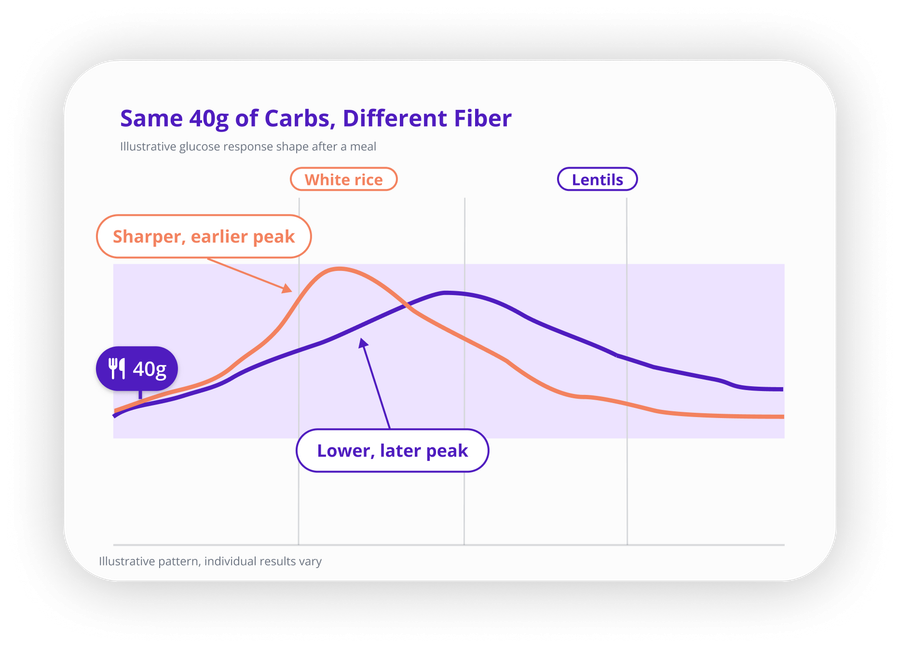
A bowl of lentils with 40 grams of total carbs and 15 grams of fiber has 25 grams of net carbs. That fiber slows digestion and flattens the glucose curve compared to 40 grams of white rice.
Fiber doesn't just reduce the effective carb count. It also moderates post-meal glucose peaks, supports gut health, and improves satiety. A 2018 review in The Journal of Nutrition found that higher dietary fiber intake was associated with better insulin sensitivity and a lower risk of Type 2 diabetes.
If you're tracking carbs, telling net and total apart can help explain why two meals with the same carb count produce different glucose responses. For more on how fiber and meal composition affect blood sugar, see Net Carbs vs Total Carbs: Which One Actually Matters for Blood Sugar?
Carb Distribution Matters as Much as Total Intake
It's not only about how many carbs you eat. It's also about when you eat them.
Breakfast often triggers higher glucose responses than the same meal eaten at lunch or dinner. This is partly due to the dawn phenomenon, a natural rise in insulin resistance in the early morning. If you notice consistent breakfast spikes, you might benefit from eating fewer carbs in the morning or choosing slower-digesting options, like steel-cut oats instead of instant oats.
Some people find that spreading carbs evenly across three meals works well. Others prefer larger carb portions at lunch, when insulin sensitivity tends to be higher, and lighter portions at dinner.
There's no universal distribution rule. Your schedule, activity patterns, and glucose data will tell you what works. For more on why breakfast behaves differently, see Why Breakfast Spikes Your Glucose More Than Lunch or Dinner.
Using CGM Data to Find Your Range
Continuous glucose monitors give you meal-level feedback that static carb targets can't provide. You can see how 50 grams of carbs from pasta compares to 50 grams from brown rice, or how the same breakfast behaves on Monday versus Thursday.
A 2017 joint statement from the European Association for the Study of Diabetes and the American Diabetes Association noted that CGM use can improve glycemic outcomes by helping people identify which foods and eating patterns lead to more stable glucose. One metric that comes up often is Time in Range, the percentage of the day your glucose stays within your personal target range.
Instead of aiming for a fixed daily carb number, you can use CGM data to answer practical questions: Does eating more protein with breakfast flatten my curve? Do I handle carbs better earlier in the day? Does splitting a larger meal into two smaller ones reduce my peak?
This is how personalized carb targets emerge, not from a guideline, but from repeated observation of your own patterns.
Building a Carb Plan That Fits Your Life
Start by tracking what you're eating now without making changes. Log meals, portion sizes, and glucose responses for at least a week. Look for patterns in timing, food type, and glucose curves.
What you do with that information next depends on your treatment, specifically, whether you take insulin at meals.
If you don't take mealtime insulin: you generally have room to adjust and observe. If breakfast consistently spikes above your target range, try trimming the carbs at that meal by a modest amount and watch how your glucose responds over the next several days. If lunch leaves you steady, keep that meal structure and focus your adjustments elsewhere.
If you take mealtime insulin: carb changes and insulin doses are connected, so this isn't something to adjust on your own. Bring your logged patterns, like a breakfast that consistently runs high, to your care team. They can help you figure out whether the fix is a carb change, a timing change, or something else in your plan.
Either way, a practical carb range often falls somewhere between 100 and 200 grams per day for people with diabetes, looking across the general population range, the ADA's individualized approach, and the lower-carb research discussed above. That's a descriptive pattern, not a prescription. Some people do well at 80 grams. Others maintain excellent Time in Range at 220 grams.
The goal isn't matching someone else's number. It's finding where your glucose stays steady and your meals still fit your life.
How SNAQ Helps You Test and Learn
Carb counting works better when it's connected to glucose context. SNAQ helps you log meals with AI photo analysis, estimate carbs and fiber, and see how those meals line up with your CGM curve.
If you're experimenting with carb distribution, SNAQ makes it easier to compare the same meal across different days or times. You can review a week of breakfasts side by side and spot which versions kept you steady and which didn't.
SNAQ also supports manual logging, voice logging, and saved meals, so repeated tracking doesn't require repeated effort. The goal isn't perfect nutrition data. It's consistent meal context that lets you see patterns over time, patterns you can act on directly if you don't take mealtime insulin, or bring to your care team if you do.
If you're working toward a personalized carb range, SNAQ gives you the tools to test, log, and learn without turning every meal into a spreadsheet. Download SNAQ.