Quick answer: Gluten-free does not mean low-carb. Most gluten-free breads and pastas swap wheat for rice flour, potato starch or tapioca starch, which usually carry the same carb load or more, and often less fiber. Since fiber is part of what slows a glucose rise, a gluten-free swap can land differently even when the carb number on the label looks familiar.
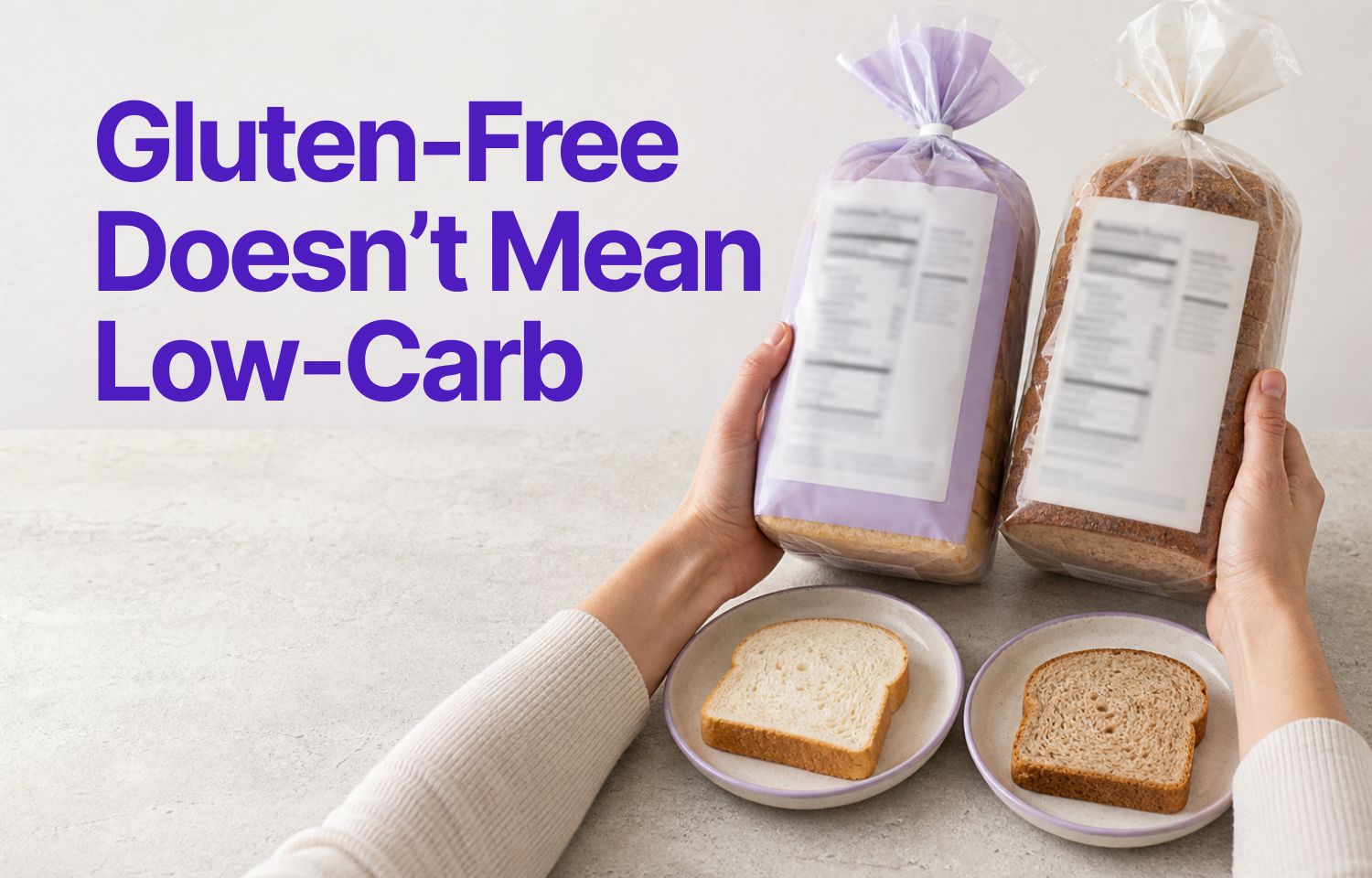
A gluten-free bagel and a regular bagel sit next to each other on the bakery shelf. One is safe for celiac disease. The other is not. Turn both packages over and the carb counts often land within a few grams of each other.
Gluten is a protein found in wheat, barley and rye. Taking it out solves an immune or digestive problem. It does not touch the carbohydrate, because the carbohydrate was never the gluten in the first place.
That much is reasonably well known by now. What gets less airtime is the fiber. When manufacturers pull wheat out of a recipe, a chunk of the fiber usually leaves with it, and fiber is part of what slows how fast carbs show up in your blood.
If you're going gluten-free and you don't have celiac disease
Without celiac disease or a diagnosed gluten sensitivity, cutting gluten is unlikely to do much for your glucose by itself. Surveys of packaged gluten-free foods have repeatedly found they offer no nutritional advantage over the wheat versions, tend to carry less protein and fiber, and cost a lot more. When blood sugar improves after someone goes gluten-free, it's usually because they also cut back on bread, pasta and baked goods. The gluten had little to do with it.
Why do gluten-free products still contain so many carbs?
Because gluten was doing structural work, not carbohydrate work. It traps gas, holds moisture, gives dough its stretch. Take it out and the loaf collapses, so manufacturers rebuild the structure with something else. Nearly always starch.
Rice flour, potato starch, tapioca starch and corn flour are the usual replacements, and they are carbohydrate-dense by nature. White rice flour carries roughly 80 grams of carbohydrate per 100 grams, a little above all-purpose wheat flour. Extra sugar and fat often go in too, since both help with texture and browning when gluten isn't there to do the job.
Market surveys in Norway, Italy and Spain all found gluten-free products landing higher in carbohydrate than their wheat equivalents more often than lower.
Do gluten-free products have less fiber?
Often, yes. And for glucose, that gap may matter more than the small differences in total carbs.
Researchers in Norway compared gluten-free products against their wheat counterparts across eleven food categories. The gluten-free versions came out lower in fiber and protein, and higher in carbohydrate, saturated fat and salt. An Italian market study found the same pattern in biscuits, pasta and bread substitutes. A meta-analysis of adults with celiac disease found people eating gluten-free took in less fiber overall.
Fiber slows digestion and can blunt how quickly carbs reach your bloodstream. Take it out and the same number of carbs can arrive faster. Same label. Different afternoon.
The pattern has exceptions, which is exactly why the label matters. Some manufacturers have started building fiber back in with quinoa, amaranth, buckwheat and seeds, and a few gluten-free seeded breads now carry more fiber than the wheat loaf sitting beside them. The category is uneven. Two gluten-free breads on the same shelf can be very different foods.
| The swap | Carbs | Fiber | What to check on the label |
|---|---|---|---|
| Bread | Usually similar or higher. Rice flour and potato starch carry a comparable carb load to wheat flour. | Often lower, but this varies more than any other category. Seeded and buckwheat loaves can beat the wheat version. | Slice weight. Gluten-free loaves are often baked smaller, so "per slice" isn't a fair comparison. |
| Pasta | Similar or slightly higher, depending on whether it's corn, rice or a legume blend. | Often lower in corn and rice versions. Chickpea and lentil pastas usually run higher. | Whether the serving is dry or cooked weight, and which flour is listed first. |
| Biscuits and crackers | Similar, and often with more added sugar to make up for texture. | Usually lower. | Sugar per serving, and how many pieces make up one serving. |
| Flour for baking | White rice flour sits around 80g per 100g, a little above all-purpose wheat flour. | Lower than wheat flour, and much lower than wholemeal. Almond and coconut flours run lower carb and higher fat. | Whether it's a single flour or a blend, and what leads the ingredient list. |
| Naturally gluten-free whole foods | Unchanged. Rice, potatoes, quinoa and buckwheat are what they always were. | Intact. Nothing was removed, so nothing was added back. | Nothing on the pack. Portion size is the variable that matters here. |
Why this matters more if you have Type 1 diabetes
For most people, gluten-free eating is a choice. For people with Type 1 diabetes it's more often a medical requirement, because celiac disease and Type 1 travel together.
Both are autoimmune conditions, and having one raises the odds of the other. Pooled analyses put biopsy-confirmed celiac disease at roughly 6 percent of people with Type 1 diabetes, against about 1 percent of the general population. Somewhere near 1 in 16.
It also tends to show up quietly. Celiac disease alongside Type 1 frequently produces no obvious digestive symptoms at all, which is why major diabetes organisations include celiac screening in their standard guidance. Whether and when to test belongs in a conversation with your care team.
If you're managing both, you end up reading every label twice. Once for gluten. Once for carbs.
How to read a gluten-free label
Start with the nutrition panel and ignore the front of the box.
Check total carbohydrate per serving, then check what the serving actually is. This catches people out more than anything else on a gluten-free diet. Gluten-free bread is often baked in a smaller tin, so a slice can weigh noticeably less than a wheat slice. Two slices of one and two slices of the other are different amounts of food, even when the per-slice numbers look close.
Then fiber. Comparing fiber between two gluten-free brands usually tells you more than comparing their carb totals, because the carb totals tend to cluster while the fiber can differ by several grams.
Look at the ingredient list too. Whatever appears first is doing most of the work. A bread led by rice flour and potato starch behaves differently from one led by buckwheat or almond flour.
If you bake at home, weigh your flours. Gluten-free recipes often blend three or four flours and starches, and estimating that by eye is close to guessing.
Getting the estimate right is half of carb counting, and it's the half that packaged gluten-free food makes harder. Carb counting apps can take some of the arithmetic off your plate, but they still depend on knowing what's in the food.
Whole foods behave more predictably than substitutes
Plenty of gluten-free eating skips the substitute aisle entirely. Vegetables, fruit, eggs, plain meat and fish, dairy, nuts, seeds, beans, lentils, rice, quinoa, buckwheat. None of it was reformulated to get that way.
Nothing was taken out, so nothing had to be added back. The carbohydrate is what it always was, the fiber is intact, and these foods tend to behave more consistently meal to meal than a muffin built from five different starches.
Packaged gluten-free products still earn their place. Bread, pasta and baked goods are hard to replace any other way, and for someone with celiac disease they're a necessity. Just read the gluten-free label for what it is. An allergen statement.
What your own data can tell you
Market surveys describe averages. How you respond to one specific gluten-free product is a narrower question, and the only way to answer it is to watch what happens.
The same gluten-free cereal eaten on three different mornings tells you something a single reading can't: whether the response is steady or all over the place. Rice-based products may rise faster than higher-fiber alternatives, particularly when the fiber is low. Baked goods made with almond or coconut flour often behave more gently, since they carry fewer carbs and more fat.
Portion size, what else was on the plate, time of day, activity. All of it moves the curve. Repeated meals cut through that noise better than one-off comparisons.
Time in range, the share of the day your glucose sits inside your target range, tends to improve when you know which of your regular meals behave predictably. Gluten is rarely the deciding variable.
Where SNAQ fits
Managing celiac disease and diabetes together means two rounds of label reading for every packaged item. Gluten-free products are where the label and the real-world response drift apart most.
For packaged gluten-free food, scanning the barcode or working from the nutrition panel will usually beat a photo estimate. A photo has no way of knowing that the muffin in front of it was built from rice flour and tapioca starch. The label does.
SNAQ earns its keep afterwards. Log the meal, and if you wear a CGM, a continuous glucose monitor that tracks your levels through the day, the meal lines up against your glucose curve. Switch from one gluten-free pasta brand to another and you can pull both up side by side. Over a few weeks the products that suit you separate from the ones that don't.
SNAQ holds the record so the comparison is there when you want it. Label reading and carb counting stay your job. Download SNAQ.