Quick answer: Yes, some of the weight lost on GLP-1 medications is muscle. Semaglutide's trials show a higher share of lean mass loss than typical weight loss, while tirzepatide's trials show the same ratio as placebo, meaning the drug itself isn't the obvious cause there. A 2026 study even found muscle strength and relative mass improved despite the drop in absolute terms. Resistance training is a reasonable precaution, though the trial proving it works in GLP-1 users specifically hasn't finished yet.
If you've spent any time in GLP-1 forums or watched more than one TikTok about Ozempic, you've heard it: you're not just losing fat, you're losing muscle. People toss it around like settled fact, some as a warning, some like it's just common knowledge by now, and almost nobody can say where the number comes from.
Let's go find out.
What the Trials Found
Two big body composition substudies exist, one for semaglutide and one for tirzepatide, and they tell slightly different stories.
In the STEP 1 trial, people on semaglutide lost 15% of their body weight over 68 weeks, compared to 3.6% on placebo. Fat mass dropped 19.3%. Lean body mass dropped too, by 9.7%. Do the math on those numbers against the total weight lost, and lean mass comes out to somewhere around 40% of it. That's higher than the roughly 25% that shows up in most weight loss research generally, a ratio researchers sometimes call the "quarter fat-free mass rule."
Tirzepatide tells a different story. In the SURMOUNT-1 substudy, people lost 21.3% of body weight, with fat mass down 33.9% and lean mass down 10.9%. Worked out as a share of total weight lost, that's about 75% fat and 25% lean. Here's the detail that matters: the placebo group in that same study lost weight in almost the exact same ratio. Whatever caused the lean mass loss, it wasn't unique to the drug.
So the honest answer isn't "yes" or "no." It's "it depends which drug, and even then, some of what you're seeing might just be what happens when anyone loses a lot of weight fast."
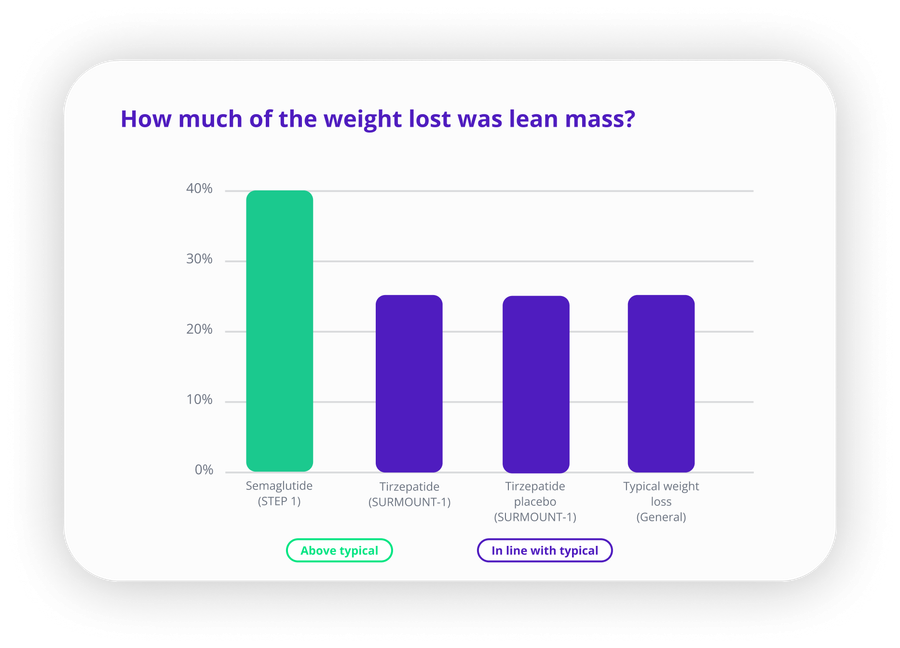
Semaglutide figure is a calculated estimate from the STEP 1 body composition substudy's published fat and lean mass changes, not a number stated directly in the trial itself. Tirzepatide and placebo figures are as reported in the SURMOUNT-1 substudy. 'Typical weight loss' reflects the commonly cited ~25% lean-mass share seen across non-drug weight loss research.
Is "Lean Mass" the Same Thing as "Muscle"?
Not exactly, and this is where a lot of the online panic gets sloppy.
"Lean body mass," the number that shows up in these DEXA scans, includes muscle, but it also includes organs, bone, and water. A 2024 paper in Advances in Nutrition dug into exactly this kind of terminology confusion, arguing that "lean body mass" is a broader category than muscle alone and gets used loosely in ways that blur the distinction. When a headline says "40% of the weight lost was lean mass," that's not automatically the same claim as "40% of the weight lost was muscle."
A study published in Cell Reports Medicine in March 2026 dug into this more directly, using mice and a small proof-of-concept human trial. The finding that got attention: liver mass dropped more than muscle mass did. And while absolute muscle mass and strength went down slightly, relative muscle mass and running performance got better, not worse. The researchers didn't find evidence that the muscle loss was disproportionate or medically concerning.
Worth being honest about the limits here too. The human portion of that study was small, and the animal work only used male mice. It's promising, but it's early.
Why This Happens With Any Fast Weight Loss
Losing weight quickly, by any method, tends to pull some muscle along with the fat. This isn't a GLP-1-specific side effect so much as a basic feature of how the body responds to a large, sustained calorie deficit. The "quarter rule" mentioned above (roughly a quarter of weight lost being lean mass) shows up across plenty of non-drug weight loss studies too.
What's different with GLP-1s is the speed and size of the deficit. Appetite drops hard and fast, calorie intake falls without much conscious effort, and if protein intake falls along with everything else, there's less raw material available to protect muscle while the deficit is doing its work.
Speed is the real culprit here, not the molecule.
Can You Prevent the Muscle Loss?
Protein and resistance training both come up constantly in this conversation, and both make sense on paper. The evidence behind each one is thinner than the confident Instagram infographics let on.
A 2024 review in Diabetes Care laid out the case for resistance training as a companion to GLP-1 therapy, arguing it should help preserve muscle during incretin-driven weight loss. But the authors were upfront that this is a proposal built on general exercise science, not a finding from a completed trial in GLP-1 users specifically. They said as much themselves: future studies are needed to test it in this population. That trial is now running. It's called LEAN-PREP, a randomized controlled trial testing resistance exercise and protein intake in people starting semaglutide or tirzepatide, and as of this writing it's still recruiting.
Until that trial reads out, the honest label for resistance training is "reasonable bet," not "proven fix."
Protein is on firmer ground, if less dramatic than the headlines suggest. General nutrition research on preserving muscle during weight loss points to somewhere around 1.2 to 1.6 grams of protein per kilogram of body weight daily, though individual needs vary with age, activity level, and how much weight you're losing. A dietitian or your care team can help you land on a number that fits your situation.
The Bottom Line
So what should you do with all this? Don't treat "muscle loss" as a reason to avoid GLP-1 medications outright, the trial data doesn't support that leap, especially on tirzepatide, where the ratio matched placebo exactly. Do treat protein as the one lever with solid evidence behind it right now, and don't wait for LEAN-PREP to finish before you start lifting something heavy twice a week. There's basically no downside to starting early. If you're older, already dealing with low muscle mass, or losing weight unusually fast, that's a conversation for your care team, not something a trial average can settle for you. The rest of this is a genuinely moving target, worth checking back on once LEAN-PREP and any follow-up human work on the Cell Reports Medicine findings report results.
Protein is the piece you have real control over, so it's worth knowing where you stand day to day instead of guessing. That's the whole idea behind SNAQ: snap a photo of a meal and get a protein estimate back, no math required. Download the SNAQ app to make that easier, or read our full guide to tracking meals and appetite changes on GLP-1 for the complete walkthrough.