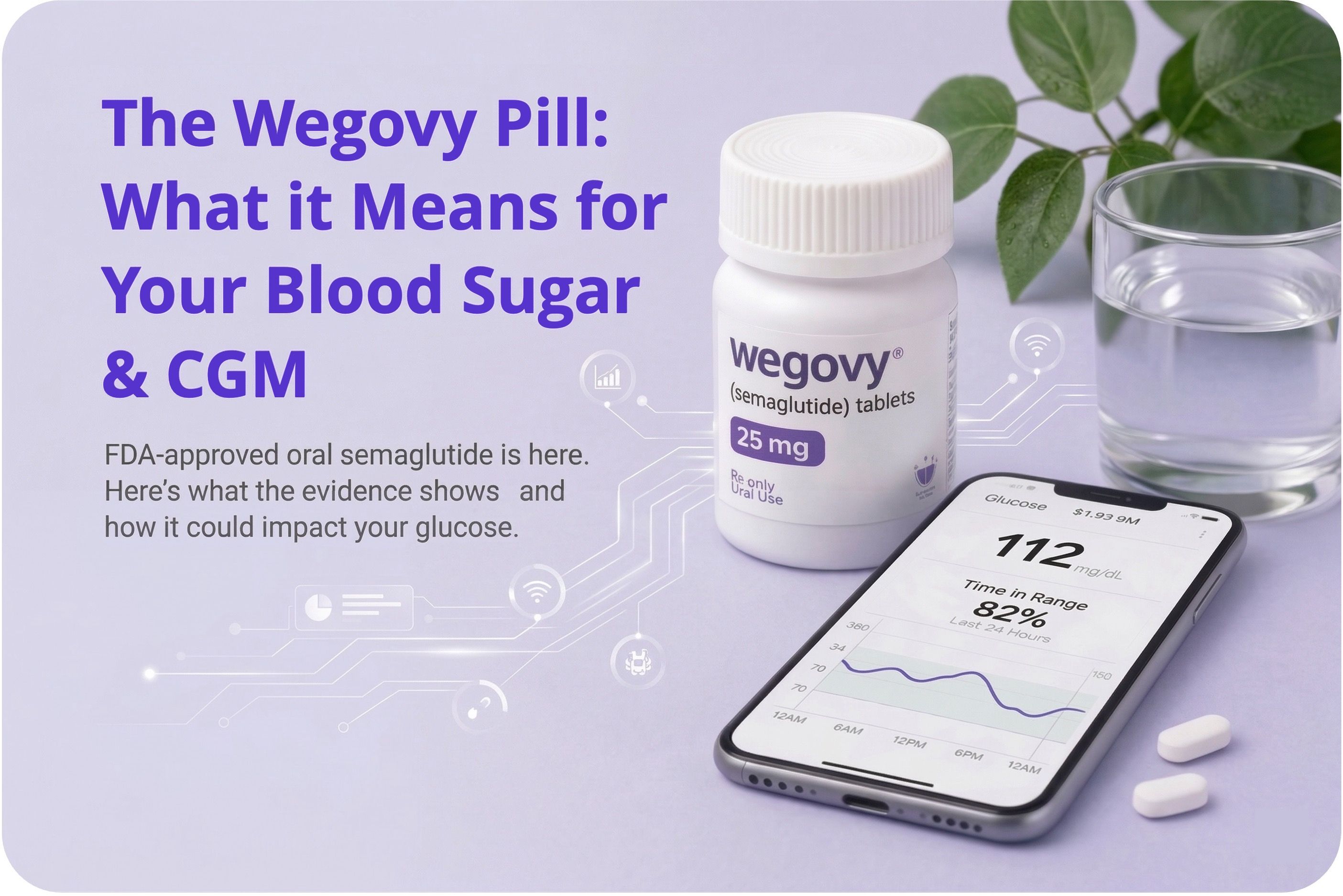
For years, if you wanted the blood sugar and weight benefits of semaglutide — the active ingredient in Ozempic and Wegovy — you had to be comfortable with a weekly injection. That changed in January 2026, when the U.S. Food and Drug Administration (FDA) approved the Wegovy pill: the first oral GLP-1 (glucagon-like peptide-1) receptor agonist cleared specifically for weight management. For people living with type 2 diabetes, prediabetes, or obesity-related metabolic conditions, this is genuinely significant news. But what does it actually mean for your blood sugar, your CGM (continuous glucose monitor) readings, and whether this medication is right for you?
Here's what the evidence says.
What Is the Wegovy Pill, and How Does It Work?
The Wegovy pill contains semaglutide — the same molecule in the injectable Wegovy and Ozempic pens — but in a tablet form you swallow once daily. Novo Nordisk, the manufacturer, developed it using a technology called SNAC (sodium N-[8-(2-hydroxybenzoyl) aminocaprylate]), which protects the semaglutide molecule from being broken down in the stomach so it can be absorbed through the stomach wall.
GLP-1 is a hormone your gut naturally releases after eating. It tells your pancreas to release insulin, signals your brain to reduce appetite, and slows the rate at which food leaves your stomach (gastric emptying). The drug amplifies all of these effects, which is why it lowers blood sugar and reduces how much you eat.
The FDA approval is based on the OASIS 4 Phase 3 clinical trial — a 64-week study of 307 adults with obesity or overweight and at least one weight-related health condition (such as high blood pressure, high cholesterol, or prediabetes), but without type 2 diabetes. Participants who took the 25 mg oral dose and stuck to the protocol lost an average of 13–16.6% of their body weight over 64 weeks.
The Blood Sugar Findings You Should Know About
Although the OASIS 4 trial enrolled people without type 2 diabetes, the glucose data is compelling for anyone at risk. Among participants who had prediabetes at the start of the study:
- 71.1% achieved normal blood glucose by week 64 in the semaglutide group
- Compared to just 33.3% in the placebo group
That's a striking reversal rate for prediabetes — a condition affecting more than 88 million U.S. adults. For context, prediabetes means your fasting blood glucose or HbA1c (glycated haemoglobin, a 3-month blood sugar average) sits above normal but below the type 2 diabetes threshold.
The trial also showed improvements in blood pressure and cardiovascular risk markers, extending the drug's potential benefits beyond weight and glucose alone.
For people already managing type 2 diabetes, the existing oral semaglutide Rybelsus (at lower doses of 7–14 mg, prescribed specifically for T2D) has a well-established track record on HbA1c reduction. The new Wegovy pill operates at a higher dose (25 mg) and is approved for weight management rather than glycemic control specifically — but the blood sugar effects are real and measurable.
Oral Semaglutide vs. the Injectable: Key Differences
If you're already on Ozempic or injectable Wegovy and wondering whether to switch, or you're new to semaglutide and considering which form to start with, here's what matters clinically.
Dosing and schedule
- Injectable Wegovy: Once weekly subcutaneous (under-the-skin) injection; maintenance dose 2.4 mg
- Oral Wegovy pill: Once daily tablet; starting dose 1.5 mg, escalating over 12 weeks to 25 mg
The daily commitment of the pill versus the weekly injection is a real trade-off. Some people strongly prefer no needles; others find a weekly injection far easier to integrate into their routine than remembering a pill every single morning.
The strict morning rule
This is the most important practical difference. Oral semaglutide has much lower bioavailability (the amount that actually reaches your bloodstream) than the injectable form, because the digestive system degrades proteins. To maximise absorption, the Wegovy pill must be:
- Taken on an empty stomach
- Swallowed with no more than 4 ounces (120 ml) of plain water
- Followed by a minimum 30-minute wait before eating, drinking anything else, or taking other medications — including coffee
Missing these steps significantly reduces how much medication you absorb and blunts the effect on your blood sugar and weight. For people with busy mornings or who take other medications in the morning, this is worth discussing with your doctor before switching.
Weight loss outcomes
Pooled clinical data shows that subcutaneous semaglutide achieves somewhat greater HbA1c reductions than oral semaglutide at equivalent doses. However, when patients follow the administration protocol correctly, weight loss outcomes are broadly comparable — approximately 14–15% over the treatment period for both forms. The difference narrows significantly with consistent, correct use.
What Could This Mean for Your CGM?
If you use a continuous glucose monitor — such as the Dexcom G7, FreeStyle Libre 3, or Dexcom Stelo — you may notice changes once you start or switch to oral semaglutide.
GLP-1 medications typically produce:
- Lower postprandial glucose peaks (post-meal spikes become flatter and shorter)
- Reduced fasting glucose over time as weight decreases
- Improved Time in Range (TIR) — the percentage of time your glucose stays between 70–180 mg/dL, which is the key CGM metric for diabetes management
Because the oral pill is taken daily rather than weekly, the GLP-1 effect on gastric emptying may be more consistent throughout the week — though individual CGM patterns will vary. Some people notice their post-meal curves flatten noticeably within the first few weeks; others see more gradual improvement as the dose escalates.
This is where SNAQ can be particularly useful — the app connects your CGM readings with your meal logs and activity, making it easier to spot which foods are still driving spikes and how your glucose patterns are shifting as the dose escalates. That meal-to-glucose visibility is especially valuable in the early weeks of a new GLP-1 medication, when you're still building an intuition for how your body is responding.
One important note: the slower gastric emptying caused by semaglutide can occasionally make CGM lag times feel more pronounced around meals. If you're carb counting or using closed-loop insulin delivery, mention to your diabetes care team that you've started a GLP-1 medication so you can adjust your approach if needed.
Who Is the Oral Wegovy Pill Right For?
The FDA approval is currently for adults with:
- A body mass index (BMI) of 30 or greater (obesity), or
- A BMI of 27 or greater (overweight) with at least one weight-related condition such as type 2 diabetes, high blood pressure, or high cholesterol
The pill is not currently approved for type 1 diabetes (T1D) management, and the OASIS 4 trial excluded people with type 2 diabetes — though that research is ongoing.
The oral form may be a particularly good fit if:
- You're newly diagnosed with type 2 diabetes and want to avoid injections
- You have prediabetes and are trying to prevent progression to T2D
- You've had an aversion to injections that has delayed starting treatment
- Your HbA1c and weight goals can be addressed together
It may be less ideal if you already take multiple morning medications, travel frequently with disrupted routines, or have a condition affecting gastric motility. Discuss with your endocrinologist or GP, who can also check for interactions with other medications you take.
Cost and Insurance Coverage
This is where many patients hit a wall — and it's worth being direct about what the landscape looks like right now.
List price vs. what you actually pay: The Wegovy pill carries a manufacturer list price of around $1,349 per month. In practice, very few patients pay that. Novo Nordisk offers self-pay pricing of $149/month for starting doses (1.5 mg and 4 mg) and $299/month for the higher maintenance strengths (9 mg and 25 mg). For patients with commercial (private) insurance, the manufacturer reports 90% have a co-pay of $0–$25/month — comparable to the injectable version.
Medicare: Federal law has historically excluded weight-loss medications from Medicare Part D coverage. The main exception in 2026 is patients who have documented cardiovascular disease — they can get Wegovy covered. The bigger news is a White House-brokered pilot programme called the Medicare GLP-1 Bridge, running July–December 2026, which caps out-of-pocket costs at $50/month for eligible beneficiaries. This is time-limited and not yet permanent policy, but it's a meaningful development for the 65+ population managing obesity alongside diabetes or heart disease.
Medicaid: Coverage varies sharply by state and remains limited. Several states, including Pennsylvania, have actually tightened Medicaid GLP-1 coverage in 2026. If you rely on Medicaid, check your state plan directly before assuming coverage.
If your insurance doesn't cover it: The Novo Nordisk savings card (NovoCare) is the most reliable route for commercially insured patients. For the uninsured, the $149–$299 self-pay programme is worth asking about at the point of prescription.
The Oral GLP-1 Race: What's Coming Next
The Wegovy pill may be first, but it won't be alone for long. Eli Lilly is close behind with orforglipron — a once-daily oral GLP-1 that works differently at the molecular level. Unlike semaglutide, orforglipron is a small-molecule drug, which means it can be taken at any time of day, with or without food, and without the strict water-only morning routine.
In the ACHIEVE-3 head-to-head trial published in The Lancet in February 2026, orforglipron 36 mg delivered 73.6% greater relative weight loss than oral semaglutide (14 mg) in people with type 2 diabetes — 9.2% body weight loss vs. 5.3%. Blood sugar control (HbA1c reduction) was also superior in the orforglipron arm. Lilly has submitted for FDA approval for obesity, with a T2D submission expected later in 2026.
For patients, this is genuinely encouraging news: a second oral option with no fasting requirement and strong glycemic data would give prescribers a more flexible alternative — particularly for people who struggle with the morning-routine demands of oral semaglutide. Goldman Sachs projects the oral GLP-1 market will reach $22 billion by 2030, with orforglipron potentially capturing the larger share.
The practical takeaway: if the Wegovy pill's administration requirements feel like a barrier for you, it may be worth waiting to see how orforglipron's FDA review unfolds over the next 12 months before making a long-term treatment decision.
What to Expect When You Start
The dose escalation phase takes 12 weeks, moving gradually from 1.5 mg to 25 mg. This slow increase is intentional — it reduces the nausea and digestive side effects (the most common complaint with all semaglutide forms) that can occur when the dose ramps up too quickly.
Most people notice appetite suppression within the first few weeks. Blood sugar improvements on your CGM tend to become more visible from around weeks 4–8, with more significant changes appearing as the maintenance dose is reached.
The Bottom Line
The oral semaglutide weight loss pill represents a genuine step forward in accessible metabolic care — particularly for people who want semaglutide's proven benefits without weekly injections. The OASIS 4 data is solid, and the prediabetes reversal rate is clinically meaningful. The trade-off is a strict daily morning routine that leaves no room for shortcuts.
If you're managing type 2 diabetes, prediabetes, or metabolic health and are curious whether the Wegovy pill belongs in your treatment plan, bring the OASIS 4 data to your next appointment and ask your doctor to walk through the options with you.