If you live with type 1 diabetes, chances are you've heard about GLP-1 medications — Ozempic, Wegovy, Mounjaro — mostly in the context of weight loss or type 2 diabetes. But a growing body of research, and a wave of real-world experience, suggests these drugs may have meaningful benefits for people with T1D too: lower daily insulin doses, flatter glucose curves on your CGM, and potentially better long-term protection for your heart and kidneys.
Here's what the evidence actually shows — and what it doesn't.
First, what are GLP-1 drugs and why do they matter for T1D?
GLP-1 receptor agonists (GLP-1 RAs) are a class of medications that mimic a hormone your gut naturally releases after eating. They work through several mechanisms that are relevant even when your pancreas no longer makes insulin: they slow gastric emptying (meaning food hits your bloodstream more gradually), suppress glucagon release (the hormone that raises blood sugar), and reduce appetite. None of these effects require a functioning beta cell — which is exactly why researchers started exploring them in T1D.
Common GLP-1 drugs you may have heard of include semaglutide (Ozempic, Wegovy), tirzepatide (Mounjaro, Zepbound), liraglutide (Victoza), and dulaglutide (Trulicity). None are currently FDA-approved for T1D, but off-label prescribing has been rising sharply — and the clinical data is starting to catch up.
What do clinical trials actually show for T1D?
Multiple randomised, placebo-controlled trials have tested GLP-1 drugs as add-on therapy to insulin in people with T1D, and the picture that emerges is consistent, if modest: meaningful weight loss, real reductions in daily insulin needs, and improvements in CGM time in range.
Trials with older GLP-1 drugs (liraglutide, exenatide) — including the large ADJUNCT ONE and ADJUNCT TWO studies — showed modest HbA1c improvements of 0.1–0.7%, meaningful weight loss, and lower insulin requirements, but also raised early concerns about hypoglycemia and ketosis that kept enthusiasm in check for years.
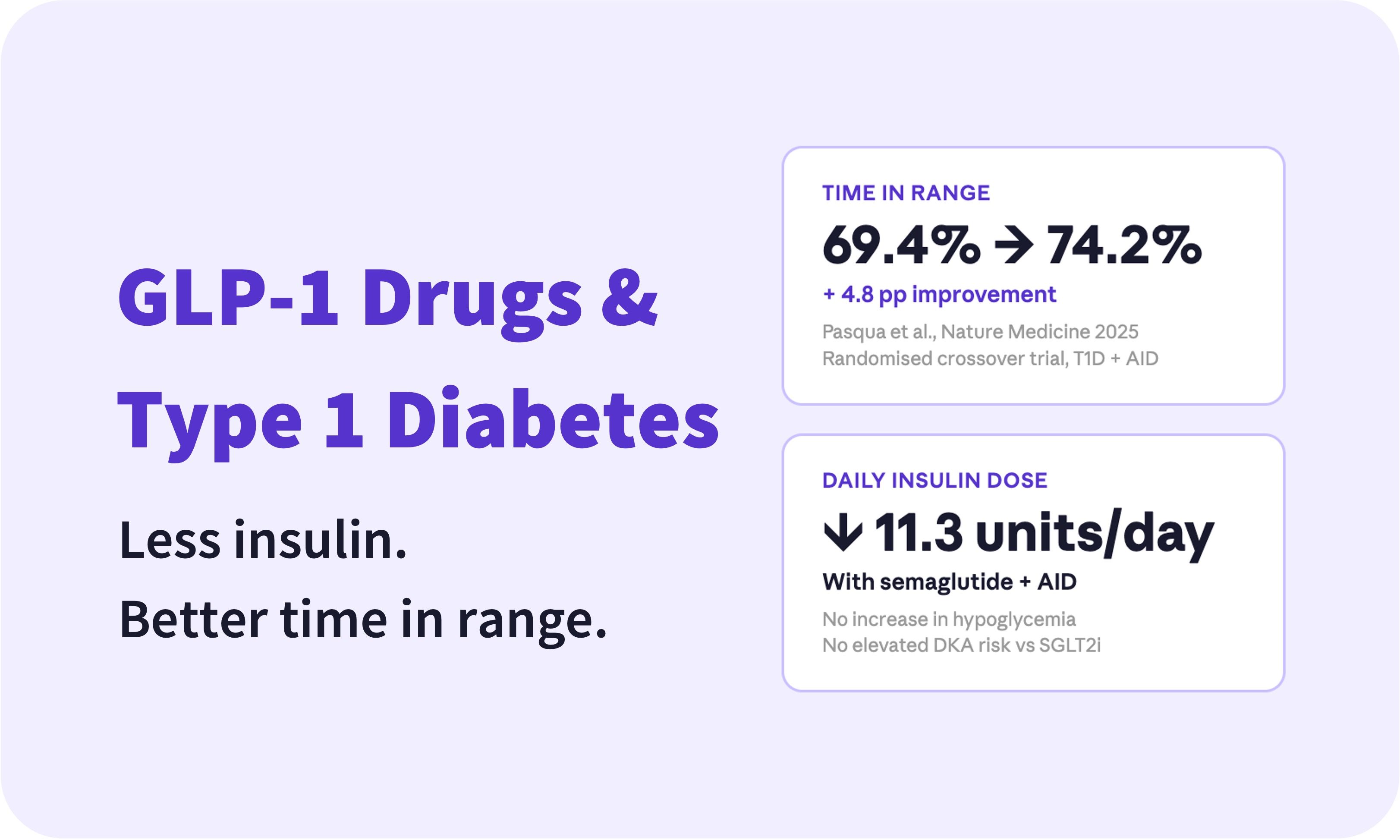
The newer generation tells a more compelling story. A 2025 randomised crossover trial published in Nature Medicine (Pasqua et al.) tested weekly semaglutide alongside automated insulin delivery in adults with T1D. Time in range improved from 69.4% to 74.2%, daily insulin use fell by 11.3 units, and participants reduced carbohydrate intake and body weight — with no increase in hypoglycemia. A separate 2025 trial in NEJM Evidence (Shah et al.) in adults with T1D and obesity on AID found that around one in three semaglutide-treated participants met a combined goal of improved time in range, low hypoglycemia, and at least 5% weight loss. Tirzepatide — which targets both GLP-1 and GIP receptors — has shown even more dramatic early results: weight loss of 10–20 kg and insulin dose reductions exceeding 30% in observational and phase 2 data, with improved CGM time in range.
What this means for your CGM data: Because GLP-1 drugs slow gastric emptying, they blunt the sharp post-meal glucose spikes that are hardest for insulin to catch. If you use a CGM, you may notice fewer steep rises after meals — and more time spent in your target range — even before your insulin doses are fully adjusted.
Importantly, none of the trials in T1D reported an increase in diabetic ketoacidosis (DKA) — a key concern that has limited the use of SGLT2 inhibitors in T1D. GLP-1 RAs don't suppress insulin secretion or alter ketone metabolism in the same way, making their safety profile meaningfully different.
What about heart and kidney protection?
This is where the evidence becomes particularly compelling — and also where the most important caveat applies. People with T1D face significantly elevated risks of cardiovascular disease and kidney disease over time, and GLP-1 drugs have shown powerful protective effects in those areas in people with type 2 diabetes and obesity.
A major real-world study published in early 2026 — led by researchers at Johns Hopkins Bloomberg School of Public Health and analysing electronic health records from approximately 175,000 people with T1D in the US — found that those taking GLP-1 drugs had a roughly 15% lower five-year risk of major cardiovascular events and a 19% lower risk of end-stage kidney disease, without any increase in hospitalisation for DKA or severe hypoglycemia. This is a large, carefully designed observational study — not a randomised trial — so it points to a promising signal rather than a proven benefit.
No dedicated large randomised trial has yet confirmed cardiovascular or kidney benefits specifically in T1D. Several are now underway — including the REMODEL T1D trial (semaglutide and kidney disease in T1D) and the SURPASS-T1D phase 3 trials (tirzepatide in T1D) — with results expected in the coming years. The honest framing right now: encouraging, but not yet established for this population.
How does this interact with CGM and AID systems?
One of the most practically relevant findings from recent research is how GLP-1 drugs interact with the technology many T1D patients already use. The Pasqua et al. (2025) trial specifically tested semaglutide as an add-on to AID systems — and found a 4.8 percentage point improvement in time in range (from 69.4% to 74.2%) alongside an 11.3-unit daily reduction in insulin, without any increase in hypoglycemia. For people already using a closed-loop system, that is a meaningful step forward.
When insulin requirements drop by 20–30%, CGM data becomes even more critical. Your AID algorithm will need time to adapt to the new patterns, and your basal and bolus settings will likely need recalibration. This is not a set-it-and-forget-it transition — it requires close monitoring and ideally a care team experienced in adjusting insulin regimens. The glucose timing reference below can help you make sense of what you're seeing on your CGM during this period.
| Timing | What the number might mean | What to check next |
|---|---|---|
| Fasting / on waking | Can fit the ADA general pre-meal target range of 80–130 mg/dL for many nonpregnant adults, though targets are always individualized. | Was it truly fasting? Is this repeating across mornings? |
| Pre-meal (before lunch/dinner) | Often consistent with ADA general pre-meal targets, though higher numbers warrant a closer look at the trend. | Check the trend arrow. Is this your usual pre-meal pattern? |
| After eating (post-meal) | Post-meal rises are expected. You may not have peaked yet — or you are already past the peak. Many care plans use a peak post-meal goal of under 180 mg/dL. | How long since the meal? Rising or falling? Does it come back down over time? |
| During / after exercise | Could be stable or rising fast. Check the trend arrow first. This is when CGM lag tends to show up most. | The trend matters more than the number here. Watch the direction. |
| Bedtime / overnight | One reading at bedtime does not describe the full night. Your target range depends on your care plan. | Look for recurring overnight highs or lows. Discuss patterns with your care team. |
What are the real risks to know about?
GLP-1 drugs are not without side effects. Nausea, vomiting, and other gastrointestinal symptoms are common, particularly when starting or increasing the dose — and in T1D trials, these rates were similar to those seen in T2D and obesity trials. For most people they ease over time, but severe vomiting can be a problem: dehydration and reduced food intake while still on insulin can put you at risk for hypoglycemia.
There is also a more subtle risk worth knowing: the Pasqua 2025 trial reported two cases of euglycemic ketosis without acidosis in semaglutide-treated participants. This means ketone levels can rise even when blood glucose looks normal — because reduced food intake and lower insulin doses can shift the body toward fat burning. It is not DKA, but it is a signal to check ketones more frequently during periods of reduced appetite or GI side effects, not just when your glucose is high.
The risk of DKA does not appear to be elevated with GLP-1 drugs in T1D — a meaningful distinction from SGLT2 inhibitors. But insulin dose reduction needs to be done carefully and gradually, with close CGM monitoring, to avoid either hypoglycemia (from too much insulin relative to your new needs) or hyperglycemia (from reducing too aggressively).
The bottom line
GLP-1 drugs are not a replacement for insulin, and they are not officially approved for T1D (outside of the new 2026 ADA recommendation for T1D with obesity). But the evidence supports real, clinically meaningful benefits for many people with T1D: less insulin needed each day, flatter post-meal glucose curves visible on your CGM, meaningful weight loss where relevant, and — based on emerging data — potentially significant long-term protection for the heart and kidneys.
If you’re curious whether a GLP-1 medication might be appropriate for your situation, the most productive first step is a conversation with your endocrinologist — particularly one familiar with off-label use and experienced in adjusting insulin regimens in response. Bring your CGM data. The patterns it shows will be central to any decision.